
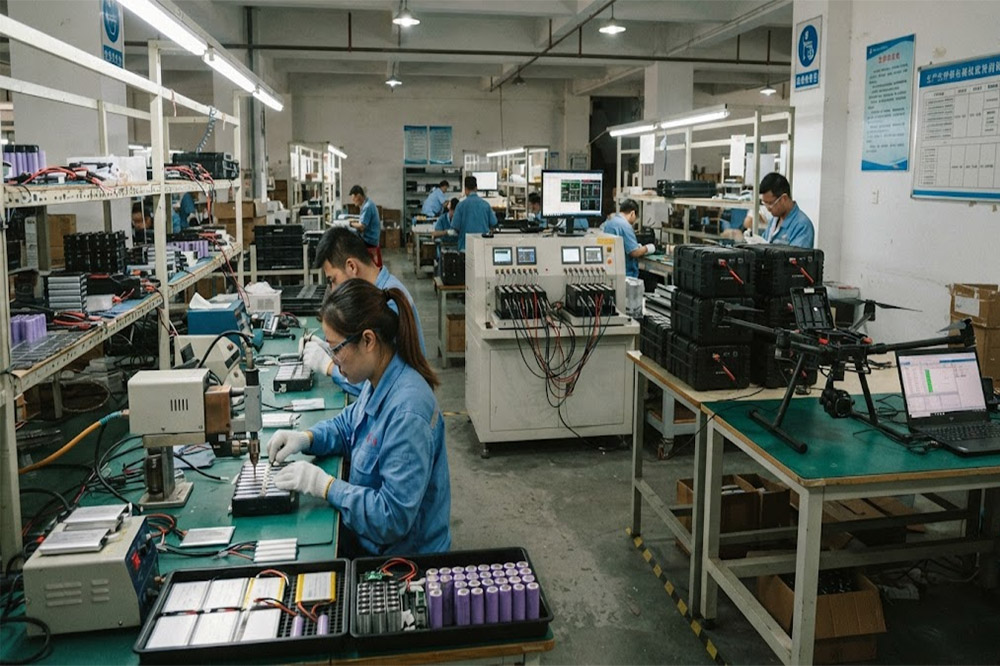
China has no shortage of drone battery suppliers.
Search for “UAV battery manufacturer China” and you can quickly find dozens, if not hundreds, of companies offering LiPo batteries, Li-ion packs, custom battery packs and OEM services.
The difficult part is not finding a supplier.
It is figuring out which supplier can actually produce your battery consistently after the sample stage.
A supplier may have a good-looking website and a long product list. Another may offer a very low price. A third may say they can “customize everything.”
That does not necessarily tell you much about the factory behind the quotation.
For UAV companies, distributors and overseas buyers, I would look at a few practical things before making a decision: factory capability, quality systems, certification, testing and actual OEM experience.
Before comparing suppliers, it helps to understand the battery technology itself. Our LiPo Battery for Drone: Complete Guide for UAV Manufacturers and Buyers covers cell chemistry, capacity, voltage, C rating and battery selection.
Factory or Trading Company?
This is probably the first question I would ask.
Not every company selling UAV batteries is the actual manufacturer.
A trading company may still be useful. In some cases, they have good supplier networks and can handle export logistics well.
But if you need a custom UAV battery, direct communication with the manufacturer can make the development process easier.
Ask the supplier:
- Where is the factory located?
- What battery products are manufactured there?
- How many production lines are available?
- Can you provide factory photos or videos?
- Is customization done in-house?
- Where are battery packs tested?
- Who handles BMS development?
- Can you support prototypes?
You don’t necessarily need a giant factory.
A smaller manufacturer with a capable engineering team can sometimes be more suitable for an OEM UAV project than a very large general battery company.

ISO Certification: Look at the System, Not Just the Logo
ISO certification is worth checking, but I would not use an ISO logo as the only reason to choose a supplier.
For battery manufacturing, an effective quality-management system can help control:
- Production procedures
- Incoming materials
- Process inspection
- Final testing
- Traceability
- Corrective actions
- Documentation
For example, ISO 9001 is commonly associated with quality management systems.
If a supplier claims ISO certification, ask for the relevant certificate and check that it applies to the company and scope you are actually purchasing from.
This sounds obvious.
Still, when comparing several suppliers quickly, buyers sometimes skip this step.
UN38.3 Is Important for Lithium Battery Shipping
If you are importing lithium UAV batteries from China, transportation requirements need to be considered early.
UN38.3 testing is particularly important for lithium batteries being transported internationally.
The purpose is related to the safe transport of lithium batteries and cells.
But don’t simply ask:
“Do you have UN38.3?”
Ask whether the documentation applies to the specific battery model you are purchasing.
If you are ordering a customized 6S battery, for example, a document for a completely different battery should not automatically be treated as equivalent.
The battery specification, model and documentation should match.
This can save some unpleasant surprises when preparing shipment documents.

What About IEC 62133?
IEC 62133 is another standard buyers may encounter when evaluating rechargeable lithium battery products.
It relates to safety requirements and tests for portable sealed secondary cells and batteries.
Whether it is required for your particular UAV battery depends on the product and target market.
That is an important distinction.
Don’t collect certifications simply because a supplier has a long list of them.
Instead, ask:
Which standards apply to my product and destination market?
A professional supplier should be able to discuss that question with you.
Certifications Are Only One Part of Quality
This is where I would be a little careful.
A certificate tells you that certain requirements have been tested or assessed.
It does not automatically mean every battery produced today will be perfect.
You still need to look at manufacturing and testing.
For UAV battery factory, I would want to understand how they control:
- Cell quality
- Cell matching
- Welding
- BMS installation
- Connector assembly
- Capacity
- Internal resistance
- Voltage
- Charging
- Discharge
- Final inspection
A battery pack is an assembly of many small processes.
One weak process can affect the finished product.

Ask About the Cells
The cell is where the battery starts.
For a custom UAV battery, ask which cell models are being used.
Depending on the application, the manufacturer may use:
- High-energy Li-ion cells
- High-discharge Li-ion cells
- LiPo pouch cells
- 18650 cells
- 21700 cells
- Other application-specific cells
Don’t assume that a higher mAh rating automatically means a better drone battery.
A long-endurance mapping UAV and an FPV racing drone have very different battery requirements.
For one aircraft, energy density may be the priority.
For another, discharge capability matters much more.
This is why a capable drone battery supplier China should ask questions about your UAV rather than immediately sending a price list.
For long-endurance UAV projects, 21700 Li-ion cells may also be worth evaluating. See our guide to 21700 battery packs for drones.

OEM Experience Is a Big Difference
If your requirement is simply a standard replacement battery, OEM experience may not be especially important.
If you are developing your own UAV, it becomes much more relevant.
A genuine OEM project might involve:
Cell selection → electrical design → BMS → connector → housing → prototype → testing → production
The manufacturer needs to understand that these parts affect one another.
For example, changing the battery dimensions can affect cell configuration.
Changing the cell can affect current capability.
Changing the current requirement can affect the BMS and connector.
This is why I would ask a supplier to show examples of previous UAV battery projects, rather than only asking how many years they have been in business.
If you need a battery designed specifically around your UAV, see our guide to custom drone battery pack manufacturing and OEM solutions.
Prototype Experience Tells You a Lot
A supplier may be excellent at producing a standard battery in large quantities.
That does not necessarily mean they are good at developing a new UAV battery.
Prototype work requires more engineering involvement.
The first sample may need several changes.
Perhaps:
- The pack is too heavy.
- The connector needs to move.
- The battery is 5mm too tall.
- The cable needs to be longer.
- The BMS communication needs adjustment.
- The aircraft needs more peak current.
A manufacturer familiar with OEM development will usually expect some of this.
That is normal.
What matters is how they respond when the first design needs changing.
Can the Factory Actually Test Your Battery?
This is an underrated question.
Ask what equipment the factory has for battery testing.
Useful equipment may include:
- Battery capacity testers
- Electronic loads
- Charge/discharge systems
- Internal resistance testers
- Voltage testers
- Temperature monitoring
- BMS testing equipment
- Aging equipment
For UAV batteries, actual discharge testing is especially useful.
A battery may look excellent at rest.
The aircraft, however, cares about what happens when the motors demand current.
Factory Visit or Video Inspection
If the order is large enough, visiting the factory can be worthwhile.
You don’t need to spend a whole day inspecting every machine.
Look at the basic workflow.
Can you see:
Cells → Assembly → BMS → Testing → Final Inspection → Packing
?
Are workers actually using testing equipment?
Are finished batteries clearly identified?
Are defective products separated?
Is the production area organized?
If you cannot visit China, ask for a live video tour rather than relying entirely on carefully selected website photographs.
It will not prove everything, but you can usually learn something from seeing the actual working environment.
Don’t Choose China UAV Battery Manufacturer by Price Alone
This is probably the most common mistake in supplier selection.
Supplier A:
$42 per pack
Supplier B:
$47 per pack
The first quotation looks better.
But what happens if Supplier A has a 4% defect rate while Supplier B has a much lower return rate?
What happens if Supplier A takes 45 days to deliver a repeat order?
Or if the original cell is replaced without clearly informing you?
The actual cost is no longer $5.
For UAV brands, battery reliability can affect the reputation of the entire drone.
Compare Suppliers With the Same Specification
When comparing Chinese suppliers, make sure everyone is quoting the same battery.
For example:
6S 22.2V
20Ah
Continuous current: XX A
Peak current: XX A
Maximum dimensions: XX mm
Maximum weight: XX kg
Connector: XX
BMS: Required
Quantity: 1,000 pcs
Otherwise, you may be comparing completely different batteries.
One supplier may quote a lower price because they selected a lower-cost cell.
Another may be using a more expensive high-discharge cell.
The numbers look similar on the quotation.
The products are not necessarily similar.
Apsenx as UAV Battery Manufacturer in China
For overseas UAV companies looking for a UAV battery manufacturer in China, Apsenx focuses on lithium battery development and customized battery pack production.
For UAV projects, the development process can involve:
- Cell selection
- Battery configuration
- BMS
- Connector
- Housing
- Prototype
- Testing
- Production
The company also works with different lithium battery technologies, including Li-ion and LiPo solutions depending on the application.
For commercial UAV customers, the battery can be developed around the aircraft’s voltage, capacity, current, dimensions and weight requirements.
You can explore the UAV Battery product category to see the available battery solutions.
A Simple Supplier Checklist
Before choosing a drone battery supplier China, I would put the candidates into a simple comparison sheet.
| Item | What to Check |
|---|---|
| Factory | Manufacturer or trading company |
| ISO | Relevant quality-management certification |
| UN38.3 | Documentation for the actual battery |
| IEC 62133 | Applicability to your product/market |
| Cells | Brand, model and consistency |
| Testing | Capacity, resistance, charge/discharge |
| OEM | Previous custom UAV battery experience |
| Prototype | Sample development capability |
| BMS | Protection and communication options |
| MOQ | Sample, pilot and mass-production MOQ |
| Lead Time | Sample and repeat-order schedule |
| After-sales | Handling of quality issues |
This makes supplier comparison much less subjective.
Questions to Send Before Requesting a Quote
You can send something as simple as:
We are looking for a UAV battery manufacturer in China for a commercial drone project.
Please provide your factory information, ISO certification, UN38.3 documentation, applicable IEC 62133 documentation, OEM experience and sample lead time.
Our battery requirements are: voltage, capacity, current, dimensions, weight and estimated quantity.
A serious supplier should be able to respond with specific information.
If the answer is mostly general marketing language, I would keep looking.
The Right Manufacturer Should Be Able to Grow With You
A UAV battery project can start with 5 samples.
Then 50.
Then perhaps 1,000 packs.
The supplier that works well during prototype development may eventually become part of your production supply chain.
That is why I would evaluate the relationship from the beginning.
Can the manufacturer maintain the same cell specification?
Can they scale production?
Can they support documentation?
Can they make engineering changes?
Can they handle repeat orders?
And, perhaps most importantly, can you talk to someone who understands the battery technically when something goes wrong?
Those questions are more useful than simply asking who has the lowest price.
Request UAV Battery Quote
If you are comparing UAV battery manufacturers in China, send us your basic requirements.
Useful information includes:
- Voltage
- Capacity
- Continuous/peak current
- Battery dimensions
- Maximum weight
- Connector
- UAV application
- Prototype quantity
- Estimated production quantity
Apsenx can discuss cell selection, BMS, battery structure, connectors, prototypes and production requirements based on your UAV project.
FAQ
How do I find a reliable UAV battery manufacturer in China?
Look beyond price. Check whether the company is an actual manufacturer, review its quality system, battery certifications, testing capability, OEM experience and ability to produce consistent repeat orders.
Is UN38.3 required for drone batteries?
UN38.3 is highly relevant to the transportation of lithium cells and batteries, but exact documentation requirements depend on the battery and shipping situation. Always confirm the requirements for your specific product.
What is ISO 9001 useful for in battery manufacturing?
ISO 9001 relates to quality-management systems. It can provide useful information about how a manufacturer manages processes and quality, although it should not replace actual product testing.
Should I ask for IEC 62133 certification?
If it is relevant to your battery and target market, yes. Ask the supplier for documentation applicable to the exact battery model rather than accepting a generic certificate list.
Can a Chinese UAV battery manufacturer provide OEM service?
Yes. OEM UAV battery projects can include cell selection, BMS, connectors, housing, dimensions, prototypes and production.
Should I visit the battery factory?
For a large or long-term order, a factory visit or third-party inspection can be useful. If visiting is not practical, a live video factory tour and sample testing are reasonable alternatives.
Leave a Reply