
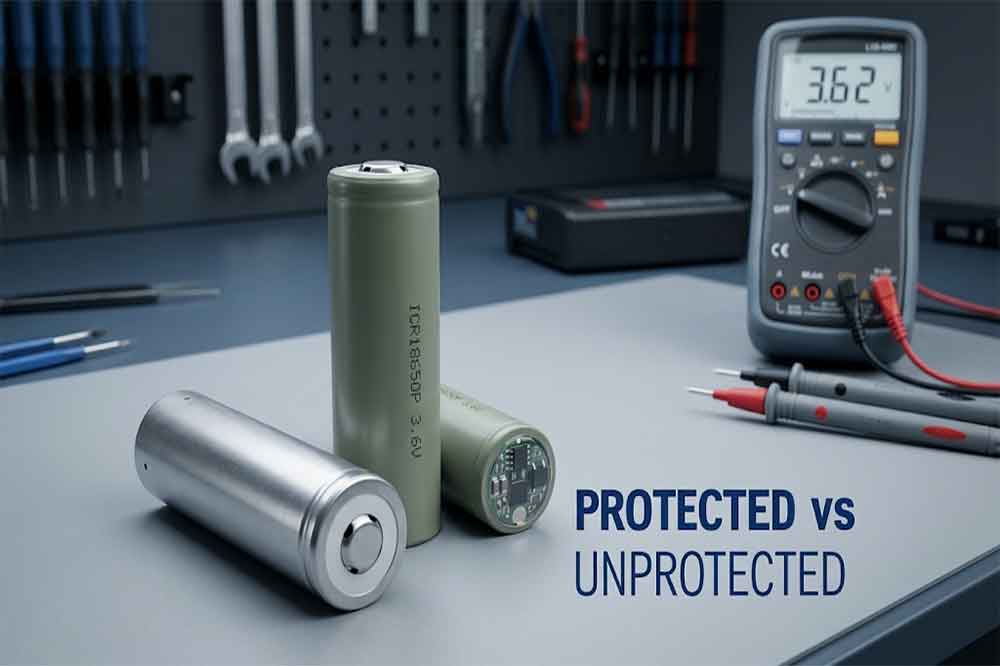
Do All 18650 Batteries Need Protection?
18650 lithium-ion battery may look like a simple cylindrical cell, but the right protection arrangement depends on how the battery will be used. Some applications require a protected cell with an integrated circuit. Others use unprotected cells inside a battery pack managed by a separate battery management system (BMS).
For product developers, distributors, and OEM buyers, the question is not simply whether every 18650 battery needs protection. The more useful question is where the protection should be installed and which functions the complete system needs.
Choosing the wrong configuration can cause compatibility problems, reduce available space, or leave the finished product without suitable safeguards. Understanding the differences helps buyers specify a battery solution that matches the application.
For a wider explanation of protected cells, circuit types, and OEM considerations, read our 18650 protected battery complete guide.”
Short Answer: Not Every 18650 Cell Has Built-In Protection
No, not every 18650 battery has a built-in protection circuit. Some cells are sold as protected batteries, while others are supplied without an integrated protection board.
A protected 18650 battery usually has a small protection circuit attached to the cell. Depending on its design, the circuit can disconnect the battery when it detects conditions such as excessive voltage, excessive discharge, or an overcurrent event.
An unprotected 18650 cell does not have that same integrated protection arrangement. It must be used in equipment or a battery system that provides the necessary protection externally.
This distinction is important because an unprotected cell is not automatically unsuitable or defective. It may be the correct choice for an engineered battery pack with a properly selected BMS and other required safeguards.
Likewise, a protected cell is not automatically suitable for every device. Its dimensions, discharge-current capability, cutoff behavior, and electrical connections must match the equipment.
Before selecting a battery, buyers should establish whether they need a single cell for a device or multiple cells assembled into a custom battery pack.

Why 18650 Lithium-Ion Batteries Need Protection
Lithium-ion cells must operate within their specified voltage, current, temperature, and charging limits. Protection components help prevent certain electrical conditions from moving beyond the limits established by the cell and system designers.
However, protection circuits do not make a battery immune to every form of damage. Incorrect charging equipment, physical damage, overheating, manufacturing defects, and unsuitable installation can still create risks.
Overcharge and Over-Discharge
Overcharging means charging a cell beyond its permitted voltage. Over-discharge means allowing its voltage to fall below the specified lower limit.
Both conditions can damage a lithium-ion cell. A protection circuit may interrupt charging or discharging when its detection thresholds are reached. The exact thresholds and response depend on the protection design and cell specifications.
For OEM projects, the charging system and protection circuit should be treated as parts of one design. A protection board is not a substitute for a compatible charger or a correctly configured charging process.
Excessive Current and Short Circuits
A battery may supply excessive current when the connected equipment draws more than the system is designed to deliver. A short circuit can create an especially rapid and potentially dangerous current surge.
A suitably designed protection circuit can interrupt the current path when its overcurrent or short-circuit conditions are detected. However, not every circuit supports the same current level or response time.
Buyers should therefore check the cell’s continuous discharge rating, peak-current requirements, protection-board rating, and wiring capability together. A board with an unsuitable current rating can cause nuisance shutdowns or fail to provide the intended level of protection.
When Should You Choose a Protected 18650 Battery?
A protected 18650 battery can be a practical choice when the product uses a single cell and does not have a separate, suitable battery protection system.
Single-Cell Devices
Some single-cell products have limited internal space and relatively simple electrical designs. In these applications, a protected cell may provide a convenient way to incorporate basic electrical protection.
Before selecting one, confirm that the device supports the cell’s dimensions and voltage range. Some protected 18650 cells are longer than comparable unprotected cells because of the added protection components. This difference can affect fit in a battery holder or enclosure.
Also check the device’s current demand. The protection circuit must support the required load without repeatedly disconnecting during normal operation.
Equipment Used by General Consumers
For consumer products, the battery may be replaced by a user who has limited knowledge of lithium-ion battery requirements. A protected cell can help reduce certain risks when the product is specifically designed to use that configuration.
Nevertheless, the device must still have suitable charging control, mechanical protection, and clear battery compatibility requirements. Users should never assume that any cell labeled “protected” will work safely in any device.
Flashlights, portable electronics, and other compact products may have different requirements. The device manufacturer’s specified battery type should always take priority over a general recommendation.

When Can Unprotected 18650 Cells Be Appropriate?
Unprotected cells are commonly considered for applications where protection is designed into the battery pack or the equipment itself. This arrangement can give engineers greater flexibility when choosing cell dimensions, current capability, and pack architecture.
Battery Packs With a Dedicated BMS
A multi-cell battery pack may use unprotected cells connected to a dedicated BMS. Depending on the design, the BMS can monitor individual cell-group voltages and manage functions such as overcharge protection, over-discharge protection, overcurrent protection, and cell balancing.
The actual functions vary by BMS model. Some systems also monitor temperature or communicate with the host device.
For example, an OEM product using a 3S or 4S battery pack generally needs a protection and monitoring arrangement designed for that series configuration. A single-cell protection board should not simply be substituted for a correctly specified multi-cell BMS.
The complete pack design must account for cell matching, charging voltage, current demand, temperature limits, wiring, insulation, and fault response.
OEM Products With a Designed Protection System
Industrial equipment and custom electronics may have specific electrical requirements that make a dedicated battery pack more appropriate than individual protected cells.
Engineers can select cells based on discharge performance, capacity, dimensions, and supply availability, then design the protection system around the complete application.
This does not mean protection can be omitted. It means the required functions are provided by the overall system rather than relying solely on a small circuit attached to each cell.
For OEM buyers, it is important to document who is responsible for protection design, validation, and final product safety. A battery supplier and equipment manufacturer should agree on these requirements before approving production samples.
Does a Battery Pack Need More Than Cell-Level Protection?
Often, yes. Cell-level protection and pack-level protection address different design needs.
An integrated protection circuit on a single cell generally focuses on a limited set of electrical fault conditions. A multi-cell battery pack may require monitoring across several cell groups, control of charging and discharging, temperature sensing, and balancing between series-connected groups.
The right arrangement depends on the chemistry, number of cells, series-parallel configuration, load profile, charging method, and applicable product requirements.
Consider a device that needs a custom 3S 18650 battery pack. Even if each cell has its own protection board, those boards may not provide coordinated monitoring or balancing across the complete series string. Adding individual boards without checking compatibility can also affect pack dimensions, electrical behavior, and reliability.
For this reason, OEM projects should define protection requirements at the battery-pack level before selecting cells. A properly designed BMS or other appropriate protection architecture should be evaluated against the actual application.
What Should OEM Buyers Check Before Choosing a Protection Solution?
A useful specification begins with the equipment rather than the battery listing. Before requesting samples or a quotation, prepare the following information.
1. Electrical configuration
Specify the required nominal voltage, maximum charging voltage, capacity, and series-parallel arrangement. If the design uses a single cell, confirm whether the equipment expects a protected or unprotected format.
2. Continuous and peak current
Provide the normal operating current and any startup or peak-current demand. Ask the supplier to confirm both the cell capability and the protection circuit’s limits.
3. Physical dimensions
Check the cell length and diameter, including any additional length introduced by a protection circuit. Also consider the battery holder, enclosure, wiring, connector, and required insulation.
4. Charging method
Identify the charger or charging control system and its voltage and current settings. Protection components should be compatible with the charging design rather than expected to correct a fundamentally unsuitable charger.
5. Operating environment
State the expected temperature range, vibration exposure, duty cycle, and installation conditions. Industrial and outdoor equipment may need additional mechanical and environmental measures.
6. Compliance and validation requirements
Depending on the target market and end product, request applicable battery test reports, transport documentation, and quality records. Confirm what testing is required for the finished battery pack rather than assuming cell-level documents cover the complete assembly.
A supplier should be able to explain the proposed protection arrangement and identify any assumptions that still need engineering confirmation.

Common Mistakes When Selecting 18650 Battery Protection
Several avoidable mistakes can create problems during product development.
One is choosing a protected cell without checking its physical dimensions. The extra circuit can make the battery too long for an existing holder.
Another is focusing on capacity while ignoring current capability. A cell with a high capacity rating may not support the load required by the application.
A third mistake is assuming that every protection board has the same cutoff thresholds, current rating, or recovery behavior. These details depend on the actual circuit and its design.
Some buyers also assume that a protected cell eliminates the need for safe charging, temperature management, and correct assembly. It does not.
Finally, adding protection boards to a multi-cell pack without checking the complete architecture can introduce compatibility issues. Protection should be designed and validated as part of the finished battery system.
How to Choose the Right 18650 Battery for Your Project
The best choice depends on the product, not on a universal rule that every cell must be protected individually.
For a compatible single-cell device, a protected 18650 battery may offer a convenient integrated solution. For a custom multi-cell pack, unprotected cells with a properly designed BMS may provide a more suitable arrangement. In either case, electrical specifications, dimensions, charging requirements, and safety validation need to be considered together.
OEM buyers should provide the supplier with the target voltage, capacity, current, available space, operating environment, and intended charging method. If these requirements are still under development, request an engineering review before finalizing the battery configuration.
You can explore available 18650 lithium battery options and compare cell formats for your project. For a wider explanation of protected cells, circuit types, and OEM considerations, read our 18650 protected battery complete guide.
Conclusion
Not all 18650 batteries need an integrated protection circuit, but every application needs an appropriate safety and protection strategy for its lithium-ion battery system. Protected cells can suit certain single-cell products, while unprotected cells may be appropriate in engineered battery packs with a dedicated BMS.
For OEM and wholesale buyers, the key is to match the protection arrangement to the electrical load, charging system, mechanical design, and end-use requirements. Confirming these details early helps avoid compatibility issues and supports a more reliable product-development process.
FAQs
1. Do all 18650 batteries have a protection circuit?
No. Some 18650 cells include an integrated protection circuit, while others are unprotected and must be used with suitable external protection.
2. Is an unprotected 18650 battery unsafe?
Not necessarily. It may be appropriate in a properly engineered battery pack or device with suitable protection, charging control, and operating limits. It should not be used without understanding the system requirements.
3. Are protected 18650 batteries always better?
No. A protected cell can be convenient for some single-cell applications, but it may be too large or unsuitable for the required current. The best choice depends on the device design.
4. Do multi-cell 18650 battery packs need a BMS?
Many multi-cell lithium-ion packs require a suitably designed BMS or equivalent protection and monitoring arrangement. The required functions depend on the pack configuration and application.
5. What information should OEM buyers provide when ordering 18650 batteries?
Provide voltage, capacity, continuous and peak current, dimensions, series-parallel configuration, charging method, operating environment, and any applicable compliance requirements. These details help determine the appropriate cell and protection design.
-

12V 4400 mah Lithium ion 3S2P 18650 Battery Pack
-

18650 2000mAh 3.7 volt Lithium-ion Battery
-

18650 20V 3.0Ah Cordless Drill battery
-

18650 22.2V 7.8Ah 2600Mah 6S3P Rechargeable Battery Pack
-

18650 2600mAh Rechargeable Lithium-Ion Battery 3.7V
-

18650 3.7V 10Ah Li-Ion Power Battery Pack
-

18650 3.7V 3300mah Rechargeable Lithium ion Battery
-

18650 7S7P 24V 14Ah Lithium ion Electric Scooter Battery Pack
-

18650 battery 3.7V 1500mAh Lithium-Ion Battery
-

18650 Battery 3500 mah Rechargeable Battery Cells
-

18650 Electric Scooter 48V 13000mAh Lithium Battery
-

2600mAh 3S1P 11.1V 18650 Battery Packs
-

3.7V Li ion Rechargeable 3000mah 18650 Battery Cell
-

36V 5200mAh 10S2P 18650 Battery Pack
-

48v 4400mah 13S2P 18650 Rechargeable Battery Pack
-

7S2P 24V 18650 Lithium Battery Pack
-

Electric Scooter 36V 4400mAH 10S2P 18650 Battery Pack
-

ICR 18650 Battery 2200mah 3.7V
Leave a Reply