
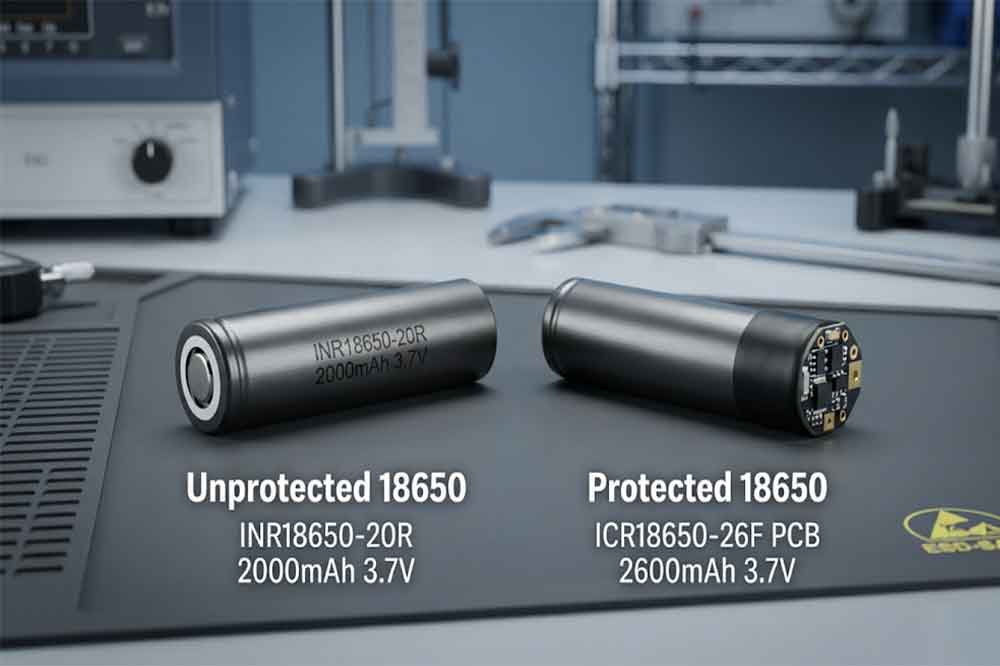
When choosing 18650 lithium-ion battery, one of the first questions engineers and purchasing teams often face is whether to use a protected or unprotected cell.
At first glance, the two products can look almost identical. Both use the familiar cylindrical 18650 format, and both can have similar nominal voltage and capacity ratings. The important difference is the protection system.
A protected 18650 battery has an additional protection circuit connected to the cell. An unprotected 18650 cell normally does not have this circuit integrated into the individual cell.
That difference can affect battery dimensions, electrical behavior, application compatibility, and the overall design of an OEM battery system.
What Is a Protected 18650 Battery?
A protected 18650 battery combines a standard 18650 lithium-ion cell with a small protection circuit.
The protection circuit is designed to monitor electrical conditions and can disconnect the cell when certain abnormal conditions occur.
Depending on the design, protection functions may include:
- Overcharge protection
- Over-discharge protection
- Over-current protection
- Short-circuit protection
The exact thresholds and current limits depend on the protection circuit and its design.
A protected battery is therefore not simply a higher-quality version of an unprotected cell. It is a different battery configuration designed for applications where individual-cell protection may be required.
For a detailed explanation of the basic structure, see our guide to what a protected 18650 battery is.

What Is an Unprotected 18650 Battery?
An unprotected 18650 is generally a bare lithium-ion cell without an integrated protection circuit.
The cell itself still has its normal electrical specifications, including voltage, capacity, internal resistance, and discharge characteristics.
Unprotected cells are commonly considered when the final battery system already includes an external protection circuit or BMS.
This is especially relevant in multi-cell battery packs.
For example, a battery manufacturer may assemble several matched 18650 cells into a custom pack and use a dedicated BMS to monitor the complete battery system.
In this type of design, adding an individual protection circuit to every cell may not be the intended architecture.
Protected vs Unprotected 18650: Main Difference
The simplest way to understand the difference is:
Protected 18650:
Cell + Protection Circuit
Unprotected 18650:
Cell only
However, this simple difference creates several practical consequences.
| Feature | Protected 18650 | Unprotected 18650 |
|---|---|---|
| Individual protection circuit | Usually included | Normally not included |
| Physical length | Usually longer | Usually shorter |
| Protection against abnormal conditions | Provided by integrated circuit | Requires external system |
| Multi-cell pack use | Application dependent | Common in BMS-based packs |
| Mechanical compatibility | Must check total length | Easier where space is limited |
| System design | More self-contained | Requires external protection |
The exact specifications should always be confirmed with the battery manufacturer because protected-cell designs vary.
Physical Size: Protected vs Unprotected
One practical difference that is easy to overlook is physical size.
A bare 18650 cell has a standard cylindrical form factor, but a protected version may have additional components attached to one end.
This can increase the overall battery length.
For a device with a tight battery compartment, this difference can be critical.
A buyer might select a 3000mAh protected 18650 based on capacity, only to discover that the additional protection circuit makes the battery too long for the existing housing.
Therefore, OEM buyers should specify the maximum allowable battery dimensions before choosing the battery.
The important measurement is not just the length of the bare cell.
It is the complete assembled battery length and diameter.

Protection and Safety
The protection circuit is one of the main reasons engineers choose a protected 18650 battery.
A properly designed protection circuit can help disconnect the battery under certain abnormal electrical conditions.
For example, if the cell reaches the circuit’s overcharge threshold during charging, the circuit can interrupt the charging path.
If the cell voltage falls below the specified discharge cutoff, the protection circuit can disconnect the load.
The circuit may also respond to excessive current or a short circuit.
However, protection does not make a lithium-ion battery completely risk-free.
Battery safety still depends on:
- Cell quality
- Charger design
- Protection circuit design
- Battery assembly
- Operating temperature
- Mechanical protection
- Wiring
- Manufacturing quality
- Correct application
This is particularly important for OEM projects. A protection circuit should be viewed as one part of the battery safety system rather than the entire safety strategy.
Which Has Higher Discharge Current?
It is a mistake to assume that a protected 18650 always has lower discharge current than an unprotected cell.
The actual limit depends on both the cell and the protection circuit.
A high-current cell may be capable of delivering substantial current, but if the protection circuit has a lower current limit, the complete protected battery may not support the same current.
For example, the cell may be designed for a certain continuous discharge current while the selected protection circuit has a different over-current threshold.
This is why OEM buyers should check both specifications.
Ask for:
- Cell maximum continuous discharge current
- Protection circuit operating current
- Over-current protection threshold
- Peak current capability
- Application load profile
The battery should be selected according to the complete system rather than the cell specification alone.
Does Protected Mean Better?
Not necessarily.
Protected and unprotected 18650 cells are designed for different system architectures.
A protected battery can be a practical choice for a standalone device that needs individual-cell protection.
An unprotected cell may be more suitable for a professionally designed multi-cell battery pack that already has an appropriate BMS.
Calling one option “better” without knowing the application can lead to the wrong battery choice.
The correct question is:
Which battery architecture matches the device?
That is more useful than simply asking which type has a higher specification.
When Should You Use a Protected 18650?
A protected 18650 can be considered when the application uses an individual rechargeable cell and requires integrated protection.
Potential applications include:
- Portable electronics
- Lighting equipment
- Instruments
- Small battery-powered devices
- Certain backup power applications
- Customized single-cell products
The device should still be checked for physical compatibility.
The protection circuit can increase the total battery length, and the battery’s current capability must match the load.
If the equipment already contains an appropriate battery protection system, the engineering team should check whether an additional protection circuit is necessary.
When Should You Use Unprotected 18650?
Unprotected cells are often considered in custom battery packs where the protection and monitoring system is designed separately.
A multi-cell pack can use a dedicated BMS or PCM to monitor the complete pack.
For example, an OEM manufacturer may build a 4S2P battery pack using eight 18650 cells.
In this configuration, the battery designer needs to consider:
- Cell matching
- Series voltage
- Parallel capacity
- Pack current
- BMS design
- Cell balancing
- Charging method
- Thermal design
- Mechanical construction
Using individual protected cells in such a pack may not automatically provide the desired system architecture.
The complete pack should be designed as one electrical system.
Protected 18650 vs Unprotected 18650 for OEM Projects
For OEM battery projects, the choice should normally be made after the device requirements are defined.
A useful specification sheet can include:
Electrical Requirements
- Nominal voltage
- Capacity
- Continuous discharge current
- Peak current
- Charging voltage
- Protection requirements
Mechanical Requirements
- Maximum length
- Diameter
- Connector
- Cable length
- Terminal arrangement
- Housing requirements
Battery System Requirements
- Single cell or multi-cell
- Series configuration
- Parallel configuration
- BMS or protection circuit
- Cell balancing requirements
- Charger compatibility
This information allows a battery manufacturer to recommend a more appropriate design.

Can an Unprotected 18650 Be Used Without a BMS?
This depends entirely on the application and electrical design.
An unprotected lithium-ion cell should not simply be treated as a protected battery because it does not have an integrated protection circuit.
If the device does not have a suitable protection system, an unprotected cell can create a significant design concern.
For multi-cell battery packs, the protection system is normally designed as part of the complete battery pack.
For single-cell applications, an appropriate protection circuit may be incorporated into the battery or device.
The important point is that the protection function needs to exist somewhere in the complete system where it is required.
What About Charging?
Charging is another important difference between battery selection and system design.
A lithium-ion cell requires an appropriate charging method and voltage control.
A protected 18650 may provide a protection function that disconnects the cell if a specified voltage condition is exceeded, but the protection circuit should not be considered a replacement for a properly designed charger.
For OEM applications, the battery, charger, and device should be evaluated together.
This is especially important when the product will be manufactured in large quantities.
Choosing Between Protected and Unprotected 18650
A simple decision process can help.
Choose a protected 18650 when:
- The application uses an individual cell.
- Integrated cell protection is required.
- The device has enough space for the protected battery dimensions.
- The protection current matches the load.
Consider an unprotected 18650 when:
- The cell is being used in a custom battery pack.
- A suitable external BMS or protection system is included.
- The battery designer needs a specific cell configuration.
- The complete pack architecture has been engineered separately.
These are general guidelines rather than universal rules.
The final decision should be based on the actual device and battery design.
Protected and Unprotected 18650 for Wholesale Buyers
For wholesale purchasing, buyers should avoid ordering only according to a generic product name.
A better RFQ should specify the actual requirements.
For protected batteries, include:
- Cell capacity
- Nominal voltage
- Protection current
- Protection functions
- Maximum dimensions
- Connector requirements
- Quantity
For unprotected cells, include:
- Cell model
- Capacity
- Discharge current
- Chemistry
- Dimensions
- Required quantity
- Intended battery configuration
For OEM battery packs, provide a drawing or existing sample whenever possible.
This helps reduce misunderstandings between the battery supplier and the engineering team.
Conclusion
The main difference between a protected and unprotected 18650 battery is the presence of an integrated protection circuit.
A protected 18650 can provide individual-cell protection functions, while an unprotected 18650 normally depends on an external protection system.
Neither type is automatically the better choice.
For a standalone device, a protected 18650 may be convenient when integrated protection is required. For a custom multi-cell battery pack, an unprotected cell combined with a properly designed BMS may be a more suitable architecture.
For a broader overview of protected 18650 batteries, protection circuits, specifications, and OEM applications, see our 18650 protected battery complete guide.
For more 18650 battery options for OEM and wholesale projects, visit the 18650 Lithium Battery product category.
FAQ
1. What is the main difference between protected and unprotected 18650 batteries?
A protected 18650 has an integrated protection circuit, while an unprotected 18650 normally does not. The protection system for an unprotected cell must be provided elsewhere in the device or battery pack.
2. Is a protected 18650 battery safer than an unprotected one?
A protected 18650 has an additional protection layer against certain abnormal electrical conditions. However, overall battery safety also depends on cell quality, charger design, assembly, temperature, and the complete device design.
3. Can I use an unprotected 18650 in a battery pack?
Yes, unprotected cells are commonly considered for professionally designed multi-cell battery packs with an appropriate BMS or protection system. The complete pack must be engineered for the required voltage, current, charging, and balancing functions.
4. Are protected 18650 batteries larger?
Often, yes. The additional protection circuit can increase the total length of the battery. Always check the complete assembled dimensions rather than relying only on standard 18650 cell dimensions.
5. Which 18650 battery should OEM buyers choose?
The correct choice depends on the device architecture. A protected cell may suit some standalone applications, while an unprotected cell can be appropriate for a custom multi-cell pack with a dedicated BMS.
-

12V 4400 mah Lithium ion 3S2P 18650 Battery Pack
-

18650 2000mAh 3.7 volt Lithium-ion Battery
-

18650 20V 3.0Ah Cordless Drill battery
-

18650 22.2V 7.8Ah 2600Mah 6S3P Rechargeable Battery Pack
-

18650 2600mAh Rechargeable Lithium-Ion Battery 3.7V
-

18650 3.7V 10Ah Li-Ion Power Battery Pack
-

18650 3.7V 3300mah Rechargeable Lithium ion Battery
-

18650 7S7P 24V 14Ah Lithium ion Electric Scooter Battery Pack
-

18650 battery 3.7V 1500mAh Lithium-Ion Battery
-

18650 Battery 3500 mah Rechargeable Battery Cells
-

18650 Electric Scooter 48V 13000mAh Lithium Battery
-

2600mAh 3S1P 11.1V 18650 Battery Packs
-

3.7V Li ion Rechargeable 3000mah 18650 Battery Cell
-

36V 5200mAh 10S2P 18650 Battery Pack
-

48v 4400mah 13S2P 18650 Rechargeable Battery Pack
-

7S2P 24V 18650 Lithium Battery Pack
-

Electric Scooter 36V 4400mAH 10S2P 18650 Battery Pack
-

ICR 18650 Battery 2200mah 3.7V
Leave a Reply