
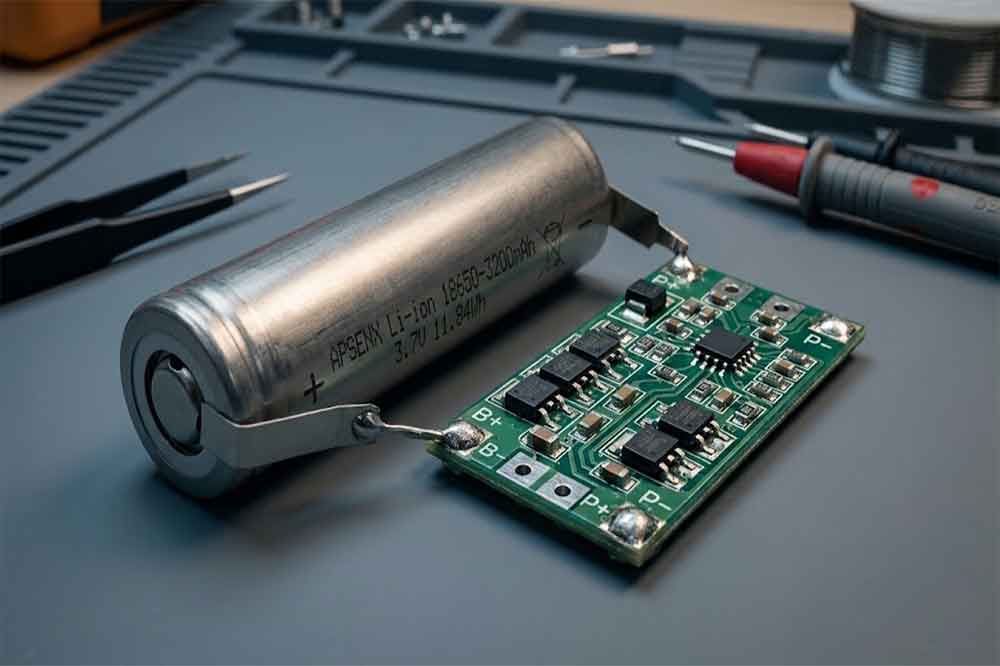
18650 lithium-ion battery can be supplied as a bare cell, a protected cell, or part of a custom battery pack with a dedicated battery management system. These options may look similar in a product quotation, but their electrical functions can be quite different.
One source of confusion is the terminology. Suppliers may use PCB, PCM, and BMS when discussing battery protection. In some applications, these terms overlap. In others, they refer to different levels of monitoring and control.
For OEM buyers, the important question is not simply whether a battery has a protection board. The real question is what the circuit monitors, which faults it can respond to, what current it supports, and whether it matches the device’s charging and discharging requirements.
This guide explains the common terms and shows how to evaluate an 18650 battery protection solution for commercial projects.
What Is 18650 Battery Protection Circuit?
18650 battery protection circuit is an electronic system designed to monitor selected battery conditions and interrupt the current path when a defined abnormal condition is detected.
Depending on the circuit, its protection functions may include:
- Overcharge protection.
- Over-discharge protection.
- Overcurrent protection.
- Short-circuit protection.
A typical compact circuit may contain a protection IC, MOSFET switching components, resistors, capacitors, and other supporting parts.
The protection IC monitors electrical signals and determines when a configured protection threshold has been reached. MOSFETs act as electronic switches that can disconnect the charging or discharging path.
Not every board includes the same functions. Some designs support only basic voltage protection, while others include additional monitoring or control features.
For example, a protected 18650 battery intended for a low-current portable device may use a compact board with a current rating suited to that device. A higher-power application may require a different circuit and a cell capable of supplying the required current.
The protection circuit must be selected as part of the complete battery system, not as an isolated component.
For a broader overview of protected cells, specifications, and OEM requirements, read our 18650 protected battery complete guide.
What Is a PCB in an 18650 Battery?
PCB Means Printed Circuit Board
PCB stands for printed circuit board. It is the physical board that holds and electrically connects electronic components.
In battery discussions, suppliers sometimes use “PCB” as shorthand for a battery protection board. Strictly speaking, however, the PCB is the board itself, while the protection function comes from the components and circuit design mounted on it.
A small 18650 protection board may be installed at one end of a cylindrical cell. Depending on the product, it may be connected to the cell through metal strips, wires, or another suitable arrangement.
Common PCB Protection Functions
A battery protection PCB may provide one or more of the following:
Overcharge protection: Interrupts charging when the cell voltage reaches the circuit’s configured upper threshold.
Over-discharge protection: Disconnects the discharge path when the cell voltage falls below its configured lower threshold.
Overcurrent protection: Responds when current exceeds a defined limit for the specified detection conditions.
Short-circuit protection: Attempts to disconnect the current path when a supported short-circuit condition is detected.
These functions depend on the selected protection IC, switching components, and board configuration.
A small board should not automatically be considered inferior to a larger board. Size alone does not establish protection quality or current capability. Component selection, thermal performance, electrical layout, and verified test results matter more.
What Is PCM in Lithium Battery?
PCM commonly stands for Protection Circuit Module. It is a term widely used for a circuit or module designed to provide basic battery protection.
In a single-cell lithium-ion battery, a PCM may monitor cell voltage and current-related conditions, then disconnect the charging or discharging path when a protection threshold is reached.
The exact functions depend on the design. Some PCMs focus on essential voltage and current protection, while other modules may provide additional functions.
PCM for a Single 18650 Cell
A PCM can be integrated into a protected 18650 battery or used as part of a battery assembly.
For a single-cell application, the module must be compatible with the cell chemistry, voltage limits, load current, and charging method.
Consider a portable electronic device that uses one 18650 cell. Its designer may need a protected cell with a compact form factor and a specified discharge capability. In this case, a suitable PCM may provide the required basic protection without needing the more extensive functions associated with a complex battery pack.
However, the product designer still needs to confirm the protection thresholds and current rating. The term “PCM” alone does not tell the buyer exactly what the module can do.
Is PCM Different from PCB?
In common supplier terminology, PCB and PCM can refer to very similar battery protection assemblies. There is no universal industry-wide naming rule that guarantees every supplier uses the terms in exactly the same way.
A supplier might call a small board a PCB, PCM, or protection board. Another supplier may distinguish the physical circuit board from the complete protection module.
For procurement, ask for the actual protection functions, circuit specifications, and component details instead of relying on the abbreviation alone.

What Is BMS in 18650 Battery Pack?
BMS stands for Battery Management System. It generally refers to a system that monitors and manages a battery or battery pack, with functions depending on the application.
A BMS may include protection functions similar to those found in a basic protection circuit. More advanced designs can also support cell-group voltage monitoring, temperature monitoring, balancing, state estimation, communication, and system-level control.
Not every BMS includes every feature. A simple BMS may have a limited function set, while a sophisticated industrial battery management system may include communication with a host controller or charger.
BMS for Multi-Cell Battery Packs
A battery pack made from multiple series-connected 18650 cells has additional design requirements.
The total pack voltage is higher than the voltage of a single cell. The designer may also need to monitor individual series-connected cell groups, control pack current, and manage temperature.
For example, a custom pack used in industrial equipment may need:
- A specified series and parallel configuration.
- Pack-level charge and discharge protection.
- Monitoring of individual series-connected cell groups.
- Temperature sensing.
- Balancing where required.
- Communication with the host device, if specified.
The required functions depend on the battery architecture and application. A BMS should be selected based on actual system requirements rather than on the name alone.
Does a BMS Always Mean More Protection?
Not necessarily.
The label “BMS” does not guarantee that a system includes every monitoring, balancing, communication, or diagnostic function an OEM project might require. Two BMS products can have different capabilities.
For procurement, verify the protection thresholds, current ratings, temperature inputs, balancing method, communication protocol, and operating conditions that apply to the particular model.
A suitable BMS must also be compatible with the cell chemistry, series configuration, charger, and load.
PCB vs PCM vs BMS: What Is the Difference?
The following table provides a practical comparison. The terms describe common usage rather than strict definitions shared by every manufacturer.
| Feature | PCB / Protection Board | PCM | BMS |
|---|---|---|---|
| Common meaning | Physical board or shorthand for a protection circuit | Protection Circuit Module | Battery Management System |
| Typical role | Houses and connects protection components | Provides basic battery protection | Monitors or manages a battery or pack |
| Single-cell use | Common | Common | Possible, depending on design |
| Multi-cell monitoring | Depends on circuit | Depends on module | Common in multi-cell applications |
| Cell balancing | Not implied | Not implied | Available in designs that support it |
| Temperature monitoring | Not guaranteed | Not guaranteed | Available when designed with suitable sensors |
| Communication | Not implied | Not implied | Available on supported models |
| Selection priority | Circuit design and ratings | Protection functions and ratings | Complete system requirements |
The key distinction is functional, not simply physical. A PCB is a board, a PCM commonly describes a protection module, and a BMS usually describes a battery monitoring and management system.
Because supplier terminology varies, buyers should confirm the exact scope of each product.

How Should OEM Buyers Choose the Right Protection Solution?
Start with the battery configuration.
A single-cell 18650 device may need a protected cell or a separately designed protection circuit. A multi-cell battery pack may need a dedicated BMS matched to the cell arrangement and overall system.
Next, confirm the electrical requirements.
Check Voltage and Chemistry
The protection thresholds must match the cell chemistry and manufacturer specifications. Do not assume that every lithium-based cell uses the same upper and lower voltage limits.
The charging system must also be compatible with the cell and pack.
Confirm Current Capability
Check the cell’s continuous discharge capability, expected peak current, and the protection circuit’s supported current.
A protection board with a current limit below the device’s normal operating requirement may cause unwanted shutdowns. A board with an unsuitable rating may also fail to provide the intended protection.
Peak current should be evaluated alongside its duration and frequency. Motor startup, radio transmission, and other short high-load events can affect the selection.
Verify Mechanical Fit
A protected 18650 cell can be longer than a comparable unprotected cell because the protection circuit adds components at one end.
Confirm the permitted length, diameter, terminal arrangement, connector, and wire routing. For compact products, even a small dimensional difference can prevent installation.
Request the Right Technical Documents
For OEM and wholesale orders, request the information needed to verify the design:
- Cell datasheet and rated capacity.
- Protection board or PCM specification.
- BMS specification for multi-cell packs.
- Overcharge and over-discharge thresholds.
- Overcurrent and short-circuit response information.
- Continuous and peak current ratings.
- Charging requirements and operating temperature range.
- Applicable test reports and transport documentation.
The documents required will depend on the product, destination market, and intended use.
Can You Add a Protection Circuit to an Existing 18650 Cell?
Technically, a suitable protection circuit can be incorporated into a battery assembly, but it is not a simple universal upgrade.
The circuit must match the cell’s voltage limits, chemistry, current requirements, and physical design. The installation also needs appropriate electrical connections, insulation, mechanical support, and quality control.
Adding a board can change the overall cell length and terminal arrangement. It may also affect current capability and compatibility with the original device.
For OEM production, it is usually better to define the complete protected-cell specification before ordering samples. If the application requires a custom multi-cell pack, the cell arrangement, protection circuit, BMS, enclosure, and connector should be evaluated together.
Any modification should be performed by qualified battery engineers using appropriate manufacturing and testing procedures. Improvised assembly can create short-circuit, overheating, and other safety risks.
Final Thoughts: Specify the Function, Not Just the Name
PCB, PCM, and BMS are useful terms, but they do not replace a complete technical specification. PCB often describes the physical circuit board, PCM commonly describes a protection module, and BMS generally refers to a battery management system. Actual functions vary by manufacturer and model.
For OEM buyers, the right solution depends on whether the application uses one protected 18650 cell or a multi-cell battery pack, as well as its voltage, current, charging, mechanical, and monitoring requirements.
Review our 18650 Lithium Battery options to explore suitable cell options for your project. For customized applications, provide the required electrical specifications and device details so the battery and protection design can be evaluated together.
FAQs
1. What is the difference between PCB and PCM in 18650 battery?
PCB refers to a printed circuit board, while PCM commonly means Protection Circuit Module. In battery supplier terminology, both may refer to a similar protection assembly, so confirm the actual functions and specifications.
2. Is a BMS better than a PCM?
Neither is automatically better for every application. A PCM may be sufficient for basic single-cell protection, while a multi-cell pack may need a BMS with additional monitoring or management functions.
3. Does every protected 18650 battery have a BMS?
No. A protected single 18650 cell commonly uses a compact protection circuit or PCM. A full BMS is more commonly associated with multi-cell battery packs, although terminology and designs vary.
4. Can 18650 protection board support high current?
Some can, but current capability depends on the circuit design, MOSFETs, thermal conditions, and other components. Check the verified continuous and peak current ratings before selection.
5. What should OEM buyers provide when requesting a protected 18650 battery?
Provide the required voltage, capacity, current, dimensions, charging method, connector, application, and any monitoring or communication requirements. For multi-cell packs, also specify the series-parallel configuration and required BMS functions.
-

12V 4400 mah Lithium ion 3S2P 18650 Battery Pack
-

18650 2000mAh 3.7 volt Lithium-ion Battery
-

18650 20V 3.0Ah Cordless Drill battery
-

18650 22.2V 7.8Ah 2600Mah 6S3P Rechargeable Battery Pack
-

18650 2600mAh Rechargeable Lithium-Ion Battery 3.7V
-

18650 3.7V 10Ah Li-Ion Power Battery Pack
-

18650 3.7V 3300mah Rechargeable Lithium ion Battery
-

18650 7S7P 24V 14Ah Lithium ion Electric Scooter Battery Pack
-

18650 battery 3.7V 1500mAh Lithium-Ion Battery
-

18650 Battery 3500 mah Rechargeable Battery Cells
-

18650 Electric Scooter 48V 13000mAh Lithium Battery
-

2600mAh 3S1P 11.1V 18650 Battery Packs
-

3.7V Li ion Rechargeable 3000mah 18650 Battery Cell
-

36V 5200mAh 10S2P 18650 Battery Pack
-

48v 4400mah 13S2P 18650 Rechargeable Battery Pack
-

7S2P 24V 18650 Lithium Battery Pack
-

Electric Scooter 36V 4400mAH 10S2P 18650 Battery Pack
-

ICR 18650 Battery 2200mah 3.7V
Leave a Reply