
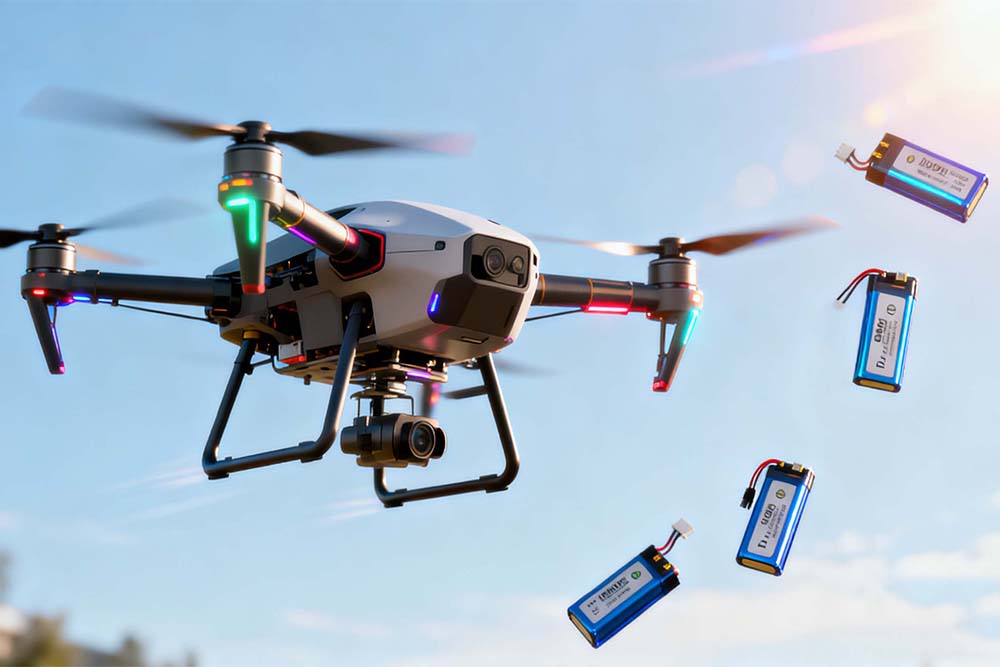
Honestly, understanding your drone battery—its lifespan, endurance, and how you care for it—is one of the most practical things you can do to improve flying.
Whether you’re filming, mapping, doing security patrols, or just flying for fun, how long your battery lasts, how stable it is, and how much it costs in the long run all depends on it.
So I’m putting everything in one place: battery tech, lifespan, flight time, charging habits, storage, and how to pick a long-endurance drone.

1. Why Do Most Drones Use LiPo Batteries?
Why do 90%+ of consumer and professional drones use LiPo? Honestly, it’s just practical, no magic here.
1.1 High Energy Density
Same weight, more energy stored. That means—same payload, longer flight.
Plain and simple: better endurance.
1.2 High Discharge Rate
Takeoff, sudden climbs, fighting wind, quick accelerations… all demand big current bursts.
LiPo can handle it, unlike some batteries that just choke.
1.3 Customizable Shapes & Lightweight
LiPo can be flat, thin, and light.
Lighter drone, better efficiency.
1.4 Mature & Safe (when used correctly)
Been used in drones for years, reliability proven.
As long as you don’t mess with charging or storage, it’s “light, good, and stable.”
Bottom line:
LiPo is the best balance of weight, performance, and cost right now.
2. Why Do Drone Batteries Become Less Durable Over Time?
External factors hit them harder than most people realize.
Theoretically, LiPo lasts 200–300 full charge cycles, but in real life? Usually shorter.
Here are the most common “silent killers” for drone batteries:
2.1 Strong Wind
Flying against the wind forces the motors to push harder.
More current, more heat, battery ages faster.
2.2 Low Temperature
Cold days hit noticeably.
You’ll see:
- Voltage dropping faster
- Flight time clearly reduced
- Auto-return triggered by “low voltage”
Preheating the battery actually helps.
2.3 Aggressive Flying
Rapid acceleration, hard stops, sharp turns, sport mode…
Current fluctuates wildly; LiPo hates that.
Bottom line:
The harder you fly, the faster your battery wears out.
3. Correct Charging Habits & Storage That Extend Battery Life by at Least 30%
LiPo is a bit “sensitive,” but if you handle it right, it lasts much longer.
3.1 Don’t Charge Immediately After Flying
Freshly flown batteries are hot.
Don’t rush—let it cool to room temp first.
3.2 Storing Long-Term? Keep at 30–60%
Fully charged or fully empty storage accelerates aging.
3.3 Don’t Fully Drain
Return when battery hits 10–20% to avoid permanent damage.
3.4 Regularly Check the Battery
Swelling, leakage, strange smell—stop using immediately.
Exploding batteries are always from taking risks.
4. How to Charge a LiPo drone battery Properly
This routine is simple but super practical:
- Check battery temperature (25°C is ideal)
- Use the original charger; don’t mismatch voltage or current
- Don’t fly or discharge while charging
- Keep it ventilated
- Unplug when full; don’t leave it plugged in
These small habits noticeably extend cycle life.
5. How Long Does a Drone Battery Last? (Lifespan vs Flight Time)
Newbies often mix up “lifespan” and “single flight time”—they’re not the same.
5.1 Battery Lifespan (Cycle Life)
Normal flying:
- 200–300 cycles
Aggressive or heavy load flying:
- About 150 cycles
5.2 Single Flight Time
Typical numbers:
- Consumer drones: 20–30 min
- High-end flagship: 35–46 min (e.g., Mavic 3 series)
- Industrial drones: 55–70 min (e.g., Matrice 300 RTK)
- Fixed-wing / hybrid industrial: hours, sometimes 10+ hours
6. Which Drones/Batteries Have the Longest Flight Time Today?
From multiple reviews:
6.1 Consumer-Level: 40–46 minutes
Examples:
- DJI Mavic 3 / Mavic 3 Pro
- DJI Air series with high-capacity batteries
6.2 Professional-Level: 50–70 minutes
Example:
- DJI Matrice 300 RTK (~55 min)
6.3 Industrial & Special Applications: Up to Several Hours
Examples:
- Fixed-wing industrial drones
- Gas-electric hybrid drones
- Large wingspan multirotors
Some reach 600 min (10 hours).
Used for land inspection, border patrol, mapping, etc.

7. Industries That Require Maximum Endurance
These industries basically live on long flight time:
7.1 Mapping / GIS / Aerial Surveying
Long routes; more endurance = higher efficiency.
7.2 Agriculture Spraying & Crop Monitoring
Big fields; constant battery swapping slows everything.
7.3 Powerline & Pipeline Inspection
Long, straight routes; endurance is critical.
7.4 Public Safety / Search & Rescue / Fire Recon
Needs continuous searching or hovering.
7.5 Construction & Mining Monitoring
Large areas (2–5 km); sometimes endurance matters more than image quality.
8. Factors That Affect Drone Flight Time
Main things that make or break flight time:
8.1 Battery Capacity (mAh / Wh)
Higher Wh = theoretically longer flight.
8.2 Motor Efficiency
More efficient motors = less power draw.
8.3 Flight Weight (Payload)
Adding a GoPro, light, or thermal cam can drop flight time 20–50%.
8.4 Environment
Headwind, cold, high humidity all shorten flight.
8.5 Flying Style
Sport mode, high-speed flight, rapid maneuvers = battery killer.
9. Key Things to Consider When Buying a Long-Endurance Drone
Want longer flight? Focus on:
9.1 Manufacturer’s Rated Time vs Real Flight Time
Official specs are usually 15–30% longer than reality. Totally normal.
9.2 Battery Quantity & Price
Some drones have expensive batteries.
Sometimes switching models is more economical.
9.3 Drone Weight & Structure
Lighter drones fly longer, but handle wind worse.
9.4 Your Task Needs
Commercial work often requires bigger platforms (Matrice series, etc.).
9.5 Accessory Ecosystem
Easy to buy batteries?
Supports fast charging?
Any larger battery options?
These affect long-term cost.
Summary
Drone batteries may look simple, but half your flying experience depends on them.
Once you understand why LiPo is popular, how to extend lifespan, and what endurance different tasks need, picking the right drone becomes obvious.
Leave a Reply