
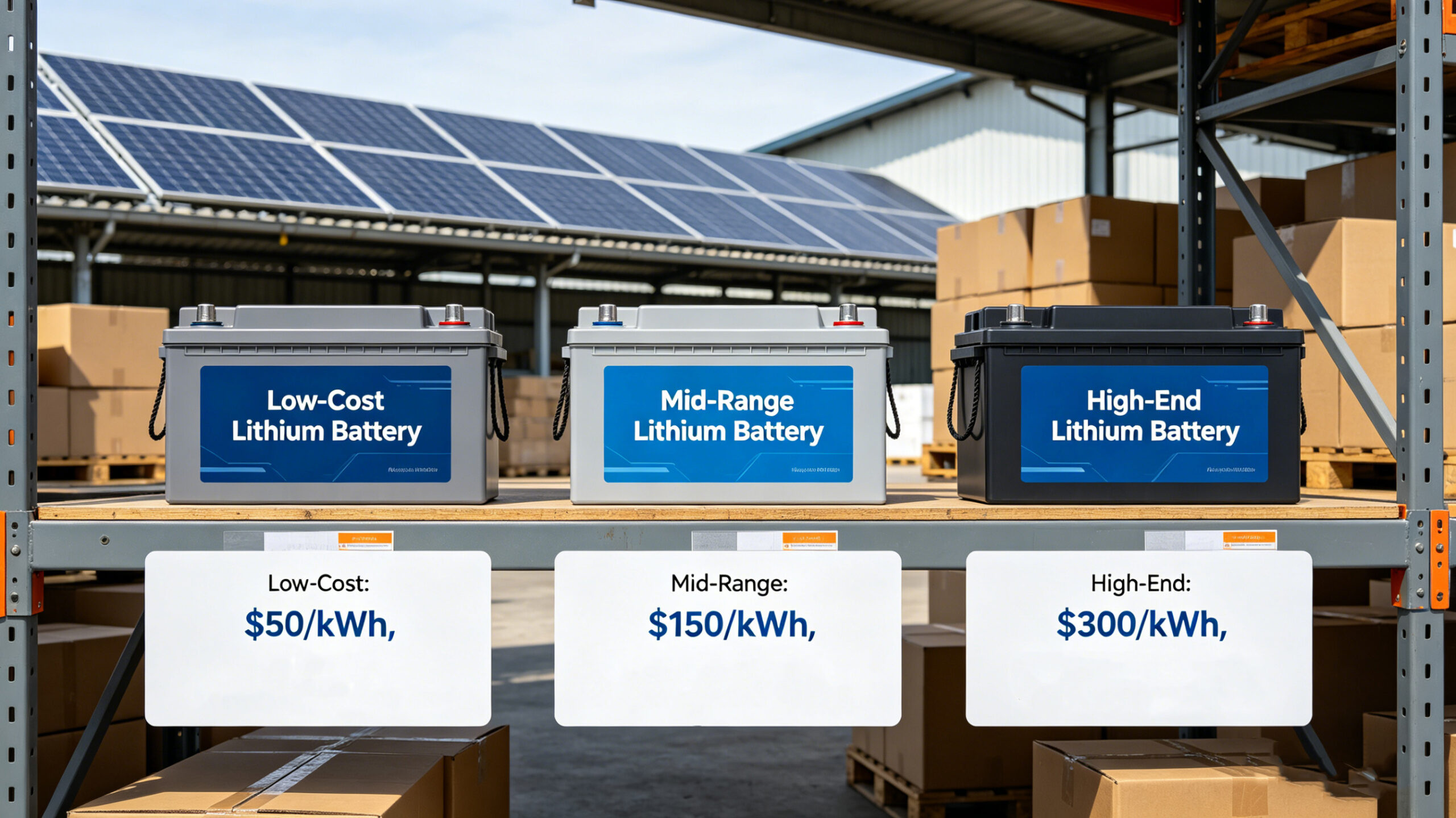
If you’ve compared quotes for a 12V 100Ah LiFePO4 battery, you’ve probably seen this:
Same spec on paper.
But prices? Sometimes 30–50% apart.
At first glance it doesn’t make much sense.
But once you’ve dealt with a few suppliers, you start to see a pattern—most of that price difference isn’t random.
It usually comes down to a few key things that aren’t always obvious from a datasheet.
1. Cell Quality: The Biggest Hidden Cost Factor
This is where most of the price difference comes from.
Two batteries can both say “100Ah,” but internally:
- One uses well-matched, stable cells
- The other uses mixed or lower-grade cells
What happens in real use:
- Voltage drops faster
- Capacity becomes inconsistent
- Lifespan shortens
For small orders, this might not be obvious right away.
But for bulk projects, the difference shows up quickly—especially after a few hundred cycles.
2. BMS Quality: Where Corners Are Often Cut
If there’s one place manufacturers try to save cost, it’s the BMS.
On paper, most BMS systems list similar protections.
In reality, the implementation varies a lot.
Lower-cost setups often lead to:
- Unexpected cut-offs under load
- Poor cell balancing
- Weak temperature control
These issues usually don’t show up during initial testing—they appear later, which makes them harder (and more expensive) to deal with.
3. Real Cycle Life vs Claimed Numbers
Cycle life is one of those specs that’s easy to “optimize” on paper.
You’ll see numbers like:
- 4000 cycles
- 6000 cycles
But the real question is: under what conditions?
- Lab conditions → controlled temperature, shallow cycles
- Real use → deeper discharge, variable environment
In actual solar projects, batteries are rarely used under ideal conditions.
That’s why it helps to evaluate a complete
12V 100Ah LiFePO4 battery for solar applications
that’s built with real operating conditions in mind, not just optimized test results.
4. Structural Design and Build Quality
This is something people don’t always think about until problems show up.
Differences in:
- Casing strength
- Internal layout
- Thermal management
can affect:
- Durability during transport
- Performance under load
- Long-term reliability
For example, poor internal design can lead to uneven heat distribution, which speeds up degradation.
5. Consistency Across Batches
If you’re buying in bulk, this matters more than anything else.
You don’t just need one good battery—you need all of them to perform the same.
Common issues with inconsistent batches:
- Different voltage behavior
- Uneven aging
- System imbalance
This is where some lower-priced suppliers struggle, especially at scale.
6. Certification and Compliance Costs
Some suppliers include:
- UN38.3
- MSDS
- Transport certifications
Others either don’t have them or provide incomplete documentation.
This affects:
- Shipping options
- Customs clearance
- Project compliance
And yes—it also affects price.
7. OEM and Customization Support
If you need:
- Branding
- Custom terminals
- Communication interfaces
that usually adds cost—but it also adds value.
A supplier that can adjust the product to your needs often helps you:
- Enter new markets
- Differentiate your offering
- Avoid redesign later
8. After-Sales Support (Often Overlooked)
This is one of those things you don’t think about—until something goes wrong.
Lower-priced options often come with:
- Slower response
- Limited technical support
- More back-and-forth
For bulk buyers, this can become a bigger cost than the battery itself.
9. Logistics and Delivery Stability
Price isn’t just about the product.
Things like:
- Lead time reliability
- Packaging quality
- Shipping experience
can affect your overall cost and timeline.
Delays or damaged shipments can quickly offset any initial savings.
Final Thoughts
So why do 12V 100Ah LiFePO4 battery prices vary so much?
Because you’re not just paying for capacity—you’re paying for:
- Cell quality
- BMS reliability
- Consistency
- Support
- Supply stability
Once you look at it this way, the price gap starts to make a lot more sense.
If you’re comparing suppliers, it’s worth looking beyond just the quote and reviewing a
12V 100Ah LiFePO4 battery solution built for solar projects
to understand what a balanced design looks like in terms of performance, structure, and long-term usability.


Leave a Reply