
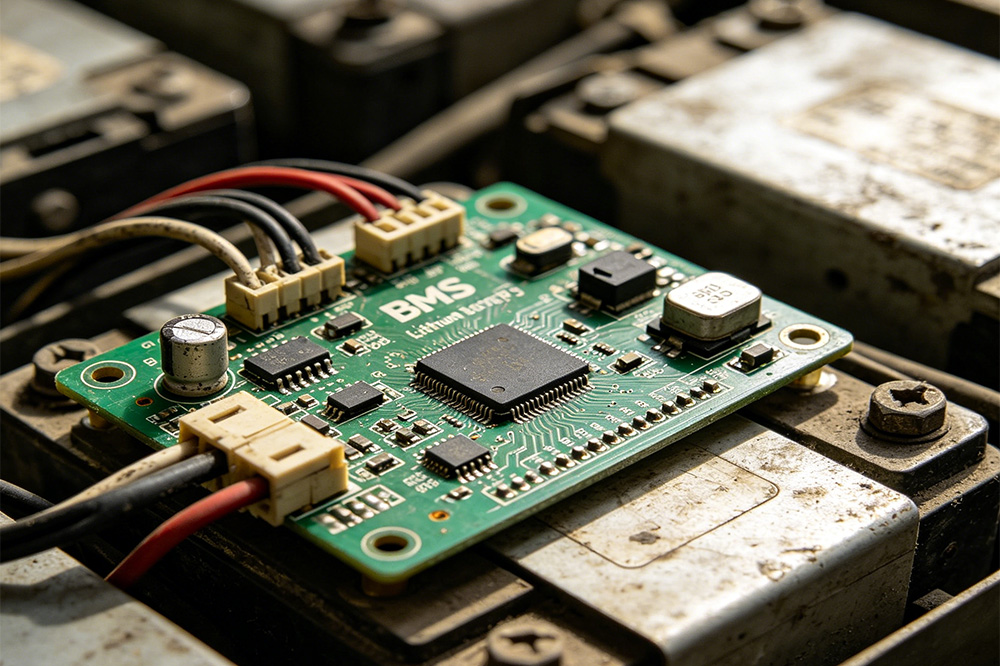
When people compare 12V 100Ah LiFePO4 batteries, they usually look at:
- capacity
- cycle life
- price
But in real use, most problems don’t come from the cells.
They come from the BMS (Battery Management System).
And the tricky part is — you don’t see it until something goes wrong.
What a BMS Actually Does (In Simple Terms)
At a basic level, the BMS is there to protect the battery.
It handles things like:
- overcharge protection
- over-discharge protection
- overcurrent protection
- temperature cut-off
That’s the “standard” explanation.
But in real-world systems, it does something more important:
it decides when your battery stops working

Why “100A BMS” Doesn’t Tell the Full Story
Most 12V 100Ah batteries come with a 100A BMS.
Sounds straightforward, but here’s where people get caught off guard.
A few real situations:
- inverter startup surge exceeds 100A
- motor creates short spikes above limit
- multiple devices run at the same time
What happens?
the BMS cuts off power
Not because the battery is empty — but because it’s protecting itself.
From the user’s perspective, it just looks like a failure.
Continuous vs Peak Current (Big Difference)
This is rarely explained clearly.
- Continuous current → what the battery can handle long-term
- Peak current → short bursts (seconds or milliseconds)
Some BMS units handle spikes well.
Some don’t.
That’s why two “100A batteries” can behave completely differently under the same load.
Temperature Protection: More Important Than It Looks
Temperature cut-off is often overlooked, especially in:
- marine environments
- outdoor solar systems
- winter RV setups
A good BMS will:
- stop charging at low temperatures
- prevent overheating during discharge
A weak one might:
- trigger too early (annoying shutdowns)
- or too late (long-term damage)

What Causes Most BMS Complaints
From real usage and feedback, most issues fall into a few categories:
1. Unexpected Shutdowns
Usually caused by current spikes or unstable protection thresholds.
2. Inconsistent Performance Across Units
Common in bulk orders when BMS quality varies between batches.
3. Parallel System Conflicts
When multiple batteries are connected, mismatched BMS behavior can lead to imbalance.
What to Look for (If You’re Buying in Bulk)
If you’re sourcing batteries for projects or resale, don’t just check “100A BMS” on the spec sheet.
Look deeper:
- how stable is it under real load
- does it handle surge current properly
- is protection consistent across batches
A well-built option like this
12V 100Ah LiFePO4 battery
is usually designed with more stable BMS behavior, especially for:
- solar systems
- RV setups
- marine applications
That consistency matters more than the headline number.
A Practical Way to Think About BMS
Instead of asking:
“Is it 100A?”
A better question is:
“Will it stay stable under my actual load?”
Because in real systems:
- loads fluctuate
- spikes happen
- environments aren’t controlled
And that’s exactly where weaker BMS designs start to show problems.

Why This Matters More in Lithium Than Lead-Acid
With lead-acid batteries, there’s no BMS controlling everything.
They degrade slowly, but they rarely “shut off.”
LiFePO4 is different:
it’s safer and smarter
but also more dependent on electronics
So the BMS becomes a critical component, not just a feature.
Final Thought
Most people only think about the BMS after something goes wrong.
By then, it’s already a problem.
If you’re buying in bulk or building systems, it’s worth paying attention earlier — because the BMS is what determines whether the battery feels reliable or unpredictable in real use.


Leave a Reply