
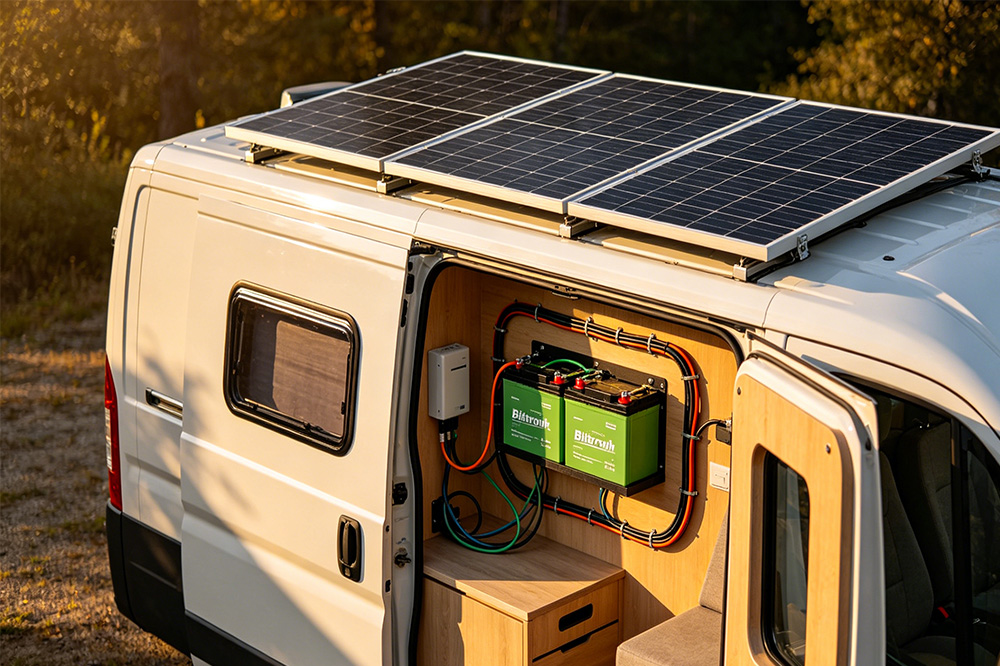
RV power systems have changed a lot in the past few years.
If you’ve worked with campers or van conversions, you’ve probably noticed the shift:
people are moving away from AGM and lead-acid and switching to 12V 100Ah LiFePO4 batteries
At first, it looks like a simple upgrade.
But once you get into real usage, the reasons become much clearer.
Why 12V 100Ah Is the “Standard” RV Battery
For most RV setups, 12V 100Ah hits a practical balance between:
- capacity
- size
- cost
A single unit provides around 1280Wh, which is enough to handle:
- lighting
- fridge
- fans
- small electronics
That’s why many entry-level RV systems start with one battery — and expand later.

The Real Advantage: Usable Power
Here’s something RV users notice immediately.
With lead-acid batteries:
- you can only use about 50% of capacity
With LiFePO4:
- you can safely use up to 90%
So in real terms:
- 100Ah lead-acid → ~50Ah usable
- 100Ah LiFePO4 → ~90Ah usable
That’s almost double the practical runtime without increasing space.
Weight Matters More Than You Think
RV builds are always weight-sensitive.
Switching to LiFePO4 means:
- significantly lighter battery system
- easier installation
- better fuel efficiency (for mobile setups)
For van conversions especially, this becomes a big advantage.
Common Setup: Start Small, Then Expand
Most RV users don’t stay with one battery.
Typical upgrade path:
- start with 1 × 100Ah
- move to 2–4 batteries in parallel
This modular approach works well because:
- no need to replace the whole system
- easy to scale based on usage
- flexible for different travel needs

What Causes Problems in RV Battery Systems
From real-world usage, most issues don’t come from capacity — but from mismatched expectations.
1. Undersized Battery Bank
Users underestimate how much power they actually use.
2. BMS Limitations
Most 100Ah batteries have a 100A BMS.
This can become a bottleneck when running:
- inverters
- coffee machines
- induction cookers
3. Inconsistent Battery Quality
When multiple batteries are used in parallel, inconsistency leads to:
- uneven charging
- reduced lifespan
- system instability
What Installers and Buyers Should Look For
If you’re sourcing batteries for RV projects or resale, focus on real-world usability.
A reliable option like a
12V 100Ah LiFePO4 battery should support:
- stable performance under continuous load
- consistent cell matching (important for parallel setups)
- reliable BMS protection
- scalability for system expansion
These are the factors that reduce issues after installation.
Why RV Demand Is Driving Lithium Growth
The RV market is one of the biggest drivers behind lithium battery adoption.
Why?
Because users want:
- longer off-grid time
- faster charging (especially with solar)
- less maintenance
- lighter systems
And LiFePO4 delivers on all of these.

A Quick Reality Check
A single 100Ah battery works for light users.
But for most real RV setups:
200Ah–400Ah is more realistic
That’s why bulk buyers often see repeat orders — users expand their systems over time.
Conclusion
The shift from lead-acid to LiFePO4 in RV systems isn’t just a trend — it’s a practical upgrade.
For buyers and installers, the key isn’t just choosing a battery.
It’s choosing one that works well in a real system:
- stable under load
- easy to expand
- consistent across units
Because in RV applications, performance issues show up fast — and are hard to ignore.


Leave a Reply