
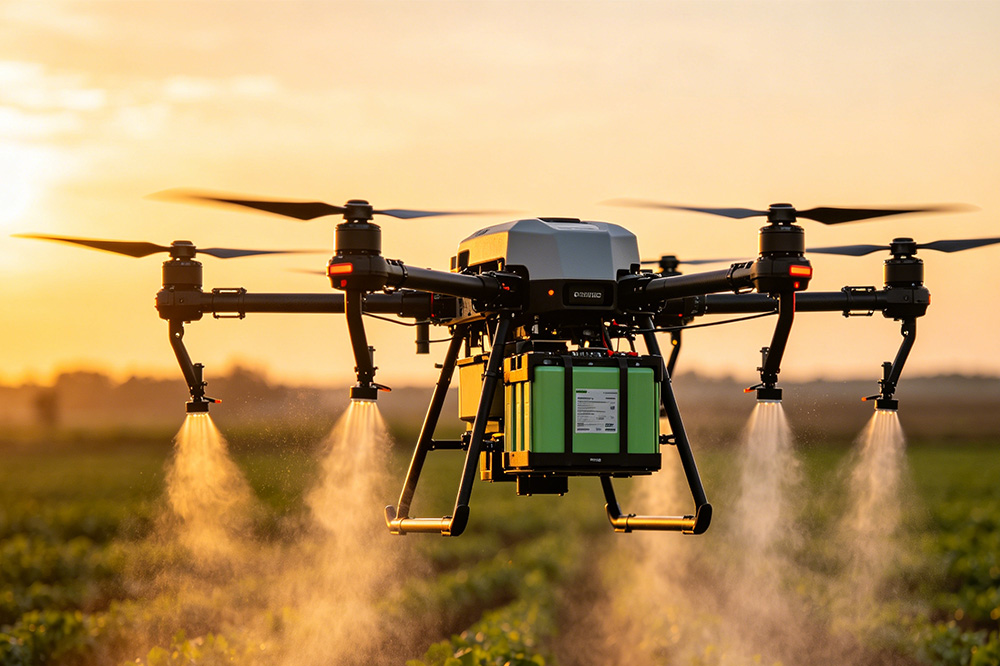
In commercial UAV operations, battery performance is rarely just a technical detail. It directly affects flight time, payload capacity, maintenance costs, and even project profitability.
Whether you’re building agricultural spraying drones, mapping UAVs, inspection platforms, or heavy-lift industrial systems, choosing the right high capacity drone battery can make a noticeable difference in day-to-day operations.
A lot of buyers focus only on battery capacity numbers. In reality, experienced UAV integrators pay much closer attention to discharge stability, weight balance, cycle life, and system compatibility.
Here’s what actually matters when selecting batteries for commercial drone projects.
Start with the Real Flight Requirements
Before comparing battery models, it helps to define the actual mission profile of the UAV.
Questions commercial buyers usually ask include:
- How long should the drone stay airborne?
- What payload weight will it carry?
- Will it operate in high temperatures or cold environments?
- Does the project require fast battery swapping?
- How many charge cycles are expected per year?
A mapping drone flying lightweight sensors has completely different battery demands compared to an agricultural sprayer carrying liquid payloads.
For long-duration industrial operations, many manufacturers now use specialized high capacity drone battery systems designed for higher energy density and more stable continuous discharge.
Capacity Alone Does Not Determine Flight Time
One of the most common sourcing mistakes is assuming that a larger Ah rating automatically means significantly longer flight time.
In practice, battery weight also increases as capacity rises.
If the battery becomes too heavy, the drone consumes more power just to stay airborne. At that point, the additional capacity delivers diminishing returns.
Commercial UAV engineers usually balance:
- Battery capacity
- Total battery weight
- Motor efficiency
- Propeller size
- Payload demand
- Airframe design
The best industrial drone battery is not necessarily the largest one. It’s the one that delivers the best energy-to-weight ratio for the specific UAV platform.

Understand the Difference Between Li-ion and LiPo Batteries
Commercial UAV projects often choose between Li-ion and LiPo battery chemistry.
Li-ion Batteries
Advantages:
- Higher energy density
- Longer flight endurance
- Lower self-discharge
- Better for long-range missions
Common applications:
- Mapping drones
- Surveillance UAVs
- VTOL fixed-wing drones
- Inspection systems
LiPo Batteries
Advantages:
- Higher discharge rate
- Better instant power output
- Strong acceleration performance
Common applications:
- Heavy-lift drones
- Agricultural spraying drones
- Racing or high-thrust UAVs
For many industrial applications, buyers now prefer hybrid solutions that combine endurance with high discharge capability.

Pay Attention to Discharge Rate
Battery capacity means very little if the pack cannot safely provide enough current during takeoff or heavy-load operation.
This is where C-rating becomes important.
A drone carrying industrial cameras, spraying systems, or logistics payloads often creates sudden power demand spikes. Poor-quality batteries may experience:
- Voltage sag
- Overheating
- Reduced flight stability
- Shortened battery lifespan
- Emergency landing risks
Professional UAV battery suppliers normally provide detailed discharge specifications rather than marketing-only capacity claims.
When evaluating suppliers, always ask for:
- Continuous discharge rate
- Peak discharge rate
- Internal resistance data
- Temperature performance testing
Battery Safety Should Never Be Ignored
Commercial drone operations usually involve higher financial and operational risks than hobby drones.
Battery failure during industrial flights can damage:
- Expensive payload equipment
- UAV airframes
- Customer projects
- Inspection operations
- Agricultural spraying schedules
That’s why industrial buyers increasingly prefer battery packs with advanced BMS protection features.
Modern intelligent UAV battery systems may include:
- Overcharge protection
- Over-discharge protection
- Temperature monitoring
- Cell balancing
- Smart communication protocols
- Real-time battery diagnostics
Many professional UAV battery manufacturersnow integrate smart monitoring systems specifically for commercial fleet management.

Cycle Life Matters More Than Initial Price
Cheap batteries often appear attractive during early sourcing stages.
But for commercial UAV fleets operating daily, battery replacement costs quickly become a major expense.
A lower-cost battery with unstable cell quality may:
- Lose capacity faster
- Develop swelling problems
- Require earlier replacement
- Increase downtime
Experienced fleet operators usually calculate:
- Cost per flight cycle
- Long-term maintenance costs
- Downtime risk
- Replacement frequency
In many cases, higher-quality batteries reduce overall operational cost over time.
Environmental Conditions Affect Battery Performance
Industrial drones rarely operate in ideal laboratory environments.
Real-world conditions may include:
- High summer temperatures
- Dust exposure
- Humid farmland
- Mountain regions
- Cold weather inspections
Extreme temperatures can significantly affect:
- Battery efficiency
- Voltage stability
- Charging speed
- Cycle lifespan
Commercial UAV projects operating in difficult environments often require customized thermal management and protective battery housing designs.

Fast Charging and Swappable Systems Improve Efficiency
For large drone fleets, charging efficiency becomes almost as important as flight performance.
Agricultural drone operators especially prefer:
- Fast charging support
- Hot-swappable battery systems
- Parallel charging solutions
- Intelligent charging stations
Reducing charging downtime allows operators to cover larger operational areas each day.
This becomes critical during:
- Crop spraying seasons
- Infrastructure inspections
- Emergency response missions
Certifications Are Important for International Projects
Commercial drone batteries shipped internationally often require certifications such as:
- UN38.3
- MSDS
- CE
- RoHS
Without proper certification documents, shipping delays and customs issues can become serious problems for UAV manufacturers and distributors.
Reliable suppliers usually provide complete export documentation and transportation support for bulk battery orders.
Final Thoughts
Choosing a high capacity drone battery is not simply about finding the biggest battery available.
Commercial UAV projects require a balance between:
- Flight endurance
- Weight
- Safety
- Discharge performance
- Cycle life
- Operational efficiency
For industrial drone manufacturers and fleet operators, battery reliability directly affects project success and long-term operating costs.
As commercial UAV applications continue expanding across agriculture, logistics, inspection, and mapping industries, demand for stable and high-performance battery systems will only continue to grow.


Leave a Reply