
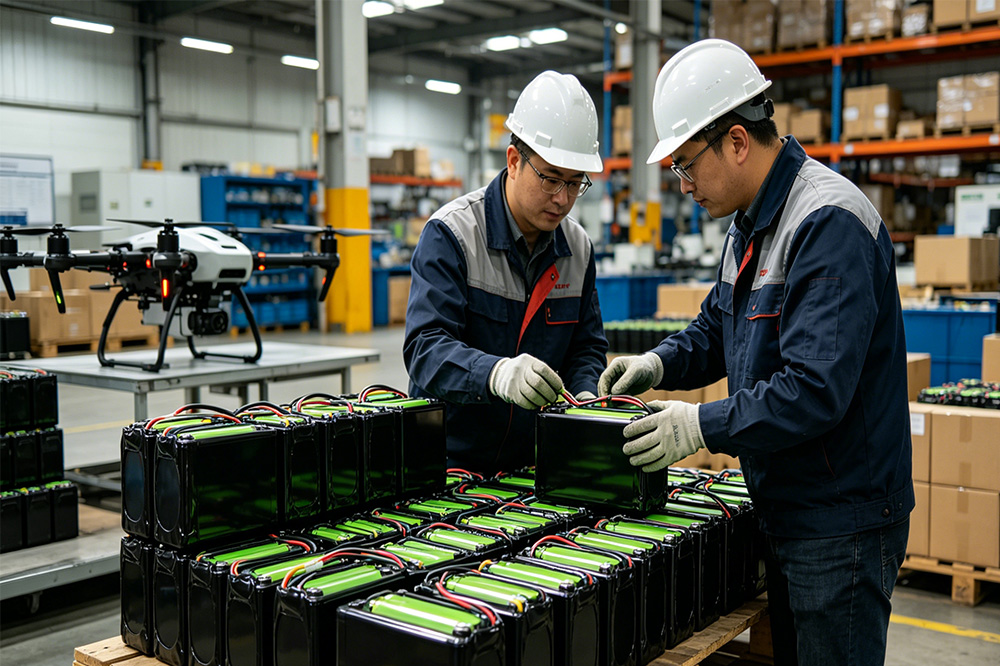
For many commercial drone companies, battery sourcing becomes more complicated as operations scale.
Buying a few batteries for testing is one thing. Ordering hundreds or thousands of high capacity drone batteries for industrial UAV projects is completely different.
At that level, buyers are no longer focused only on voltage and capacity. Supply consistency, safety compliance, production capability, and long-term reliability become far more important.
A battery problem inside a commercial drone fleet can quickly lead to delayed projects, grounded aircraft, and expensive operational downtime.
That’s why experienced UAV buyers usually spend more time evaluating suppliers than comparing marketing specifications.
Stable Cell Quality Is More Important Than Advertised Capacity
Many suppliers advertise extremely high capacity numbers. But in commercial UAV operations, consistency matters far more than theoretical maximum performance.
Even small differences between cells can create:
- Voltage imbalance
- Uneven discharge
- Heat buildup
- Reduced cycle life
- Flight instability
For industrial drone applications, stable cell matching is critical.
Professional buyers normally ask suppliers about:
- Cell grading process
- Internal resistance matching
- Capacity tolerance
- Batch consistency
- Aging test procedures
Reliable high capacity drone battery manufacturers usually maintain strict quality control standards before packs move into assembly.
Not Every High Capacity Battery Fits Industrial UAV Use
Some batteries are designed mainly for consumer drones or hobby applications.
Commercial UAV projects operate under much heavier conditions:
- Longer working hours
- Higher payloads
- Frequent charging cycles
- Outdoor environments
- Continuous daily operation
A battery that performs well in short hobby flights may fail much faster inside industrial operations.
Bulk buyers should evaluate:
- Continuous discharge performance
- Heat resistance
- Vibration tolerance
- Waterproof protection
- Structural durability
This becomes especially important for:
- Agricultural drones
- Mapping UAVs
- Delivery drones
- Inspection platforms
- Heavy-lift UAV systems

Battery Weight Directly Affects UAV Efficiency
Many new buyers focus only on increasing capacity.
However, oversized batteries can negatively affect:
- Flight efficiency
- Motor load
- UAV balance
- Payload capacity
Commercial drone manufacturers usually optimize battery systems based on the entire aircraft design.
An experienced supplier should understand:
- Airframe limitations
- Power consumption curves
- Flight duration targets
- Payload requirements
In many industrial UAV projects, achieving the best energy density matters more than simply using larger battery packs.
Ask About Real Cycle Life Data
Battery lifespan claims can sometimes be misleading.
Some suppliers advertise cycle life under ideal laboratory conditions that don’t reflect actual drone operations.
Commercial UAV buyers should ask:
- Under what discharge rate was testing performed?
- At what temperature?
- What remaining capacity defines end-of-life?
- Was the battery tested under payload conditions?
Real-world drone operations usually involve:
- High current discharge
- Rapid charging
- Outdoor temperatures
- Frequent operational stress
These factors can significantly reduce practical battery lifespan.
For fleet operators, cycle life directly affects long-term operating costs.

Smart BMS Systems Are Becoming Standard
Industrial UAV batteries are no longer simple power packs.
Many commercial drone projects now require intelligent battery systems with:
- Real-time voltage monitoring
- Temperature tracking
- Cell balancing
- Fault warnings
- Data communication
- Battery health diagnostics
Advanced BMS systems help operators reduce:
- Unexpected failures
- Battery swelling
- Overheating risks
- Maintenance downtime
Large UAV fleets especially benefit from smart battery management because battery tracking becomes easier across multiple aircraft.
Modern industrial UAV battery solutions increasingly include integrated smart communication functions for commercial fleet operations.
Certifications Matter More Than Many Buyers Expect
Battery transportation regulations continue becoming stricter worldwide.
Without proper certification documents, shipments can face:
- Customs delays
- Air freight restrictions
- Import compliance issues
- Project disruptions
Commercial UAV battery suppliers should normally provide:
- UN38.3
- MSDS
- CE
- RoHS
- Transportation safety documentation
For international distributors and OEM drone manufacturers, compliance support is often just as important as battery performance itself.
Production Capacity Should Match Future Growth
A supplier may handle small sample orders successfully but struggle with large-scale production later.
Before placing bulk orders, experienced buyers usually evaluate:
- Monthly production capacity
- Lead time stability
- Cell inventory availability
- Automated assembly capability
- Quality inspection systems
Supply chain stability became a major concern for many UAV manufacturers after recent global logistics disruptions.
Long-term commercial drone projects require battery partners capable of maintaining consistent supply over time.

Customization Is Often Necessary for Industrial UAV Projects
Many commercial UAV platforms require customized battery solutions rather than standard off-the-shelf packs.
Common OEM customization requests include:
- Custom voltage configurations
- Different connector types
- Waterproof housing
- Smart communication protocols
- Customized dimensions
- Fast-swap battery structures
Industrial UAV integrators often work closely with battery manufacturers during early aircraft development stages.
This helps optimize:
- Weight distribution
- Flight endurance
- Charging efficiency
- Aircraft balance
Cheap Pricing Can Create Expensive Problems Later
Low-cost battery offers may look attractive during procurement.
But experienced UAV buyers know that battery failure can become far more expensive than the initial purchase price difference.
Poor-quality batteries may cause:
- Fleet grounding
- Flight instability
- Early replacement
- Customer complaints
- Safety incidents
For commercial UAV operations, reliability usually matters more than achieving the absolute lowest procurement cost.

Communication and Technical Support Matter
Technical support becomes increasingly important in industrial drone projects.
Bulk buyers often need assistance with:
- Battery integration
- Connector compatibility
- Charging systems
- Flight testing
- Export logistics
- OEM modifications
Suppliers with strong engineering communication typically create fewer problems during long-term cooperation.
Fast response times and technical knowledge can save significant development time for UAV manufacturers.
Final Thoughts
Ordering high capacity drone batteries in bulk involves much more than comparing specifications on paper.
Commercial UAV buyers need to evaluate:
- Cell quality consistency
- Safety systems
- Cycle life
- Production capability
- Certification support
- OEM flexibility
- Long-term supply reliability
As industrial drone applications continue expanding worldwide, reliable battery sourcing is becoming one of the most important factors behind successful UAV operations.
For serious commercial drone projects, choosing the right battery supplier is often just as important as choosing the drone platform itself.


Leave a Reply