
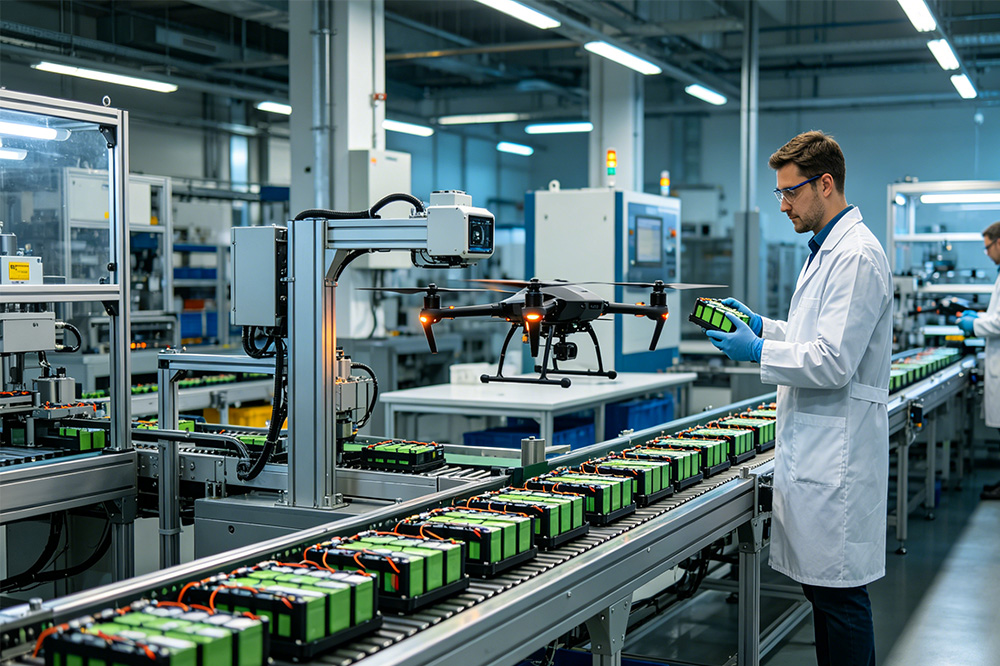
As industrial UAV applications continue expanding across agriculture, mapping, logistics, inspection, and security industries, battery sourcing has become a much bigger strategic issue for drone manufacturers.
For many UAV companies, the battery is no longer just another component. It directly affects:
- Flight endurance
- Payload stability
- Operational efficiency
- Maintenance costs
- Product reliability
And once production scales up, battery procurement becomes even more important.
A delayed battery shipment can slow down drone assembly schedules. Poor-quality cells can create field failures. Inconsistent pack performance can affect the reputation of the entire UAV platform.
That’s why industrial drone manufacturers usually treat battery suppliers as long-term strategic partners rather than simple component vendors.
Industrial UAV Batteries Require Different Standards
Consumer drone batteries and industrial UAV batteries are built for very different workloads.
Commercial UAV systems often operate:
- For extended daily flight hours
- Under heavy payload conditions
- In difficult outdoor environments
- Across large-scale fleet deployments
Because of this, industrial buyers focus heavily on:
- Stable discharge performance
- Long cycle lifespan
- Thermal reliability
- Structural durability
- Smart battery management systems
Professional high capacity UAV battery suppliers usually design battery packs specifically for industrial operating conditions instead of hobby-level applications.

Battery Cell Quality Is the Foundation
Even advanced battery designs cannot compensate for inconsistent cell quality.
For wholesale UAV battery orders, experienced buyers usually evaluate:
- Cell brand consistency
- Internal resistance matching
- Capacity tolerance
- Aging stability
- Production batch traceability
Poor cell matching can eventually lead to:
- Voltage imbalance
- Reduced endurance
- Heat generation
- Battery swelling
- Early failure
In large drone fleets, small battery inconsistencies become much more visible over time.
Reliable suppliers normally perform strict grading and matching procedures before battery assembly begins.
Energy Density Matters More Than Maximum Capacity
Many buyers initially focus only on larger Ah numbers.
But industrial UAV engineers usually pay closer attention to energy density.
Why?
Because heavier batteries also increase:
- Motor workload
- Power consumption
- Aircraft stress
- Flight instability
An oversized battery may actually reduce operational efficiency if the airframe becomes too heavy.
For commercial UAV platforms, the goal is usually to achieve the best balance between:
- Battery weight
- Flight duration
- Payload capacity
- Discharge performance
This becomes especially important for:
- VTOL UAVs
- Agricultural spraying drones
- Mapping systems
- Heavy-lift logistics drones

Understand the Difference Between Li-ion and LiPo Solutions
Different industrial drone applications require different battery chemistries.
Li-ion Batteries
Typically preferred for:
- Long endurance missions
- Mapping UAVs
- Inspection drones
- Fixed-wing systems
Advantages include:
- Higher energy density
- Longer flight time
- Better cycle life
LiPo Batteries
Commonly used for:
- Heavy-lift drones
- Agricultural UAVs
- High-thrust applications
Advantages include:
- Higher discharge rates
- Strong instant power output
- Better acceleration performance
Many modern industrial UAV projects now combine endurance-focused battery structures with higher discharge capability.
Smart Battery Systems Are Becoming Essential
Battery intelligence is becoming a major requirement in commercial UAV projects.
Modern industrial drone batteries increasingly include:
- Real-time monitoring
- Temperature tracking
- Cell balancing
- Data communication
- Fault diagnostics
- Remaining capacity estimation
These smart systems help operators improve:
- Flight safety
- Fleet management
- Maintenance scheduling
- Battery lifespan prediction
For large UAV fleets, intelligent battery management significantly reduces operational risks.
Many advanced industrial drone battery systems now integrate communication protocols that work directly with UAV flight control platforms.
Thermal Management Is Often Overlooked
High capacity drone batteries generate significant heat during:
- Fast charging
- High current discharge
- Heavy payload flights
- Hot weather operations
Without proper thermal control, batteries may experience:
- Voltage instability
- Faster degradation
- Reduced cycle life
- Safety risks
Industrial UAV manufacturers should evaluate:
- Cooling design
- Heat dissipation structure
- Temperature protection systems
- Environmental testing capability
Thermal reliability becomes especially important in agricultural and desert operating environments.
Certifications Are Critical for Global Distribution
Drone battery transportation regulations continue becoming stricter worldwide.
Wholesale buyers should confirm suppliers can provide:
- UN38.3
- MSDS
- CE
- RoHS
- Air transportation compliance documentation
Without proper certification support, international shipments may face:
- Customs delays
- Freight rejection
- Regulatory complications
Experienced battery manufacturers usually have dedicated export support teams for international UAV projects.

OEM and Customization Capability Matters
Industrial drone manufacturers rarely use fully standard battery designs.
Common customization requirements include:
- Custom voltage systems
- Specialized connectors
- Waterproof battery housings
- Smart communication integration
- Fast-swappable structures
- Lightweight casing materials
OEM battery development often starts during early UAV platform design.
Close cooperation between drone engineers and battery suppliers helps optimize:
- Aircraft balance
- Structural integration
- Flight endurance
- Charging efficiency
Strong customization capability is often one of the biggest differences between industrial battery manufacturers and consumer-level suppliers.
Production Stability Is Just as Important as Product Quality
A supplier may produce good samples while struggling with large-scale consistency.
Industrial UAV manufacturers usually investigate:
- Monthly production output
- Lead time stability
- Automation level
- Quality inspection procedures
- Cell inventory management
Battery shortages can delay entire UAV production schedules.
For growing drone manufacturers, stable long-term supply becomes a major competitive advantage.
Low Pricing Often Creates Long-Term Risk
Extremely low battery pricing usually comes with trade-offs somewhere.
Potential risks may include:
- Lower-grade cells
- Weak BMS protection
- Inconsistent assembly
- Reduced cycle life
- Poor after-sales support
Commercial UAV failures caused by battery problems can become far more expensive than the initial savings.
Most experienced industrial buyers prioritize:
- Stability
- Reliability
- Technical support
- Long-term cooperation
over simply finding the cheapest quotation.
Technical Support Can Save Development Time
Battery integration inside industrial UAV systems is rarely simple.
Manufacturers often require support with:
- Connector compatibility
- Communication protocols
- Charging systems
- Structural integration
- Flight testing
- Export logistics
Responsive engineering support helps UAV companies reduce development delays and avoid integration problems later.
Strong technical communication is often a sign of a mature industrial battery supplier.
Final Thoughts
Wholesale sourcing for high capacity drone batteries involves much more than comparing specifications and pricing.
Industrial UAV manufacturers should evaluate:
- Cell consistency
- Energy density
- Thermal reliability
- Smart battery systems
- Certification support
- OEM flexibility
- Production stability
- Technical communication
As commercial drone applications continue growing worldwide, battery reliability is becoming one of the key factors behind successful UAV platforms.
For many industrial drone manufacturers, choosing the right battery supplier is now a long-term operational decision rather than a simple purchasing task.


Leave a Reply