
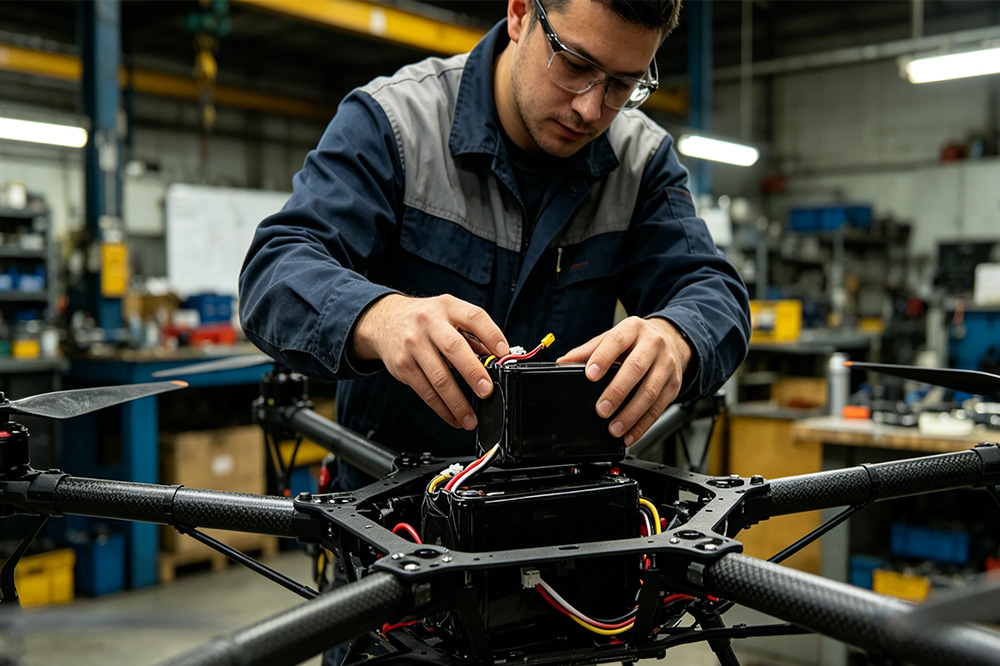
A few years ago, many commercial drone manufacturers were still using standard battery packs that could fit multiple UAV models.
That approach worked for small projects. But once drone applications started becoming more specialized, the limitations became obvious.
An agricultural spraying drone doesn’t use power the same way as a mapping UAV. A heavy-lift logistics drone behaves differently from an inspection aircraft flying long-distance routes.
Using the same battery solution for all of them usually creates compromises somewhere.
That’s one reason more industrial UAV companies are now choosing custom high capacity battery packs instead of generic batteries.
For many manufacturers, battery customization is no longer about adding “premium features.” It’s simply about making the aircraft work better in real operating conditions.
Standard Batteries Usually Force Design Compromises
A universal battery sounds convenient on paper.
But in actual UAV projects, standard battery sizes often create problems:
- The battery may be too heavy
- The shape may not fit the airframe properly
- Connectors may need modification
- Cooling performance may be limited
- Weight balance may feel off during flight
Drone engineers often end up redesigning parts of the aircraft just to adapt to a battery that was never made specifically for that platform.
With a custom battery pack, the battery is designed around the aircraft instead of the other way around.
That usually leads to a cleaner and more efficient UAV structure.

Flight Stability Improves More Than People Expect
Battery position affects drone balance much more than many new buyers realize.
If the center of gravity shifts too far forward or backward, pilots may notice:
- Less stable hovering
- Increased power consumption
- Slower response
- Flight controller compensation issues
This becomes more obvious on:
- VTOL drones
- Heavy payload UAVs
- Long-endurance aircraft
Custom battery packs allow manufacturers to adjust:
- Shape
- Thickness
- Cell arrangement
- Mounting position
Sometimes even small layout changes can noticeably improve flight behavior.
Several industrial UAV battery suppliers now work directly with drone engineers during airframe development for this reason.
Bigger Capacity Doesn’t Always Mean Better Performance
A common mistake in drone projects is assuming the largest battery automatically gives the best results.
In reality, once the battery becomes too heavy, efficiency starts dropping.
The motors work harder. Heat increases. Flight efficiency decreases.
Experienced UAV manufacturers usually focus more on energy density than simply adding more amp-hours.
The goal is finding the best balance between:
- Battery weight
- Flight time
- Payload
- Power output
That balance is different for every drone platform.
A custom battery pack makes it easier to optimize around the actual aircraft instead of trying to adapt to a standard product.
Industrial Drones Need Different Power Characteristics
Commercial UAVs often operate under much heavier workloads than consumer drones.
For example:
- Agricultural drones carry liquid payloads
- Inspection drones may fly long-distance routes
- Delivery drones need stable lift during transport
- Mapping UAVs prioritize endurance
Each application stresses the battery differently.
Some projects need:
- High discharge performance
- Fast acceleration
- Strong takeoff current
Others care more about:
- Long steady discharge
- Lower heat generation
- Longer cycle life
Custom battery systems allow manufacturers to choose the right cell combination for the job instead of relying on a general-purpose setup.

Smart Battery Systems Are Becoming Standard
Modern industrial drones rely much more on battery data than before.
Many UAV operators now want:
- Remaining flight estimation
- Battery health monitoring
- Temperature tracking
- Fault warnings
- Cycle management
That’s difficult to fully optimize with generic battery packs.
Custom systems can integrate smart BMS functions directly with the aircraft software.
Some commercial drone battery systems are now designed to communicate with flight controllers in real time, helping operators monitor battery condition during missions.
For fleet operations, this becomes especially useful.
Heat Management Matters in Real-World Flights
Battery heat is one of the biggest issues in industrial UAV operations.
Especially during:
- Summer agricultural work
- Heavy payload flights
- Fast charging
- Continuous missions
If heat builds up too quickly, battery lifespan usually drops much faster.
Custom battery packs make it easier to improve:
- Cooling structure
- Internal spacing
- Airflow design
- Heat dissipation materials
This is one area where industrial drone companies often notice a major difference between consumer-level batteries and professionally designed UAV power systems.
Harsh Environments Change Battery Requirements
Commercial drones rarely operate in perfect conditions.
They may work around:
- Dust
- Moisture
- Mud
- Chemicals
- High vibration
Agricultural UAV operators especially run into these issues constantly.
A custom battery housing can improve protection through:
- Waterproof sealing
- Reinforced casing
- Dust resistance
- Shock protection
Over time, these details help reduce maintenance problems and battery failures in the field.

Faster Battery Swaps Improve Daily Efficiency
Large drone operations usually care a lot about turnaround time.
When batteries are difficult to replace, operators lose working hours every day.
Custom battery systems can include:
- Quick-release structures
- Slide-in battery rails
- Locking systems
- Smart docking interfaces
For agricultural spraying or inspection work, even saving a few minutes per battery swap adds up over time.
That’s one reason fast-swappable battery systems are becoming common in commercial UAV fleets.
OEM Companies Want More Control Over Their Ecosystem
Some drone manufacturers also prefer custom batteries because they want tighter control over the overall product experience.
A custom battery system allows them to:
- Standardize connectors
- Integrate proprietary communication
- Match the aircraft design
- Improve branding consistency
Instead of depending completely on universal third-party batteries, they build a more complete UAV ecosystem around their own platform.
Long-Term Reliability Usually Gets Better
One thing many drone manufacturers notice after switching to custom battery systems is fewer operational problems later.
Because the battery is designed specifically for the aircraft:
- Stress on components is lower
- Balance improves
- Cooling works better
- Electrical matching becomes more stable
That usually means:
- Fewer battery failures
- More consistent flight performance
- Lower maintenance costs
- Better long-term reliability
For industrial drone companies running large fleets, those differences matter much more than small upfront price savings.
Final Thoughts
Industrial drone companies are moving toward custom high capacity battery packs because commercial UAV operations have become far more specialized than before.
Generic batteries may still work for smaller projects, but larger commercial platforms usually benefit from systems designed around the aircraft itself.
Custom battery solutions help improve:
- Flight stability
- Endurance
- Thermal performance
- Maintenance efficiency
- Long-term operational reliability
And as industrial UAV applications continue expanding, battery design is becoming a much bigger part of overall drone performance than many people expected a few years ago.


Leave a Reply