
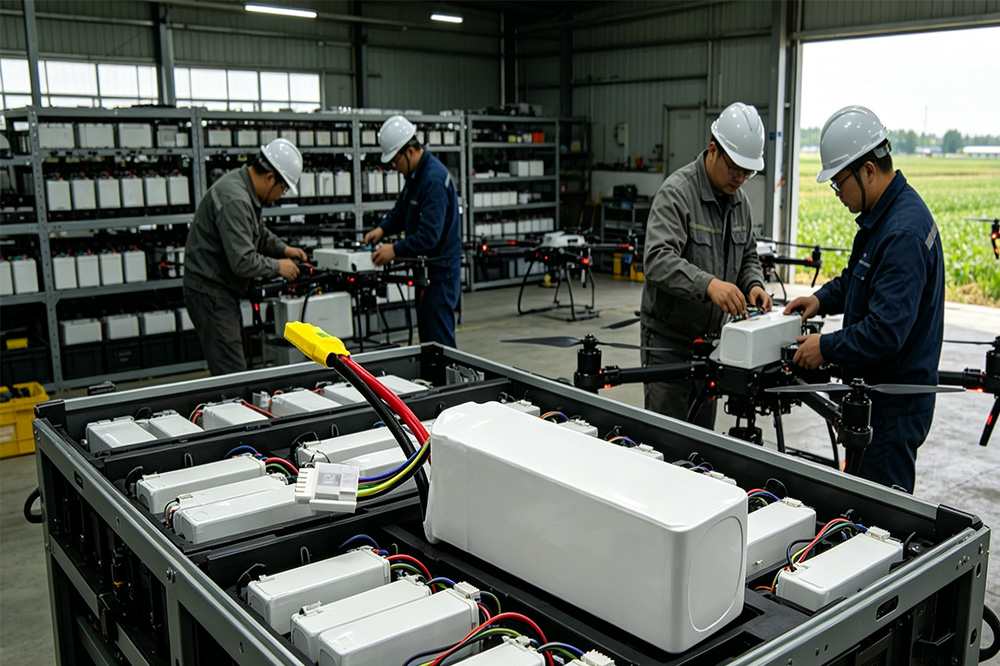
For commercial drone operations, flight time is only part of the equation.
What really affects efficiency is how quickly drones can return to work after landing.
A drone sitting on the ground waiting for batteries, charging, or maintenance is costing time and money — especially in industries like:
- Agricultural spraying
- Infrastructure inspection
- Security patrol
- Mapping
- Logistics delivery
As UAV fleets grow larger, battery management becomes one of the biggest factors affecting daily productivity.
That’s why more industrial drone operators are investing in high capacity battery systems designed not only for longer flight time, but also for reducing operational downtime.
Downtime Usually Starts with Battery Logistics
Many UAV companies initially focus only on aircraft performance.
But once operations scale up, battery logistics often becomes the real bottleneck.
Common problems include:
- Batteries charging too slowly
- Insufficient spare packs
- Unorganized charging workflow
- Inconsistent battery health
- Long replacement time in the field
In some drone operations, the aircraft itself performs well, but battery handling slows the entire workflow down.
That’s why experienced operators treat batteries as part of the operational system rather than just power accessories.

Longer Flight Time Reduces Operational Interruptions
The most obvious advantage of high capacity drone batteries is fewer landing cycles.
Longer endurance means:
- Fewer battery swaps
- Less charging interruption
- Reduced operator workload
- More continuous coverage
This becomes especially valuable in:
- Large farmland spraying
- Long-distance inspection routes
- Mapping missions
- Coastal or offshore operations
Several industrial UAV battery systems are now designed specifically for long-duration commercial flights where minimizing interruption is more important than peak speed.
Fast Swappable Battery Systems Save More Time Than Expected
Battery replacement time adds up quickly during daily operations.
Even small delays become significant across:
- Multiple drones
- Long workdays
- Large operating areas
Industrial UAV companies increasingly prefer battery systems with:
- Quick-release structures
- Slide-in battery rails
- Tool-free replacement
- Locking safety systems
Fast-swappable batteries are now common in:
- Agricultural drone fleets
- Security UAV patrol systems
- Inspection operations
In field conditions, reducing battery replacement from several minutes to a few seconds can noticeably improve productivity over time.

Smart Charging Stations Improve Fleet Efficiency
Charging becomes much more complicated once UAV fleets expand.
Without organized charging management, operators often face:
- Battery queue delays
- Uneven charging cycles
- Overheating during charging
- Poor battery rotation
Modern commercial drone operations increasingly use:
- Multi-battery charging stations
- Intelligent charging cabinets
- Automated battery balancing
- Smart charging management systems
These systems help operators:
- Track battery condition
- Balance charging schedules
- Reduce charging bottlenecks
- Improve battery lifespan
For large UAV deployments, charging infrastructure becomes almost as important as the drones themselves.
Battery Health Monitoring Prevents Unexpected Delays
Battery problems rarely appear without warning.
In many cases, batteries show early signs first:
- Rising internal resistance
- Faster voltage drop
- Higher operating temperature
- Reduced discharge stability
Without monitoring systems, operators may not notice issues until flight performance becomes unstable.
Modern smart UAV battery solutions increasingly include:
- Real-time health diagnostics
- Temperature tracking
- Cycle count monitoring
- Remaining lifespan estimation
This helps fleet managers identify weak batteries before they create operational downtime.
Consistent Battery Performance Improves Scheduling
One overlooked problem in UAV fleets is inconsistent battery behavior.
If some batteries deliver:
- Shorter flight times
- Unstable voltage
- Slower charging
operators lose efficiency trying to adjust flight schedules around unpredictable performance.
High-quality industrial battery systems usually focus heavily on:
- Cell consistency
- Stable discharge curves
- Balanced charging performance
This helps commercial UAV operators create more reliable flight planning and workflow scheduling.

Fast Charging Can Increase Daily Flight Cycles
For operations running multiple flights per day, charging speed becomes critical.
Agricultural drone operators especially rely heavily on:
- Rapid charging
- Continuous battery rotation
- Portable charging systems
Faster charging allows:
- More daily flights
- Reduced idle time
- Smaller backup battery inventory
However, fast charging also creates additional heat and battery stress.
That’s why industrial battery systems usually require:
- Advanced thermal management
- Smart charging protection
- Stable cooling structure
Cheap battery packs often degrade quickly under repeated fast charging conditions.
Thermal Stability Helps Reduce Maintenance Downtime
Heat is one of the biggest causes of unexpected battery issues in commercial UAV operations.
Industrial drones often operate:
- In direct sunlight
- Under heavy payload
- During long missions
- In high-temperature environments
Poor thermal control may lead to:
- Battery swelling
- Voltage instability
- Reduced lifespan
- Charging failure
Commercial UAV battery systems with stronger cooling and heat dissipation typically maintain more stable long-term performance.
This becomes especially important during peak agricultural spraying seasons where drones operate continuously for hours.
Better Battery Planning Reduces Spare Inventory Costs
Some operators try to reduce downtime simply by buying large numbers of spare batteries.
But that approach increases:
- Storage requirements
- Charging workload
- Inventory costs
- Battery aging during storage
More efficient battery systems help reduce the number of backup packs needed for daily operation.
Many commercial drone companies now focus more on:
- Battery efficiency
- Charging workflow
- Battery rotation strategy
instead of simply increasing battery quantity.
Battery Integration with Fleet Management Software
Large drone operations increasingly integrate battery systems directly into fleet management platforms.
This allows operators to monitor:
- Battery assignment
- Flight history
- Charging cycles
- Maintenance schedules
- Health condition
For industrial UAV fleets, centralized battery tracking improves:
- Operational planning
- Safety management
- Maintenance efficiency
Several advanced commercial drone battery platforms now support communication protocols designed for fleet-level management.
Reliability Matters More Than Maximum Specifications
In commercial drone operations, stable performance usually matters more than extreme specifications.
A battery system that delivers:
- Predictable flight time
- Stable charging
- Reliable cycle life
often creates better operational efficiency than batteries focused only on maximum capacity numbers.
Downtime reduction is usually achieved through:
- Better system integration
- Stable battery quality
- Faster workflow
- Smarter battery management
rather than simply increasing battery size.
Final Thoughts
As industrial UAV operations continue expanding, battery systems are becoming a major factor in operational efficiency.
Reducing drone downtime involves much more than extending flight time.
Commercial UAV operators now focus heavily on:
- Fast battery replacement
- Smart charging systems
- Battery health monitoring
- Thermal reliability
- Charging workflow optimization
- Fleet-level battery management
For large-scale drone deployments, efficient battery systems can significantly improve productivity, reduce maintenance interruptions, and lower long-term operating costs.


Leave a Reply