
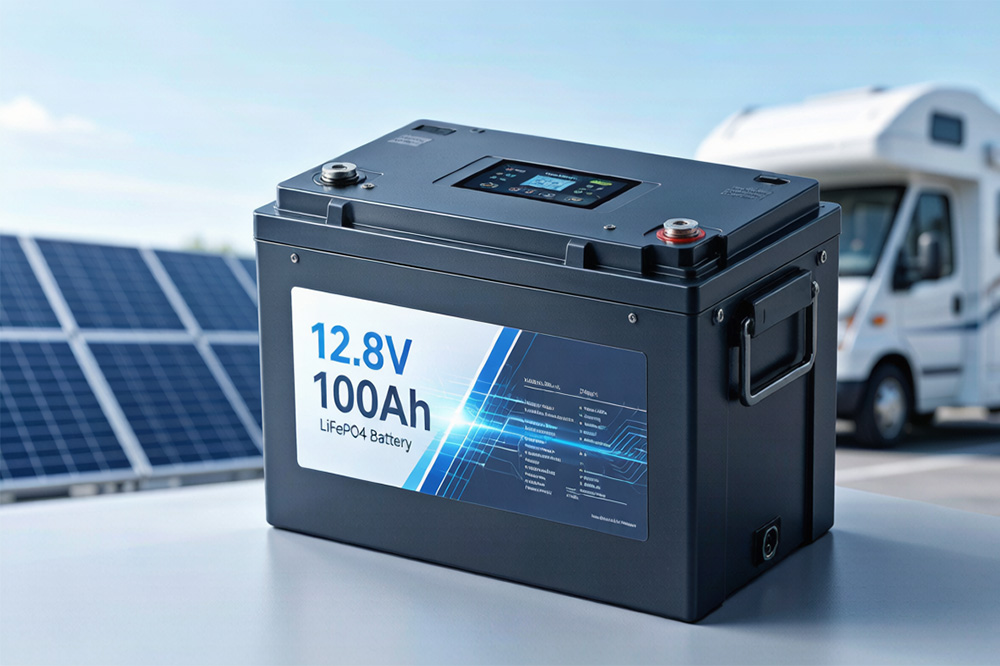
A few years ago, if you walked through an RV campground or a small off-grid solar setup, chances are you would see bulky lead-acid batteries sitting in a battery box.
Today, that’s changing fast.
More RV owners, boat users, and solar enthusiasts are replacing lead-acid batteries with 12V 100Ah LiFePO4 batteries. The reason isn’t complicated. People want longer run times, less maintenance, and batteries that don’t need replacing every couple of years.
Among all lithium battery sizes, the 12V 100Ah model has probably become the most common option on the market. It’s large enough for most everyday power needs while still being easy to transport and install.
But not all 100Ah batteries are built the same. One of the biggest differences is what’s happening inside the battery case—specifically the Battery Management System, better known as the BMS.

So What Does a BMS Actually Do?
Many buyers focus on capacity and cycle life. Those things matter, but the BMS is often what determines whether a battery performs reliably over the long term.
Think of it as the battery’s safety manager.
If charging voltage becomes too high, the BMS steps in. If discharge current exceeds safe limits, it reacts. Some systems can also monitor temperature and stop charging when conditions become unsafe.
Without a properly designed BMS, even high-quality lithium cells can be damaged over time.
That’s why experienced installers usually ask about the BMS specifications before asking about anything else.
How Much Power Does a 12V 100Ah Battery Actually Provide?
On paper, a 12V 100Ah LiFePO4 battery stores roughly 1.28kWh of energy.
Numbers are useful, but most people want to know what that means in real life.
A fully charged battery may be able to:
- Run a 12V compressor refrigerator for an extended period
- Power LED lighting for several nights
- Support small appliances through an inverter
- Serve as backup energy for communication equipment
- Store excess solar energy during the day
Actual runtime depends on load size, temperature, inverter efficiency, and discharge depth, but for many RV and off-grid users, 100Ah hits a practical sweet spot between size and usable capacity.

Why Are So Many People Switching from Lead-Acid?
The weight difference is usually the first thing people notice.
A traditional 100Ah lead-acid battery can weigh well over 60 pounds.
Many LiFePO4 alternatives come in around half that weight.
The second advantage is usable capacity.
Lead-acid batteries generally perform best when they are not discharged too deeply. Lithium iron phosphate batteries can safely use a much larger percentage of their stored energy without significantly affecting lifespan.
For users who rely on stored power every day, that extra usable energy makes a noticeable difference.
Can a Cheap 12V 100Ah Battery Be Trusted?
This question comes up regularly in solar forums and battery communities.
The answer depends less on the advertised capacity and more on what components are inside.
Two batteries can both claim to be 12V 100Ah, yet have very different internal cell quality, BMS protection levels, and manufacturing standards.
Before placing a bulk order, wholesalers often ask suppliers about:
- Cell grade
- Continuous discharge rating
- Low-temperature protection
- Certification status
- Warranty terms
- Series and parallel expansion support
A battery may look identical from the outside, but the internal design often determines long-term reliability.
Low-Temperature Protection Is Becoming a Must-Have Feature
One feature that has received increasing attention in recent years is low-temperature charging protection.
Lithium batteries generally don’t like being charged below freezing temperatures.
To address this issue, many modern battery packs now include temperature sensors that automatically pause charging when conditions become too cold.
For users in North America and Northern Europe, this feature can be more important than extra capacity.

What Wholesale Buyers Should Really Focus On
When sourcing 12V 100Ah LiFePO4 batteries, price is only one part of the equation.
A battery that costs slightly less upfront can end up creating far higher costs if warranty claims start appearing six months later.
Experienced distributors usually evaluate suppliers based on:
- Cell consistency
- BMS quality
- Manufacturing process
- Certification support
- Custom branding options
- Technical service capability
- Long-term production stability
Those factors often matter far more than a small difference in unit price.
Final Thoughts
The popularity of the 12V 100Ah LiFePO4 battery isn’t driven by marketing hype. It comes from practical advantages that users can see immediately—lighter weight, longer lifespan, more usable energy, and minimal maintenance.
Whether the application is solar storage, RV power, marine systems, or backup energy, a properly designed battery pack with a reliable BMS can provide years of dependable service.
For importers, distributors, and OEM brands, finding a manufacturer that focuses on cell quality and battery management is usually a better long-term strategy than simply chasing the lowest quote.


Leave a Reply