
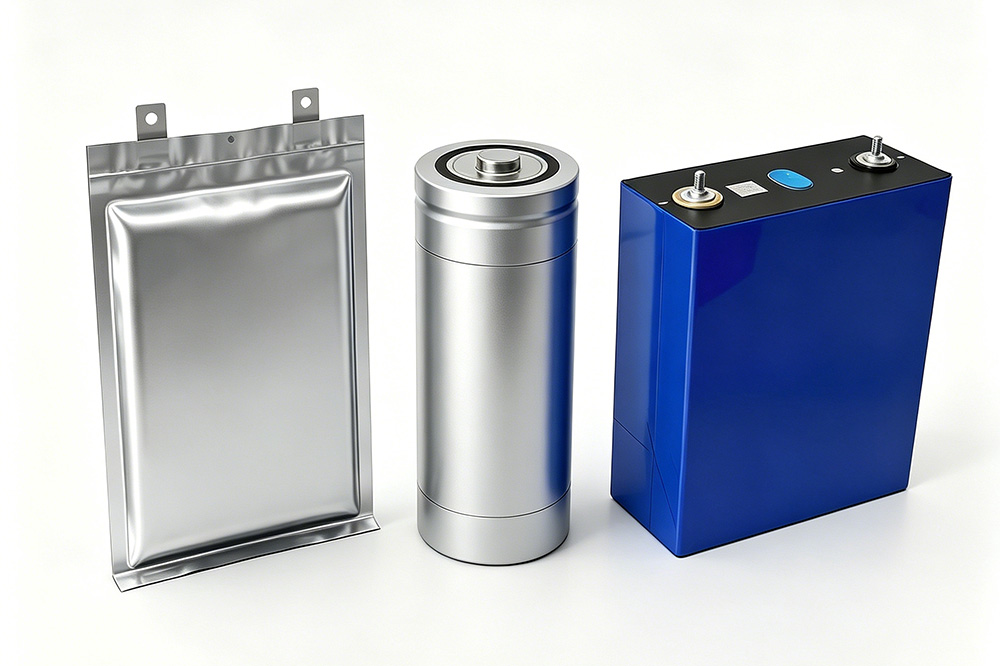
A few years ago, I opened an old drone battery that had swollen after sitting unused in a drawer. Inside wasn’t a metal cylinder like an 18650. It was a thin silver packet, almost like a sealed food pouch. That’s the form many engineers now choose when every gram and every millimeter matter.
The interesting part is that a pouch cell isn’t a different battery chemistry. It’s a packaging format. Depending on the design, it may contain various lithium-ion chemistries while using a laminated aluminum-plastic film instead of a rigid metal case. This simple change affects weight, space efficiency, cooling, manufacturing, and even product design.
For companies sourcing batteries in volume, understanding pouch cells is often more important than memorizing capacity numbers.
It isn’t just “flat.” The packaging changes everything.
Traditional cylindrical cells have a steel shell. Prismatic cells use a rigid enclosure. A li ion battery pouch replaces both with flexible laminated material and welded tabs.
That sounds like a small engineering decision, but in practice it means more of the battery volume can be active material instead of housing. Industry references often cite packaging efficiency approaching 90–95%, one reason pouch cells became common in smartphones and other compact electronics.
I’ve seen product designers gain several extra millimeters of internal space simply by switching formats. Sometimes that extra room becomes a larger battery. Other times it allows a thinner product profile.
Where pouch cells quietly dominate
Consumers may not realize it, but pouch cells appear in many products they use every day.
- Smartphones and tablets
- Wearable electronics
- Consumer drones
- Portable medical equipment
- Robotics platforms
- Some electric vehicle battery modules
- Industrial handheld terminals
- Lightweight energy storage systems
In these products, designers often value shape flexibility more than standardized dimensions.

The biggest advantage isn’t capacity
People often assume pouch cells are chosen because they hold more energy.
Not exactly.
The real attraction is design freedom.
Without a heavy metal enclosure, manufacturers can customize width, thickness, and footprint to fit available space. Imagine building a slim handheld scanner or an unusually shaped robot controller. Standard cylindrical cells might waste internal volume, while a custom pouch can use almost every corner.
That flexibility can reduce overall product weight too.
But there is a catch nobody likes talking about
Flexible packaging has downsides.
If internal gases develop through aging or abuse, the cell may visibly expand. Anyone who has seen a swollen phone battery has already encountered this behavior.
Mechanical support becomes critical because the pouch itself contributes little structural strength. Battery packs usually require compression or dedicated housing to help maintain stability during service life. Improper support can accelerate degradation or create reliability problems.
One purchasing manager once mentioned that the battery itself wasn’t causing failures—the enclosure design was.
That observation probably deserves more attention than another debate over nominal voltage.
Pouch vs cylindrical vs prismatic: looking beyond the marketing
A lot of comparison charts oversimplify the story.
Cylindrical cells are generally appreciated for mechanical robustness and mature automated production.
Prismatic cells can simplify module assembly by using rigid rectangular housings.
Pouch cells tend to maximize packaging efficiency and enable custom dimensions, but they demand careful mechanical integration and thermal management.
There’s no universal winner. The better format depends on whether the priority is manufacturing cost, available space, structural durability, or weight reduction.

Can you replace a pouch battery with a cylindrical one?
This question appears surprisingly often.
Technically, matching voltage alone isn’t enough.
Even if chemistry and nominal voltage are compatible, differences in dimensions, current capability, charging parameters, battery management electronics, thermal behavior, and physical mounting may make substitution unsafe or impractical. Engineers generally evaluate the entire battery system rather than the cell shape in isolation.
In repair work, replacing a pouch cell with a cylindrical equivalent usually requires redesign rather than a simple swap.
What bulk buyers should check before requesting quotations
Capacity gets attention, but experienced sourcing teams often start elsewhere.
First comes available installation space. If the battery bay is fixed, dimensions may matter more than a few hundred milliamp-hours.
Then comes discharge profile. A warehouse scanner used intermittently has different requirements from a drone motor pulling heavy bursts of current.
Cycle life expectations also deserve discussion early in the project. Some applications prioritize long calendar life while others simply need maximum runtime over a limited service period.
Finally, certification, connector type, wire length, protection circuits, and customization options can affect production timelines more than battery chemistry itself.
A small observation from manufacturing projects
Factories sometimes assume custom pouch batteries will automatically increase costs.
Sometimes they do.
But I’ve also seen cases where redesigning the enclosure around a pouch cell eliminated brackets, reduced material usage, and simplified assembly enough to offset battery customization expenses.
The cheapest component is not always the lowest-cost system.
What Is Pouch Lithium Ion Battery and Why Are Manufacturers Choosing It?
A pouch lithium ion battery is a rechargeable lithium battery that uses a flexible aluminum-plastic film package instead of a traditional metal casing. Unlike cylindrical cells such as 18650 or 21700 batteries, pouch lithium ion batteries do not rely on a rigid steel shell. This design allows battery manufacturers to create thinner, lighter, and more flexible battery solutions for products where internal space is limited.
For OEM product developers, the biggest advantage of a pouch lithium ion battery is not simply the capacity. The key benefit is the freedom to customize the battery shape, thickness, and size according to the product structure.
For example, a handheld medical device may require a very thin battery that fits behind a display, while a drone manufacturer may need a lightweight battery pack with a special shape to balance the aircraft. In these situations, a standard cylindrical battery may leave unused space, while a customized pouch lithium ion battery can better match the available installation area.
Why Pouch Lithium Ion Battery Is Popular for Custom Battery Packs
Compared with traditional cylindrical lithium batteries, pouch lithium ion batteries provide several advantages for customized applications:
Higher Space Utilization
The flexible packaging design reduces the amount of non-active material inside the battery. More of the internal volume can be used for energy storage, helping manufacturers achieve better energy density and smaller product designs.
Lightweight Design
Without a heavy metal casing, pouch lithium ion batteries are lighter than many traditional battery formats with similar capacity. This makes them suitable for portable electronics, drones, wearable devices, and other weight-sensitive products.
Flexible OEM Customization
One of the main reasons companies choose pouch lithium ion batteries is customization. Battery suppliers can adjust:
- Battery dimensions
- Thickness
- Capacity
- Voltage configuration
- Connector type
- Protection circuit design
- Cable length
This flexibility helps product manufacturers avoid redesigning their devices around standard battery sizes.
Applications of Pouch Lithium Ion Battery
Today, pouch lithium ion batteries are widely used in products that require compact size and customized battery structures, including:
- Consumer electronics
- Smart wearable devices
- GPS trackers
- Drones and UAV equipment
- Medical devices
- Industrial handheld equipment
- Portable testing instruments
- Custom lithium battery packs
For businesses developing new electronic products, selecting the right pouch lithium ion battery supplier at the early design stage can reduce later modification costs and improve production efficiency.

Choosing the right li ion battery pouch supplier
If you’re purchasing for OEM or private-label production, ask questions that go beyond the data sheet.
- Can dimensions be customized?
- Is the battery available with integrated protection electronics?
- What cycle-life testing has been performed?
- Are samples available before mass production?
- Can connector types and cable lengths be modified?
- Does the supplier support low-volume prototyping before scaling to large orders?
These conversations often reveal far more than advertised specifications.
Frequently Asked Questions
Are pouch batteries lithium polymer?
The terminology can be confusing. Many products marketed as “LiPo” are lithium-ion cells packaged in pouch form. The word often describes the construction rather than a fundamentally different battery category.
Do pouch cells last as long as cylindrical cells?
Not necessarily longer or shorter. Service life depends on chemistry, operating conditions, charging behavior, thermal control, and mechanical support.
Why do pouch batteries swell?
Gas generation inside aging or stressed cells can cause visible expansion because the flexible package lacks a rigid metal enclosure.
Are pouch batteries safe?
When designed with appropriate battery management systems, thermal protection, and mechanical support, they are widely used across consumer and industrial products. Like all lithium-ion batteries, they require proper charging and handling.
Final thought
The conversation around pouch batteries often focuses on whether they are “better” than cylindrical or prismatic cells. In reality, engineers rarely frame the decision that way.
The more practical question is whether the battery helps the final product use space efficiently, meet weight targets, survive daily operation, and stay manufacturable at scale. In many projects, that answer turns out to be yes. In others, a different cell format simply makes more sense.
-

11.1V 3S 850mAh li-ion Polymer Pouch Cell Battery Pack
-

134365 4500mAh 3.7V Rechargeable Lithium Polymer Battery
-

3.7V 1200mAh Li-Polymer Pouch Cell Battery
-

3.7V 15Ah 148198 Pouch Lithium Ion Battery
-

3.7V 1S2P 3000mah lithium Polymer Battery
-

3.7V 2000mAh Pouch Cell Battery
-

3.7V 502248 500mAh Lithium Ion Polymer Battery
-

3.7V 700mAh Li-Polymer Pouch Cell Battery
-

3.7V 800mAh Rechargeable Pouch Li-Polymer Battery
Leave a Reply