
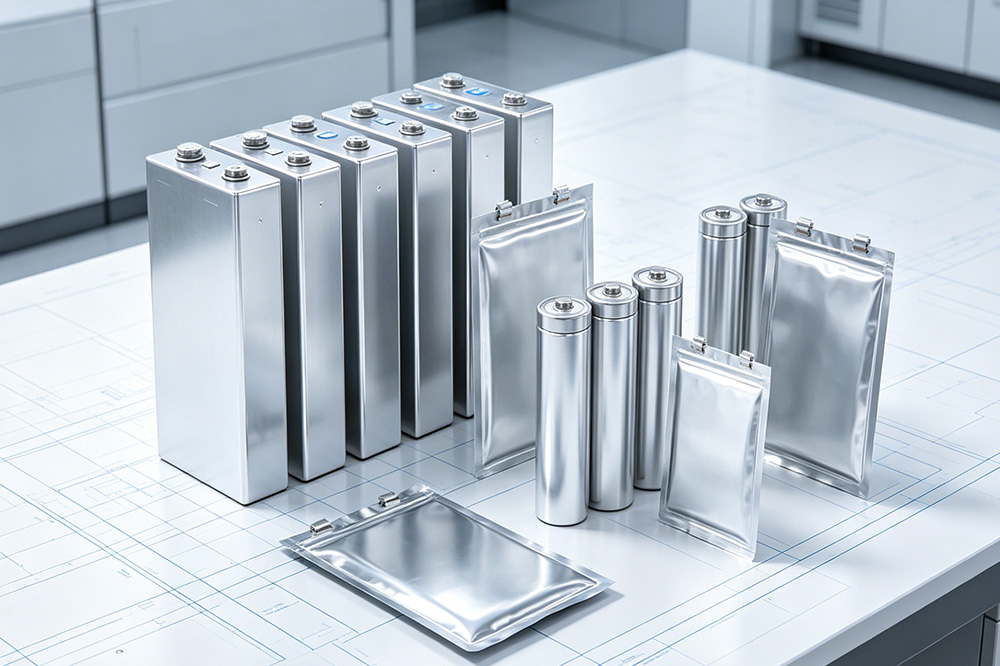
Most people shopping for batteries pay attention to capacity or voltage. Engineers tend to notice something else first: the shape.
That sounds trivial until you’ve tried fitting hundreds of cells into a battery pack with almost no room to spare. At that point, whether the cells are round or rectangular starts affecting everything from wiring to cooling to manufacturing costs.
Prismatic cells exist for exactly that reason. They’re designed to use space more efficiently, but that doesn’t automatically make them the best option in every project. I’ve seen applications where cylindrical cells were the smarter choice, and others where a prismatic design made the entire system cleaner and easier to build.
They look simple, but there’s more going on inside
A prismatic cell is essentially a lithium battery packaged in a rigid rectangular case, usually aluminum or steel. Inside, the active materials are arranged in stacked or rolled layers before the housing is sealed.
The outside doesn’t seem remarkable until several dozen are lined up together. Instead of leaving gaps like round cells do, they sit almost flush against one another. If you’re designing a battery cabinet or an EV pack, those saved millimeters add up surprisingly fast.
Someone once compared it to loading moving boxes instead of basketballs into a truck. The analogy isn’t perfect, but it’s close enough.
Why manufacturers keep coming back to this design
The obvious answer is space efficiency, yet that’s only part of the story.
Using larger rectangular cells often means fewer total cells are required. Fewer cells can reduce weld points, connectors, monitoring circuits, and assembly time. It also simplifies maintenance in some systems because technicians aren’t dealing with thousands of tiny components.
Of course, there’s another side to that equation. When one large-capacity cell develops a problem, it represents a much bigger percentage of the total battery pack.
Engineers know this trade-off well, which is why battery management systems and quality control become especially important.
Comparing prismatic cells with other formats isn’t as straightforward as people think
Online discussions often turn into arguments about which cell type is “best.” In reality, that’s the wrong question.

Round cylindrical cells have decades of manufacturing history behind them and are extremely robust. Pouch cells can offer excellent packaging flexibility and low weight. Prismatic cells strike a different balance by emphasizing efficient use of internal volume and relatively clean module layouts.Comparing Prismatic, Cylindrical, and Pouch Cells
| Feature | Prismatic Cells | Cylindrical Cells | Pouch Cells |
|---|---|---|---|
| Shape | Rectangular rigid case | Round metal can | Flexible laminated pouch |
| Space efficiency | High | Moderate | Very high |
| Mechanical strength | Strong | Very strong | Lower without external support |
| Typical pack complexity | Lower | Higher | Moderate |
| Cooling considerations | Requires careful thermal design | Often easier to cool individually | Depends heavily on module design |
| Manufacturing maturity | Mature | Highly mature | Mature but handling differs |
| Capacity per cell | Often large | Usually smaller | Varies widely |
If your product is a power tool, your priorities won’t match someone designing a home energy storage cabinet. That’s why different industries continue to use all three formats.
One interesting trend in LiFePO₄ batteries
Over the last several years, many solar installers and off-grid builders have gravitated toward prismatic LiFePO₄ cells.
Walk through online DIY communities and you’ll notice a recurring theme: people appreciate being able to build 12V, 24V, or 48V battery banks using a relatively small number of high-capacity cells instead of assembling massive arrays from hundreds of smaller ones.
That doesn’t mean assembly becomes foolproof. Proper balancing, compression, battery management, and safe installation practices still matter.
A conversation with an equipment designer changed my perspective
A purchasing manager once explained that his team wasn’t choosing prismatic cells because they loved the format.
They chose them because the enclosure dimensions were fixed months before the battery supplier was selected.
Once the available space was locked in, rectangular cells simply made the packaging work without redesigning the product.
It’s an easy detail to overlook. Many battery decisions begin with mechanical constraints rather than chemistry charts.
Where prismatic cells fit naturally
You tend to see them in places where organized packaging matters:
- Residential energy storage systems mounted on walls or in utility rooms.
- Commercial battery cabinets where maintenance access is important.
- Electric vehicles seeking efficient module layouts.
- Marine and RV battery banks with limited installation space.
- Telecom backup systems expected to operate reliably for years.
- Industrial automation equipment requiring compact energy storage.
Not every project needs them, but they appear more often as battery capacities increase.
The disadvantages deserve equal attention
Marketing material sometimes implies rectangular cells solve every engineering problem.
They don’t.
Because of their larger physical size, thermal management requires thoughtful design. Heat doesn’t magically disappear just because the case is rectangular.
Long-term dimensional changes, sometimes described as swelling under certain operating conditions, may also need to be addressed through mechanical support or compression structures depending on the application.
And while reducing cell count can simplify assembly, replacing a failed high-capacity cell isn’t necessarily inexpensive.
Ignoring these realities usually creates bigger headaches later.

Buying wholesale? Ask different questions
Many procurement teams start with unit pricing.
Experienced buyers often start somewhere else.
They ask about production consistency, batch matching, testing procedures, transportation certifications, customization capability, and long-term supply stability.
A battery that is a few dollars cheaper may end up costing much more if performance varies significantly across shipments.
That’s particularly true for OEM projects where repeatability matters as much as headline specifications.
It’s easy to focus on the cell and forget the system
A well-designed battery pack depends on much more than whether the cells are prismatic, cylindrical, or pouch.
Cooling strategy, busbar design, firmware, battery management algorithms, enclosure structure, manufacturing tolerances, and quality inspection all influence final performance.
Sometimes changing the cell format improves the product. Other times it simply shifts complexity somewhere else.
That’s probably why experienced engineers spend less time arguing over shapes and more time discussing the application itself.
For companies sourcing batteries in volume, the conversation should start with how the pack will actually be used. Once those requirements are clear, choosing the right cell format becomes far easier than chasing whichever design happens to be trending that year.
Common Questions
Are prismatic cells safer than cylindrical cells?
Safety depends on chemistry, manufacturing quality, battery management systems, and operating conditions. Cell shape alone does not determine safety.
Do prismatic cells last longer?
Cycle life varies primarily by chemistry and usage profile. Many LiFePO₄ prismatic cells are designed for long service life under appropriate operating conditions.
Are prismatic cells more expensive?
They can be, but total system cost may be offset by reduced assembly complexity and fewer supporting components.
Can prismatic cells be used for DIY battery packs?
Many hobbyists and professionals build battery packs using prismatic cells, particularly for solar and RV projects. Proper electrical design, mechanical support, balancing, and battery management remain essential.
Why are EV manufacturers interested in prismatic cells?
The rectangular format can improve packaging efficiency and reduce the number of cells needed in large battery packs, though different manufacturers choose different formats based on their own engineering priorities.


Leave a Reply