
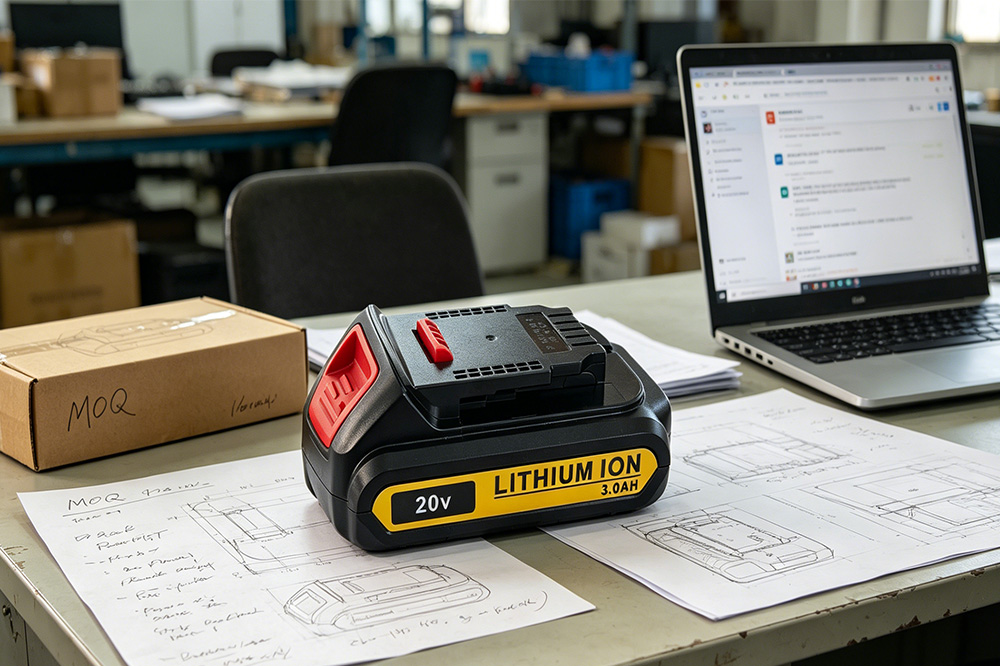
If you’ve ever tried sourcing 20V drill batteries in bulk, you probably already know this — the first quote is never the real story.
It looks simple at the beginning. You ask for price, capacity, maybe MOQ. You get a clean answer back.
But in most real cases, that number shifts later. Sometimes slightly. Sometimes more than expected.
And it’s not always because someone is trying to change the deal — it’s usually because the details weren’t fully aligned from the start.
MOQ is never just a number
People often focus on MOQ like it’s a fixed rule.
But in practice, MOQ is more like a negotiation boundary than a strict line.
One factory might say 300 units. Another says 500. But what they don’t always explain clearly is what changes behind that number:
- cell grade selection
- casing customization level
- label or branding complexity
- BMS configuration stability
A buyer once told me he thought MOQ was just “how many boxes I need to order”.
Later he realized it was actually “how much production complexity you are willing to introduce at the start”.
That misunderstanding is more common than people think.
The real cost difference is not always in the cell
At first glance, everyone compares cell type:
18650 vs 21700.
But experienced buyers usually stop focusing only on that after a while.
Because the cost differences often come from less visible parts:
- consistency of cell sourcing batch
- welding method stability
- BMS protection design (some are overbuilt, some are too minimal)
- testing time per batch
Two suppliers can quote almost the same price, but behave very differently when production scales.
That’s where surprises usually show up — not in the quotation stage, but in the repeat order stage.

OEM customization sounds simple… until you actually do it
Most suppliers say they support OEM.
And technically, that’s true.
But OEM in 20V drill batteries can mean very different things depending on expectations:
- just logo printing
- full casing redesign
- connector adjustment for compatibility
- packaging for retail vs industrial use
The problem is not capability — it’s alignment.
A buyer might think they are ordering a “simple logo change”, while the factory is already planning a new mold discussion internally.
That gap is where delays usually come from.
A small detail that affects long-term supply stability
This is something that doesn’t show up in most product pages.
Battery sourcing is not only about performance — it’s about repeatability.
Some buyers care more about:
- can I reorder the same model 6 months later?
- will the casing still match my existing stock?
- will the cell availability change without notice?
One distributor explained it in a very practical way:
“I don’t want the best battery. I want the same battery again.”
That sounds simple, but it’s actually one of the hardest things to guarantee in OEM production.

Example reference model (commonly used in OEM projects)
A typical configuration used in mid-range power tool programs:20V 18650 3.0Ah cordless drill battery
It usually sits in the “safe OEM zone”:
not aggressive on cost, but stable enough for repeat production and retail positioning.
Where deals usually become real
If you talk to enough buyers in this space, you start noticing a pattern.
Deals rarely close on:
- spec sheets
- single price quotes
They close after small confirmations like:
- sample consistency
- communication speed
- how issues are handled (even small ones)
- whether answers feel stable over time
It’s not always about being perfect. It’s more about being predictable.
And in battery sourcing, predictability is often more valuable than a slightly lower price.
Final thought
20V drill battery OEM sourcing looks straightforward from the outside.
But once you get into real orders, it becomes less about “battery specs” and more about “production behavior over time”.
That’s probably why experienced buyers don’t switch suppliers easily — not because they are loyal, but because switching usually costs more than it seems at first.
Leave a Reply