
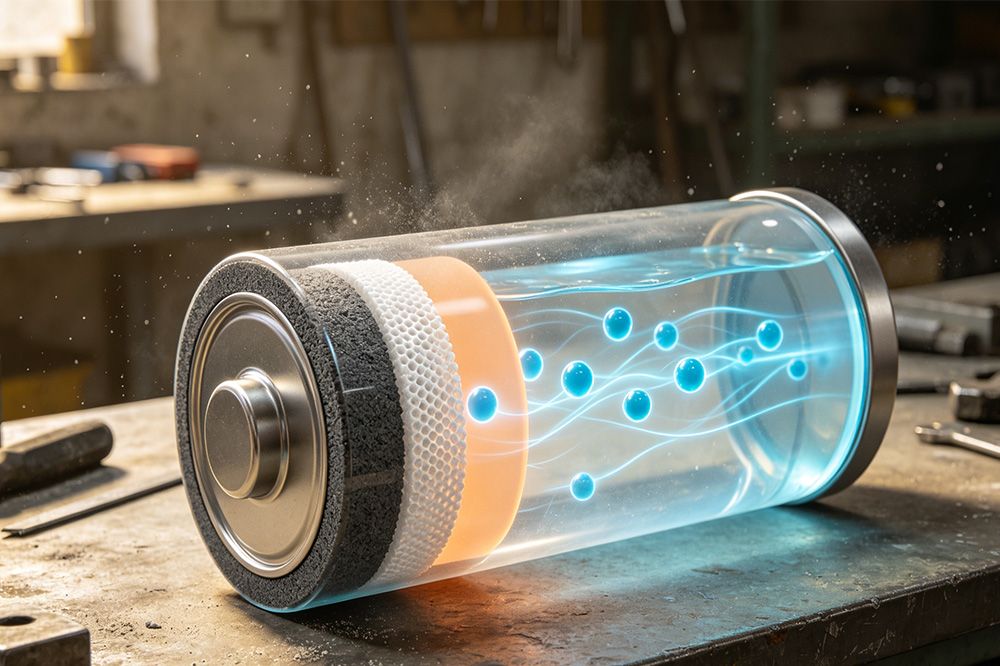
Most explanations start the same way: anode, cathode, electrolyte, ions moving back and forth.
That part is true—but it hides how “non-perfect” the system really is when it runs in real devices.
If you’ve ever opened an old power tool battery or handled a swollen phone battery, you already know: this is not a perfectly stable chemical ballet. It’s more like a controlled imbalance that keeps trying to stay under control.
Inside the Cell: Not Just “Positive and Negative”
A lithium-ion battery is basically three working parts packed tightly together:
- Anode (usually graphite)
- Cathode (lithium metal oxide)
- Electrolyte + separator
On paper, it looks simple. In reality, the structure is extremely thin-layered, almost like stacked films rolled or pressed together.
One thing most simplified diagrams skip:
the separator is doing a lot more than just “separating.” It’s constantly managing risk—preventing short circuits while still allowing ions through.
That trade-off is why battery design is never fully “solved,” only optimized.

What Actually Happens When You Charge It
During charging, lithium ions leave the cathode and move through the electrolyte toward the anode.
That sounds clean. But in practice:
- The ions don’t move evenly
- Some areas inside the electrode accept lithium faster than others
- Tiny temperature differences change reaction speed
So the battery is never charging uniformly.
Electrons, meanwhile, travel through the external circuit (the wire and charger). This split path—ions inside, electrons outside—is what creates usable electrical energy storage.
A technician once described it like this:
“You’re not filling a tank. You’re convincing particles to relocate and stay there temporarily.”
That’s closer to reality than most textbook explanations.
Discharging: The Part We Actually Use
When you power a device, the process reverses:
- Lithium ions move back to the cathode
- Electrons flow through your device, doing work (spinning motors, powering circuits, etc.)
But here’s the part that gets overlooked:
the return journey is never as efficient as the outbound one.
Some lithium gets “trapped” in side reactions over time. That’s one reason capacity slowly fades.
This is also why two batteries with the same rated capacity can feel different in real use—especially under heavy load like power tools or EV acceleration.
The Hidden Factor: Heat and Internal Resistance
If lithium-ion batteries were perfect chemical systems, they would last much longer.
But they aren’t.
Inside every cycle:
- Small resistance turns energy into heat
- Heat slightly changes chemical pathways
- Chemical changes increase resistance over time
It’s a feedback loop that slowly pushes the battery away from its original condition.
This is why battery packs in real applications often include thermal management systems—not because it’s “advanced,” but because the chemistry demands it.

Why Capacity Drops Over Time
People usually expect a single explanation. But degradation is more layered:
- SEI layer thickening (a kind of internal film buildup)
- Loss of active lithium
- Structural stress in electrode materials
- Occasional micro-damage from fast charging
None of these alone “kills” the battery. It’s the accumulation.
This is also why usage style matters so much:
fast charging every day, deep discharging, high temperature storage—all of these push the system faster toward aging.
A Real-World View: Why It Feels Different in Products
In lab data, lithium-ion batteries look extremely stable.
In real products—electric bikes, solar storage systems, tools—the behavior is more uneven:
- One batch performs slightly better than another
- Temperature changes shift runtime noticeably
- Heavy load use exposes internal resistance faster
This gap between “spec sheet” and “real life” is where most misunderstandings happen.
It’s also why battery selection in bulk applications isn’t just about capacity—it’s about consistency, discharge curve stability, and thermal behavior.
A Simple Mental Model
If you want a mental picture that actually holds up:
Think of lithium ions as workers moving between two warehouses.
- Charging = sending workers to Warehouse A
- Discharging = bringing them back to Warehouse B
- Heat = congestion and fatigue in the system
- Degradation = some workers slowly “retiring” or getting stuck elsewhere
It’s not perfect science language—but it matches what engineers often observe during testing.
Where This Matters in Real Use
Lithium-ion behavior becomes especially important in:
- Energy storage systems (solar buffering, grid smoothing)
- Electric mobility (EVs, scooters, e-bikes)
- Industrial power tools
- Portable electronics under high load cycles
In these cases, performance isn’t just about energy capacity—it’s about how consistently the battery behaves under stress.
And that’s usually where buyers in bulk or OEM projects start paying attention: not the peak number, but the stability across cycles and temperatures.
-

12V 4400 mah Lithium ion 3S2P 18650 Battery Pack
-

18650 2000mAh 3.7 volt Lithium-ion Battery
-

18650 20V 3.0Ah Cordless Drill battery
-

18650 22.2V 7.8Ah 2600Mah 6S3P Rechargeable Battery Pack
-

18650 2600mAh Rechargeable Lithium-Ion Battery 3.7V
-

18650 3.7V 10Ah Li-Ion Power Battery Pack
-

18650 3.7V 3300mah Rechargeable Lithium ion Battery
-

18650 7S7P 24V 14Ah Lithium ion Electric Scooter Battery Pack
-

18650 battery 3.7V 1500mAh Lithium-Ion Battery
-

18650 Battery 3500 mah Rechargeable Battery Cells
-

18650 Electric Scooter 48V 13000mAh Lithium Battery
-

2600mAh 3S1P 11.1V 18650 Battery Packs
-

3.7V Li ion Rechargeable 3000mah 18650 Battery Cell
-

36V 5200mAh 10S2P 18650 Battery Pack
-

48v 4400mah 13S2P 18650 Rechargeable Battery Pack
-

7S2P 24V 18650 Lithium Battery Pack
-

Electric Scooter 36V 4400mAH 10S2P 18650 Battery Pack
-

ICR 18650 Battery 2200mah 3.7V
Leave a Reply