
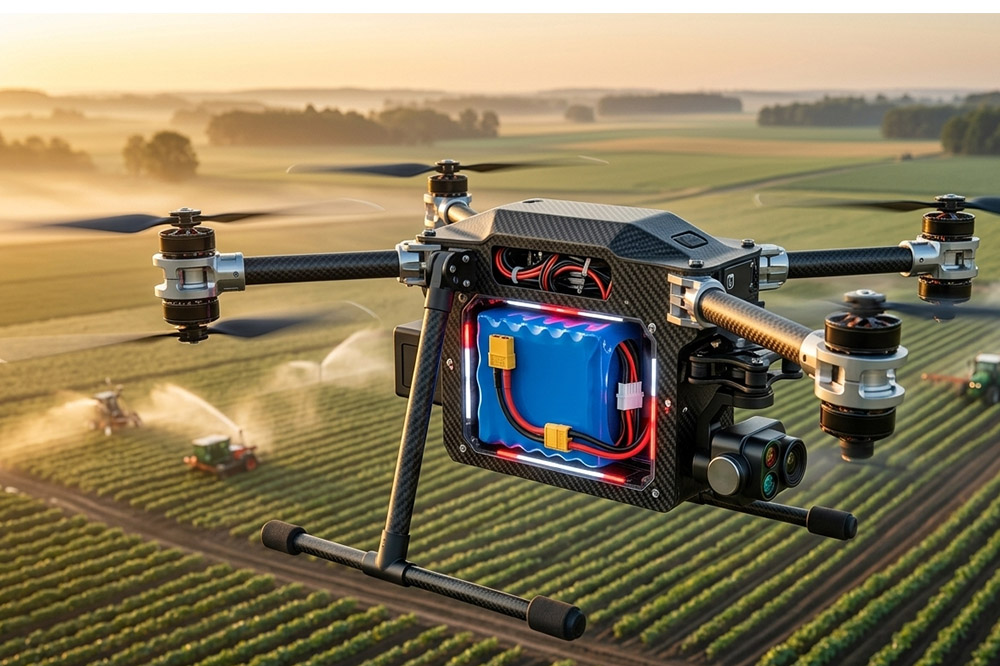
Whenever someone asks what the battery does in a UAV, the quick answer is usually, “It powers the drone.”
That answer isn’t exactly wrong, but it’s incomplete.
After working with customers who build agricultural drones, inspection UAVs, and industrial unmanned aircraft, one thing becomes pretty obvious. When a drone flies poorly, many people first suspect the motors, propellers, or flight controller. Surprisingly often, the battery turns out to be the real reason.
I’ve even seen two drones built with almost identical hardware produce completely different flight performance simply because one battery maintained a stable voltage while the other dropped sharply during acceleration.
So, what exactly does a UAV battery do?
Quite a lot, actually.
What Is UAV Battery?
UAV battery is the primary energy source for an unmanned aerial vehicle. Unlike ordinary rechargeable batteries used in consumer electronics, UAV batteries are designed to deliver large amounts of power within seconds while remaining as lightweight as possible.
Today, most commercial UAVs use lithium-based batteries, including:
- Lithium-ion batteries
- Lithium polymer (LiPo) batteries
- Lithium iron phosphate (LiFePO4) batteries for selected industrial applications
Each chemistry has its own strengths. LiPo batteries dominate racing and aerial photography because of their extremely high discharge rates, while lithium-ion packs are becoming increasingly popular for long-endurance drones.

The Battery Powers the Motors—But That’s Only the Beginning
Everyone knows the motors need electricity.
What many first-time buyers don’t realize is how demanding those motors really are.
Imagine an agricultural drone carrying a full tank of pesticide. During takeoff, every motor suddenly demands a huge burst of current. If the battery can’t respond quickly enough, the drone may climb slowly or even trigger low-voltage protection.
That’s why high-discharge batteries matter.
It’s not only about having enough capacity. The battery must deliver power immediately when the aircraft needs it.
The Battery Also Keeps the Flight Controller Alive
A UAV isn’t just flying.
It’s constantly calculating.
The flight controller processes information hundreds of times every second.
It receives signals from:
- IMU sensors
- GPS modules
- Barometers
- Electronic speed controllers (ESCs)
- Radio receivers
Without stable battery voltage, these systems can become unreliable.
Sometimes pilots describe strange flight behavior as “software issues.” In reality, unstable battery output can produce sensor errors that look almost identical.
Cameras, Sensors, and Payloads Depend on Battery Performance
Commercial UAVs carry much more than cameras today.
Depending on the application, they may include:
- Thermal imaging cameras
- LiDAR scanners
- Multispectral sensors
- HD video transmitters
- AI computing modules
- RTK positioning systems
Each additional device consumes energy.
A mapping drone flying over a construction site, for example, isn’t just lifting itself into the air. It’s also powering several precision instruments that must operate continuously throughout the mission.
If battery voltage fluctuates too much, image quality or sensor accuracy may suffer.

Handling Peak Power Is One of the Battery’s Hardest Jobs
This part doesn’t receive enough attention.
Drone power demand isn’t constant.
A UAV climbing rapidly, fighting strong wind, or carrying extra payload may suddenly require two or three times more current than during steady flight.
Think of it like driving a car uphill instead of cruising on a highway.
The battery has to react instantly.
Poor-quality cells often experience voltage sag during these moments. The drone may lose efficiency, reduce thrust, or return home earlier than expected.
Experienced UAV manufacturers usually pay close attention to discharge rate (C-rate), internal resistance, and thermal behavior rather than looking only at battery capacity.
Why Battery Quality Matters More Than Flight Time
Many buyers compare batteries by asking only one question:
“How many minutes can it fly?”
Honestly, that’s understandable, but it misses several important factors.
A professional UAV battery should also provide:
- Stable voltage throughout discharge
- High discharge capability
- Low internal resistance
- Excellent heat dissipation
- Long cycle life
- Reliable BMS protection
- Consistent cell matching
I’ve seen batteries advertised with impressive capacity numbers, yet they became noticeably weaker after only a few hundred cycles.
For industrial operators, downtime often costs much more than buying a better battery in the first place.
Different UAVs Need Different Batteries
One battery doesn’t fit every drone.
Agricultural drones usually prioritize high discharge and fast charging because they complete dozens of flights every day.
Inspection drones often need longer endurance to inspect power lines, pipelines, or wind turbines.
Delivery UAVs care about balancing payload weight with maximum flight distance.
Mapping drones place greater importance on voltage stability because even small fluctuations may affect sensor performance during long missions.
That’s why OEM battery customization has become increasingly common.
Manufacturers adjust voltage, capacity, connector type, BMS design, enclosure size, and communication protocol according to each drone platform.

What Wholesale Buyers Usually Look For
When drone manufacturers source batteries in bulk, price isn’t always the deciding factor.
Instead, purchasing teams often compare:
- Cell brand consistency
- Battery cycle life
- UN38.3 certification
- MSDS documentation
- IEC62133 compliance
- OEM customization capability
- Fast prototype development
- Production capacity
- Technical engineering support
A battery supplier who understands UAV applications can usually help reduce development time as well.
That practical support often becomes just as valuable as the product itself.
Frequently Asked Questions
Does a larger battery always mean longer flight time?
Not necessarily.
A larger battery also increases aircraft weight. Eventually, the extra weight begins to offset the additional energy stored inside the battery.
Which battery chemistry is best for UAVs?
It depends on the application.
LiPo batteries are widely used where high discharge rates are essential. Lithium-ion batteries generally provide higher energy density for longer endurance missions.
Can custom UAV batteries improve performance?
Yes.
OEM battery packs can be optimized for voltage, capacity, dimensions, connectors, communication protocols, and thermal management, allowing better integration with specific drone platforms.
Looking Beyond Flight Time
If someone asks what the battery does in a UAV, the answer is much broader than supplying electricity.
The battery determines how efficiently the motors respond, how accurately onboard electronics operate, how much payload the aircraft can carry, and, in many situations, whether the mission finishes successfully at all.
For OEM drone manufacturers, system integrators, and industrial UAV brands, choosing the right battery is rarely just a purchasing decision. It becomes part of the aircraft’s overall performance strategy. Working with an experienced lithium battery manufacturer that offers custom engineering, strict quality control, and reliable production can make development smoother and help deliver a more dependable UAV to the end customer.


Leave a Reply