
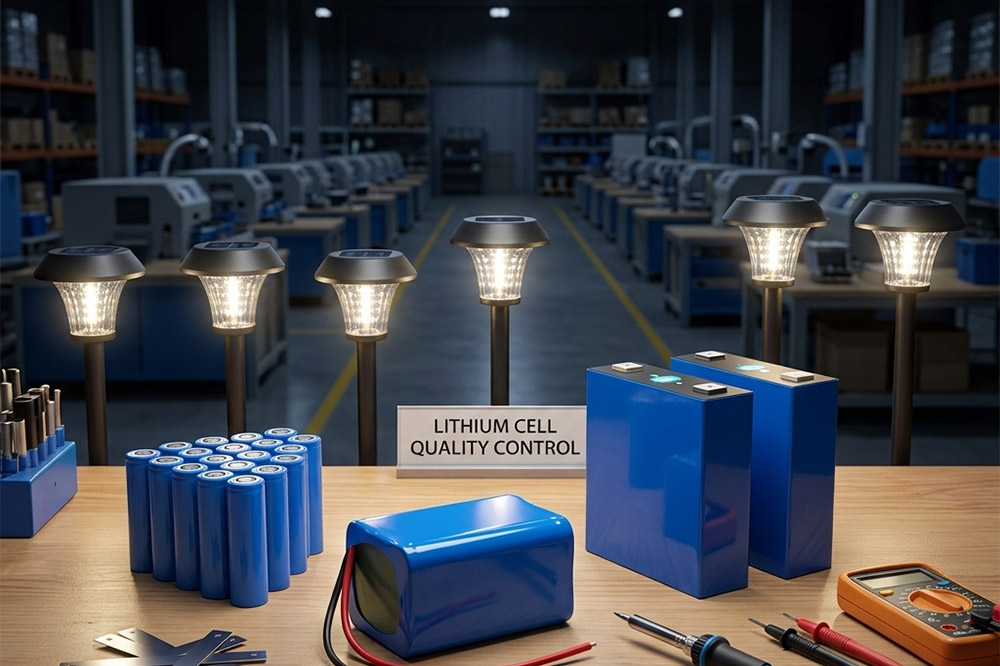
When buying solar lights, many people first look at the LED brightness, solar panel size, or housing design. The battery is usually hidden inside the product, so it is easy to ignore.
But after thousands of charging and discharging cycles, the battery becomes the part that decides whether the solar light keeps working properly.
A solar light installed in a customer’s garden may only need to work for one night. But for a manufacturer shipping 10,000 units to different countries, the situation is completely different.
A battery that performs well in a sample test may not always perform the same after six months outdoors.
That is why choosing the best rechargeable batteries for solar lights requires looking beyond the mAh number.
The Battery Inside a Solar Light Matters More Than Most Buyers Expect
Solar lighting is a simple-looking product, but the working environment is not always simple.
During the day, the battery charges from solar energy. At night, it powers the LED. This cycle repeats again and again.
In some markets, solar lights face:
- Hot summer temperatures
- Long rainy seasons
- Cold winter nights
- Limited sunlight during cloudy days
A battery that works in a laboratory environment may behave differently in real outdoor conditions.
For solar lighting companies, battery consistency is often more important than chasing the lowest purchase price.

18650 Battery Cell: Still One of the Most Used Options for Solar Lights
The 18650 battery cell has been widely used in solar lighting products for years.
One reason is the size. The standard 18mm × 65mm design makes it easy for engineers to fit the battery into compact lighting structures.
We often see 18650 cells used in:
- Garden solar lights
- Outdoor decorative lamps
- Solar security lights
- Portable lighting products
Compared with older rechargeable battery types, lithium 18650 cells usually provide higher energy density, which means manufacturers can achieve longer lighting time without increasing the product size too much.
However, there is a point that some buyers overlook.
The word “18650” only describes the battery size. It does not automatically mean the battery quality is good.
Two 18650 cells with the same capacity label can have different performance because of:
- Cell materials
- Production process
- Internal resistance
- Quality control standards
For bulk buyers, checking the battery source is usually more important than only checking the printed capacity.
Why Many Solar Light Factories Choose 18650 Battery Packs
A single battery cell works for many small products, but some solar lights need more power.
This is where 18650 battery packs become useful.
By connecting multiple 18650 cells, manufacturers can create different voltage and capacity combinations.
For example:
A small garden lamp may use a simple single-cell design.
A larger solar security light may require a battery pack with:
- Higher capacity
- Protection circuit
- Customized connectors
- Better discharge performance
From a product development perspective, a custom 18650 battery pack gives engineers more freedom.
The battery does not have to follow a fixed size. It can be adjusted according to the available space inside the solar light housing.
This is especially useful for OEM customers who want to create their own product designs instead of selling standard models.

When LiFePO4 Battery Cells Make More Sense
For larger solar lighting projects, especially outdoor installations, many buyers consider LiFePO4 battery cells.
The reason is not that LiFePO4 is always better.
It is because different applications have different priorities.
A garden lamp sold in a retail store may focus on:
- Cost
- Compact size
- Easy installation
A solar street light project may focus more on:
- Long service life
- Safety
- Low maintenance
LiFePO4 battery cells are often selected for applications where replacing batteries is difficult.
For example, a solar street light installed in a remote area might require years of operation. Sending workers to replace batteries frequently can cost much more than choosing a longer-life battery from the beginning.
Another advantage is stability.
Outdoor environments are unpredictable. Temperature changes, continuous charging, and deep discharge situations can all affect battery performance.
LiFePO4 chemistry is often preferred in these conditions.

Choosing Between 18650 and LiFePO4 for Solar Lighting
There is no universal answer.
The right battery depends on the product.
For small solar lights:
→ 18650 battery cell is often a practical choice.
For customized lighting products:
→ 18650 battery packs provide more flexibility.
For commercial solar projects:
→ LiFePO4 battery cells are usually considered because of their longer lifespan.
A battery supplier who understands the final application can usually recommend a more suitable solution than simply offering the highest-capacity battery available.
Problems Solar Light Buyers Usually Discover Later
One common mistake is buying batteries only based on price.
A cheaper battery may reduce the initial product cost, but it can create problems later:
- Shorter working time
- Higher warranty claims
- Customer complaints
- Difficult after-sales service
Another issue is inconsistent cells.
For battery packs, even small differences between cells can affect the overall performance.
This is why professional battery manufacturers usually test:
- Cell matching
- Voltage consistency
- Charging performance
- Safety protection
before shipping bulk orders.
OEM Battery Manufacturing for Solar Lighting Applications
For solar lighting companies, the battery is part of the product design, not just a component.
A reliable supplier can help with:
- 18650 battery cells
- Custom 18650 battery packs
- LiFePO4 battery cell solutions
- Battery size adjustment
- BMS configuration
- Connector customization
Different solar lighting projects have different requirements.
A small outdoor lamp, a security light, and a solar street lighting system may all need different battery designs.
Before placing a bulk order, discussing the actual working environment and product requirements with a battery manufacturer can prevent many problems later.
Conclusion
The best rechargeable batteries for solar lights are not always the batteries with the highest capacity or the lowest price.
For many solar lighting products, 18650 battery cells provide a good balance between size and performance.
For customized products, 18650 battery packs offer more design flexibility.
For long-life outdoor systems, LiFePO4 battery cells are often a better match.
The right choice depends on where the solar light will be used, how long it needs to operate, and what kind of reliability the market expects.
-

12.8V 8Ah LiFePO4 Power Wall Battery
-

12V 100Ah LiFePO4 Solar Battery
-

12V 4400 mah Lithium ion 3S2P 18650 Battery Pack
-

18650 2000mAh 3.7 volt Lithium-ion Battery
-

18650 20V 3.0Ah Cordless Drill battery
-

18650 22.2V 7.8Ah 2600Mah 6S3P Rechargeable Battery Pack
-

18650 2600mAh Rechargeable Lithium-Ion Battery 3.7V
-

18650 3.7V 10Ah Li-Ion Power Battery Pack
-

18650 3.7V 3300mah Rechargeable Lithium ion Battery
-

18650 7S7P 24V 14Ah Lithium ion Electric Scooter Battery Pack
-

18650 battery 3.7V 1500mAh Lithium-Ion Battery
-

18650 Battery 3500 mah Rechargeable Battery Cells
-

18650 Electric Scooter 48V 13000mAh Lithium Battery
-

2600mAh 3S1P 11.1V 18650 Battery Packs
-

3.2V 280ah Lifepo4 Battery Cell
-

3.2V 320Ah LifePo4 Battery Cell
-

3.7V Li ion Rechargeable 3000mah 18650 Battery Cell
-

36V 5200mAh 10S2P 18650 Battery Pack
-

48V 200Ah LiFePO4 Battery Solar Power Wall
-

48v 4400mah 13S2P 18650 Rechargeable Battery Pack
-

7S2P 24V 18650 Lithium Battery Pack
-

Electric Scooter 36V 4400mAH 10S2P 18650 Battery Pack
-

ICR 18650 Battery 2200mah 3.7V
-

IP67 48V 100Ah Solid State LiFePO4 Battery
Leave a Reply