
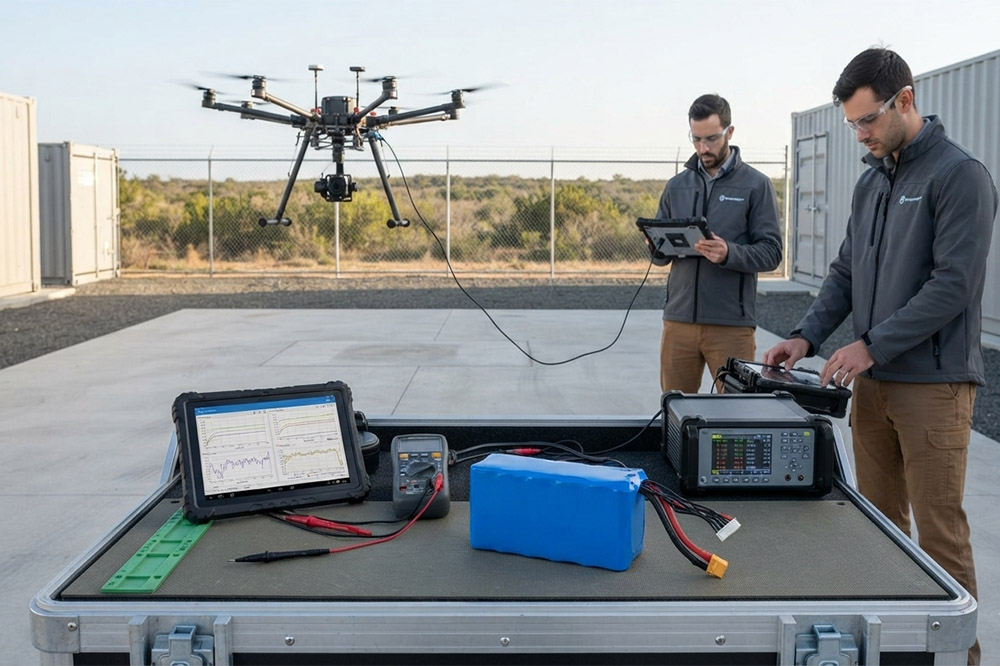
When someone asks “How long does a drone battery last?”, the first answer that usually comes to mind is a number:
20 minutes?
40 minutes?
1 hour?
But in real UAV projects, battery life is rarely that simple.
A customer may compare two drones with the same battery capacity and expect similar flight times. Then after testing, the results can be completely different.
One drone flies for 35 minutes, while another one only reaches 25 minutes.
Why?
Because the battery is only one part of the flight system.
The actual flight time depends on how the battery works together with the motor, propeller, aircraft weight, payload, and flying environment.
For drone manufacturers, the question is not only “how big should the battery be?” but rather:
How can we store enough energy without making the aircraft too heavy?
Typical Drone Battery Flight Time
The flight time of a drone depends heavily on its application.
A small FPV drone designed for speed may only fly for several minutes, while an industrial UAV designed for inspection may need much longer endurance.
Typical examples:
| Drone Type | Typical Flight Time |
|---|---|
| FPV racing drone | 5-15 minutes |
| Consumer camera drone | 20-40 minutes |
| Mapping UAV | 40-60 minutes |
| Agricultural drone | 15-40 minutes |
| Industrial UAV | 30 minutes+ |
These numbers are only references.
A manufacturer developing a new UAV cannot simply copy another drone’s battery specification because the final performance depends on the complete design.

Battery Capacity Is Important, But It Is Not Everything
Battery capacity is usually measured in mAh.
For example:
- 5000mAh battery
- 10000mAh battery
- 20000mAh battery
Normally, higher capacity means more stored energy.
However, there is a situation we often see during battery discussions.
A customer wants to increase flight time, so they request a much larger battery pack.
After checking the drone structure, they discover the larger battery adds too much weight.
The result?
The drone consumes more power to carry the heavier battery.
Sometimes the flight time improves only slightly.
In some cases, it can even become shorter.
That is why professional UAV manufacturers usually calculate the complete power system before selecting the battery.
How Battery Weight Changes Drone Flight Time
Weight is one of the biggest factors affecting endurance.
Every gram added to a drone creates additional workload for:
- Motors
- ESC system
- Propellers
- Battery
For example, an agriculture drone carrying spraying equipment already has a heavy payload.
Adding an oversized battery may not always be the best solution.
Engineers usually look for a balance:
- Enough energy storage
- Acceptable battery weight
- Stable power output
This is also why custom drone battery packs are common in commercial UAV applications.
A battery designed around the aircraft often performs better than a standard battery selected afterward.
The Role of Battery Voltage in Flight Performance
Voltage is another important factor.
Many professional drones use higher voltage battery systems, such as:
- 6S LiPo battery
- 8S battery
- 12S UAV battery system
A higher voltage system can reduce current demand when the drone requires high power.
For example, large drones carrying cameras, sensors, or spraying equipment often need more power than small consumer drones.
In these situations, increasing voltage can be a more practical solution than only increasing capacity.
This is why many industrial UAV manufacturers choose customized high-voltage battery solutions.

Motor Efficiency Directly Affects Battery Life
The battery provides energy, but the motor system decides how efficiently that energy is used.
Two drones can use the same battery and still have different flight times because of:
- Motor efficiency
- Propeller design
- Aircraft weight
- Flight control settings
A well-designed drone can often achieve better endurance with the same battery.
From a battery supplier perspective, we usually recommend customers evaluate the complete system instead of looking at battery specifications alone.
Payload: The Hidden Factor Many Buyers Forget
For commercial drones, payload is often the biggest challenge.
A camera drone may carry:
- High-resolution camera
- Thermal sensor
- Communication equipment
Agriculture drones may carry:
- Liquid tank
- Spraying system
- Control electronics
Every additional kilogram affects flight time.
A drone designed for delivery or industrial inspection may need a completely different battery solution compared with a lightweight photography drone.
How Manufacturers Improve Drone Flight Time
There are several ways to increase UAV endurance.
Use Higher Energy Density Battery Cells
Better battery cells can provide more energy without increasing weight too much.
For commercial UAV projects, manufacturers often evaluate:
- Cell chemistry
- Energy density
- Discharge performance
- Cycle life
Optimize Battery Size
A bigger battery is not always the answer.
The ideal battery size depends on:
- Drone frame
- Motor power
- Mission time
- Payload requirement
Design Custom Battery Pack
Standard batteries work well for many consumer drones.
However, professional UAV companies often need customized solutions.
Examples:
- Special dimensions
- Different voltage configuration
- Custom connectors
- Integrated protection system
A custom battery allows engineers to use the available space more efficiently.
Choosing Battery for Long Endurance Drones
Long endurance UAVs usually focus on:
- High energy density
- Lightweight design
- Reliable discharge performance
- Long cycle life
Applications include:
- Mapping
- Surveying
- Inspection
- Agriculture
- Security monitoring
For these applications, the battery is not just a replaceable part.
It becomes part of the drone design.
Custom UAV Battery Solutions for Drone Manufacturers
For companies developing commercial drones, battery selection often starts during the early design stage.
A battery supplier may need to understand:
- Required flight time
- Drone weight
- Available installation space
- Operating environment
- Charging requirements
ANPS provides customized UAV battery solutions for drone manufacturers and industrial applications.
Solutions include:
- Custom LiPo battery packs
- UAV lithium battery systems
- OEM battery development
- Different voltage and capacity configurations
Learn more:UAV Battery Solutions

FAQ
How long does a drone battery last on average?
It depends on the drone type. Small drones may fly 5-15 minutes, while commercial UAVs can achieve much longer flight times with optimized battery systems.
Does a larger drone battery always increase flight time?
No. A larger battery stores more energy but also adds weight. The drone design must be considered together.
What battery is best for long flight time drones?
The best battery depends on the aircraft. Many commercial drones use customized lithium battery packs designed for specific missions.
Conclusion
The answer to “How long does a drone battery last?” depends on much more than battery capacity.
Flight time is the result of many factors working together:
- Battery energy
- Weight
- Voltage
- Motor efficiency
- Payload
- Aircraft design
For hobby drones, a standard battery may be enough.
For commercial UAV manufacturers, achieving longer flight time usually requires a battery solution designed around the entire aircraft.
LiPo Battery for Drone: Complete Guide for UAV Manufacturers and Buyers
Choosing the right battery is the first step in improving drone endurance. Our complete guide on LiPo Battery for Drone: Complete Guide for UAV Manufacturers and Buyers explains how voltage, capacity, and battery design influence UAV performance.


Leave a Reply