
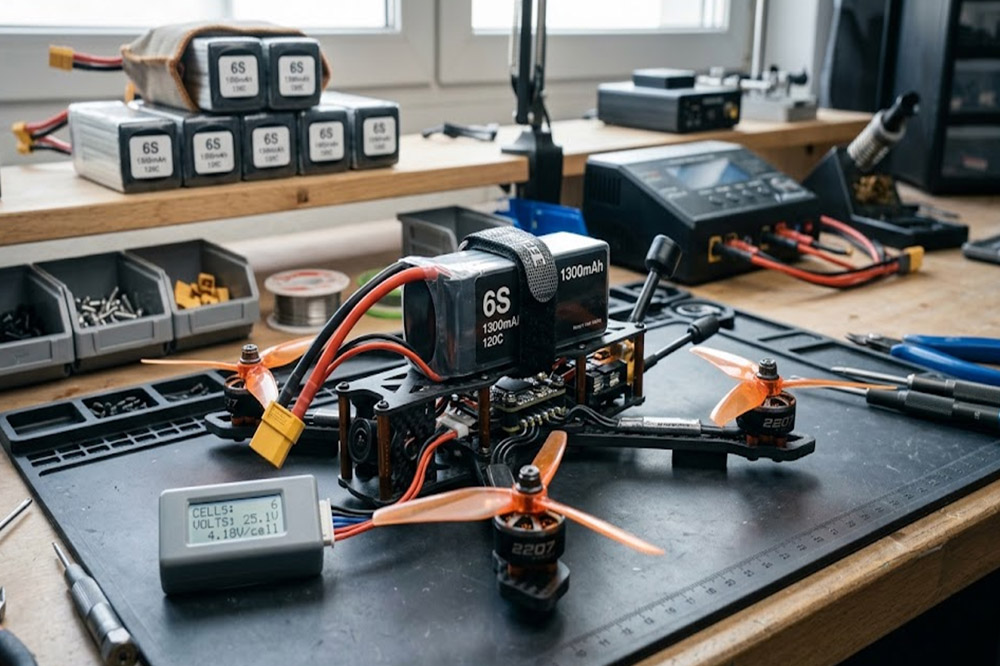
If you have ever watched an FPV racing drone launch at full throttle, you already know that its battery has a very different job from the battery in a camera drone.
The aircraft can be light, but the power demand is not.
A racing drone may go from a gentle hover to full acceleration in a second. The motors ask for a lot of current, the battery voltage drops under load, and the pilot immediately notices if the battery cannot keep up.
That is why an FPV LiPo battery is usually selected around discharge performance, weight and voltage rather than capacity alone.
For a manufacturer or distributor, this becomes even more important. A battery that feels fine in a casual flight may not perform well when the same drone is pushed hard every race.
LiPo Battery for Drone: Complete Guide for UAV Manufacturers and Buyers
If you are comparing LiPo battery chemistry, voltage, capacity and discharge requirements for different UAV applications, our LiPo Battery for Drone: Complete Guide for UAV Manufacturers and Buyers provides a broader overview.
Why LiPo Is So Common in FPV
LiPo batteries have been widely used in FPV because they can deliver high current from a relatively compact pack.
That combination works well for racing drones.
When the throttle is opened quickly, the battery needs to supply current to the ESCs and motors without excessive voltage sag. If the voltage falls too much, the drone can feel noticeably weaker.
This is one reason a high-discharge LiPo remains such a practical choice for FPV.
It is not necessarily the lightest battery chemistry in every situation. It is more about the balance between power output and weight.
What Does “High Discharge” Actually Mean?
You will often see FPV batteries described as:
- 30C
- 50C
- 75C
- 100C
- 120C or higher
The C rating is related to how much current the battery can theoretically provide relative to its capacity.
For example, a 5Ah battery rated at 50C would give a theoretical current figure of:
5Ah × 50C = 250A
But I would be careful with this number.
Different manufacturers can use different testing methods, and the printed C rating does not always tell you exactly how the battery behaves during a real FPV flight.
Internal resistance, cell quality, temperature and pack construction all matter.
For a distributor comparing suppliers, testing actual packs can be more useful than simply choosing the highest number on the label.

4S or 6S FPV Battery?
This is one of the first choices an FPV buyer usually makes.
A 4S LiPo has a nominal voltage of around 14.8V.
A 6S LiPo is around 22.2V nominal.
Both are widely used, but the correct choice depends on the motor, ESC, propeller and overall drone setup.
A 6S system can deliver a given power level at lower current than a 4S system. This can be useful for high-performance builds.
But it does not mean you can simply take a 4S drone and install a 6S battery.
The electronics need to support the higher voltage, and the motor-propeller combination needs to be appropriate.
For OEM drone manufacturers, the battery should really be specified together with the powertrain.
Capacity: Bigger Isn’t Always Better
A common FPV battery specification might look like:
6S 1300mAh 100C
It is easy to assume that a 2000mAh version must be better because it stores more energy.
But the bigger pack also weighs more.
For racing, that extra weight can affect acceleration, cornering and overall handling.
A racing pilot may actually prefer a smaller battery if it gives enough flight time while keeping the aircraft responsive.
This is different from a mapping UAV, where another few hundred grams may be acceptable if the additional energy meaningfully extends the mission.
FPV racing is much less forgiving about weight.
Capacity and C rating are easy to confuse when comparing FPV batteries. Our guide to drone battery capacity, mAh, voltage and C rating explains what these numbers actually mean

What Makes Good FPV LiPo Battery?
For racing applications, I would pay attention to several things rather than focusing only on C rating.
Battery weight
This directly affects how the drone feels.
Voltage
The battery has to match the motor and ESC system.
Capacity
Enough to provide the required flight time without becoming unnecessarily heavy.
Discharge capability
The pack must handle the aircraft’s peak and continuous current demand.
Internal resistance
Lower internal resistance generally helps reduce voltage sag under load.
Connector and wiring
A high-power battery needs suitable wiring and connectors. A good cell cannot compensate for a poorly designed connection.
Voltage Sag Is Something Pilots Notice Quickly
Imagine two batteries with the same voltage and capacity.
Battery A holds its voltage reasonably well when the pilot opens the throttle.
Battery B drops more aggressively.
On paper, both may look almost identical.
In the air, they can feel quite different.
The second battery may cause the drone to feel less responsive during acceleration. It can also become warmer under heavy load.
This is why a high discharge drone battery should be evaluated under realistic operating conditions.
For an FPV distributor, it may be worth testing several packs on the same drone and logging voltage, current and temperature rather than relying entirely on supplier specifications.

Racing, Freestyle and Long-Range FPV Are Not the Same
“FPV battery” covers several different types of flying.
A racing pilot may want:
low weight + high current + quick response
A freestyle pilot may accept slightly more weight in exchange for longer flight time.
A long-range FPV pilot may put more emphasis on energy density and capacity.
So even within the FPV market, there isn’t one perfect battery.
For example, a 1300mAh 6S pack might make sense for an aggressive 5-inch racing build, while another aircraft may be better matched to a 1500mAh or 1800mAh pack.
The motor KV, propeller and aircraft weight all change the equation.
What About Li-ion for FPV?
Li-ion cells can offer attractive energy density, but traditional high-performance FPV racing is usually a different application.
The issue is not simply how much energy the battery stores.
The drone needs to access that energy quickly.
For a long-range FPV platform flying at moderate power, Li-ion can make sense.
For an aggressive racing setup where the pilot repeatedly demands high current, a high-discharge LiPo is usually the more natural starting point.
That distinction is worth explaining to customers because “longer flight time” and “higher power” are not always achieved with the same battery.
If you are also considering Li-ion cells for long-range FPV builds, see our comparison of LiPo vs Li-ion drone battery.
A Practical Battery Selection Example
Suppose a distributor wants an FPV battery for a 5-inch drone.
The first request might be:
“We need a 6S 1300mAh battery.”
That’s a useful start, but I would still want to know:
- Motor KV
- ESC current rating
- Propeller size
- Target flight style
- Maximum battery weight
- Required connector
- Expected order quantity
If the customer wants a racing setup, weight and discharge performance may take priority.
If the same customer is actually selling freestyle drones, the preferred battery could be different.
This is where understanding the end user helps.

For FPV Distributors, Consistency Matters
If you are buying 100 or 1,000 FPV batteries, the conversation changes.
You are not just looking for one battery that performs well.
You need batches that behave consistently.
Things worth checking include:
- Cell consistency
- Actual capacity
- Internal resistance
- Welding quality
- Connector quality
- Pack dimensions
- Weight consistency
- Charging performance
A few grams of difference may not seem important when looking at one pack.
Across a large batch, inconsistent weight or electrical performance can become a customer-service problem.
When Does Custom FPV Battery Development Make Sense?
Custom batteries can be useful when you need a particular combination of:
- Voltage
- Capacity
- Weight
- Dimensions
- Connector
- Wire length
- Discharge performance
For private-label FPV products, packaging and connector configuration can also be adjusted around the distributor’s requirements.
For a small order, an existing battery may be the simpler solution.
For a larger order or a dedicated drone platform, custom development can make more sense.
ANPS provides customized UAV and FPV battery solutions for different drone applications. You can review the UAV Battery product range when comparing battery configurations for OEM or wholesale projects.
So, What Is the Best FPV LiPo Battery?
For FPV racing, I would not start with the biggest capacity or the highest C rating.
I would start with the drone.
What motor is being used?
How much current does it pull?
How much weight can the aircraft comfortably carry?
How long does the pilot actually want to stay in the air?
Then select the battery around those requirements.
A good FPV LiPo battery should give the drone enough power without becoming dead weight.
That sounds simple, but getting that balance right is what separates a battery that merely works from one that pilots actually enjoy flying.

FAQ
What is the best LiPo battery for FPV racing?
A high-discharge LiPo matched to the drone’s voltage, motor system, weight and current demand is usually the best starting point. Common configurations include 4S and 6S.
Is a higher C rating better for FPV?
Not automatically. A higher C rating can indicate greater discharge capability, but the actual cell performance and battery construction are also important.
Is 6S better than 4S for FPV?
Neither is universally better. 6S can provide advantages for high-performance systems, but the motor and ESC must be designed for the higher voltage.
What capacity is best for a racing drone?
It depends on the aircraft. A larger capacity can extend flight time but adds weight, so racing pilots often choose a compromise between endurance and responsiveness.


Leave a Reply