
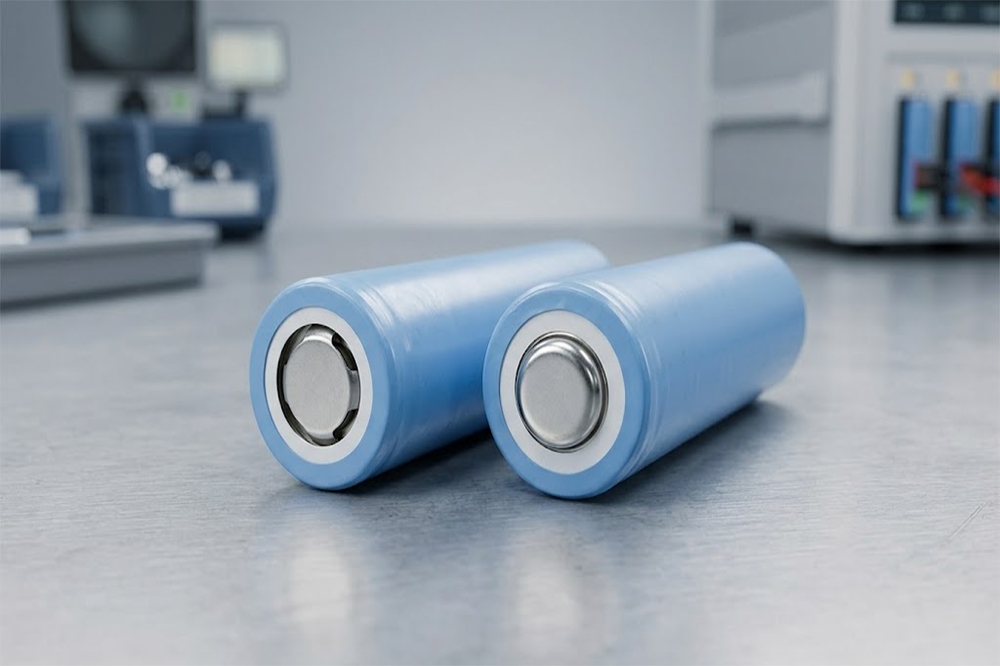
Flat top and button top 18650 batteries are two common terminal designs used in lithium-ion battery cells. Although both belong to the 18650 format, they are not always interchangeable.
The main difference is located at the positive end of the cell:
- A flat top 18650 battery has a relatively flat positive terminal.
- A button top 18650 battery has a raised positive terminal.
This small mechanical difference can affect whether the cell fits a battery holder, makes reliable contact, or works correctly inside a particular device.
For OEM battery pack manufacturing, terminal design also affects welding, cell spacing, pack dimensions, insulation, and the connection method. Choosing the correct terminal type before ordering samples can prevent compatibility problems during assembly.
What Is Flat Top 18650 Battery?
A flat top 18650 battery has a positive terminal that is relatively level with the top of the cylindrical cell.
The terminal may still include:
- A small positive contact area
- An insulating ring
- A safety vent structure
- A metal cap
- A protective outer wrap
“Flat top” does not mean that the entire top surface is completely smooth. It describes the general shape of the positive contact compared with a raised button terminal.
Flat top cells are widely used in:
- Custom battery packs
- Industrial battery assemblies
- Power tools
- Portable power systems
- Battery holders designed for flat-top cells
- OEM battery pack production
They are often convenient for pack assembly because the cells can be arranged closely and connected with nickel strips or other suitable conductors.
What Is Button Top 18650 Battery?
A button top 18650 battery has a raised positive terminal that looks like a small button.
The raised terminal can help the cell make contact with devices that use:
- Spring contacts
- Recessed positive terminals
- Flashlight battery tubes
- Consumer battery holders
- Equipment designed for button-top cells
Button top cells may be supplied as:
- Unprotected button-top cells
- Protected button-top cells
- High-capacity button-top cells
- High-drain button-top cells
The raised terminal changes the overall length. A button-top cell may therefore be longer than a similar flat-top model.
For a device with limited internal space, the exact length should be confirmed before purchase.

Flat Top vs Button Top: Main Differences
| Feature | Flat Top 18650 Battery | Button Top 18650 Battery |
|---|---|---|
| Positive terminal | Relatively flat | Raised button |
| Overall length | Often shorter | Often slightly longer |
| Common use | Custom packs and industrial assemblies | Flashlights and spring-contact devices |
| Holder compatibility | Requires flat-top-compatible contacts | Requires button-top-compatible contacts |
| Pack arrangement | Often convenient for compact packs | May require additional clearance |
| Welding suitability | Commonly used in welded packs | Depends on terminal construction |
| Protection options | Protected or unprotected | Protected or unprotected |
| Interchangeability | Not guaranteed | Not guaranteed |
The exact dimensions and performance depend on the specific cell model.
Why Terminal Design Matters
The positive terminal is the point where the battery connects to the device or pack. If the terminal does not make reliable contact, the battery may:
- Fail to power the device
- Disconnect during movement
- Produce intermittent output
- Create additional contact resistance
- Generate unwanted heat
- Damage the holder or terminal
A flat-top cell may not reach a recessed contact in a device designed for button-top batteries. Conversely, a button-top cell may be too long for a holder designed around a short flat-top cell.
The terminal shape should therefore be treated as a compatibility specification, not simply a cosmetic feature.
Are Flat Top and Button Top 18650 Batteries Interchangeable?
Sometimes, but not always.
Interchangeability depends on the equipment’s contact design and available space.
A Button Top May Work in a Flat-Top Holder When:
- The holder has enough length clearance
- The positive contact can accommodate the raised terminal
- The terminal does not interfere with the enclosure
- The cell is within the holder’s current rating
- The device is designed for the cell’s voltage and chemistry
A Flat Top May Not Work in a Button-Top Device When:
- The device requires a raised positive terminal
- The contact is recessed too far
- The spring cannot extend enough
- Movement causes intermittent contact
- The device relies on a specific terminal shape
A battery should not be modified with improvised metal pieces, solder blobs, or other makeshift extensions. Such changes can create poor contact, short-circuit risks, or mechanical damage.
Flat Top vs Button Top Dimensions
The most visible difference is the positive terminal, but the overall dimensions may also vary because of:
- Terminal height
- Protection PCB
- PVC wrap
- Insulation ring
- Cell construction
- Nickel tabs
- Wires or connectors
A bare flat-top cell may be close to the common 65mm format. A button-top or protected cell may be longer.
For accurate product selection, request:
- Overall length
- Maximum diameter
- Positive terminal height
- Terminal diameter
- Protection PCB dimensions
- Wrap thickness
- Cell drawing
For more information, read our guide to 18650 battery dimensions.

Protected Button Top vs Unprotected Flat Top
Terminal design and protection design are two separate characteristics.
A cell can be:
- Flat top and unprotected
- Flat top and protected
- Button top and unprotected
- Button top and protected
For example, a protected button-top cell may be longer because it includes both a protection PCB and a raised terminal.
An unprotected flat-top cell may be shorter and easier to arrange in a custom pack, but it requires a suitable external protection system.
Do not assume that every button-top battery is protected or that every flat-top battery is unprotected.
For more information, see protected vs unprotected 18650 batteries.
Does Terminal Type Affect Discharge Current?
The terminal shape itself does not determine the cell’s discharge current. A flat-top cell and a button-top cell can both be designed for low-current or high-current applications.
Discharge performance depends more on:
- Cell chemistry
- Electrode design
- Internal resistance
- Cell construction
- Temperature
- Protection PCB, if included
- Contact resistance
- External wiring and connectors
However, poor contact can reduce practical performance. A weak spring contact or unsuitable terminal connection may cause:
- Voltage drop
- Localized heating
- Intermittent operation
- Lower usable power
- Unexpected shutdown
For high-current applications, buyers should evaluate both the cell’s rated discharge current and the resistance of the complete connection system.
See our guide to 18650 battery discharge current for more details.
Terminal Type and Battery Holder Selection
Before purchasing a battery holder, check the following specifications:
Cell Length
The holder must support the complete length of the cell. Protected button-top batteries may be longer than bare flat-top cells.
Contact Structure
Some holders use:
- Flat metal contacts
- Springs
- Sliding contacts
- Fixed terminals
- Pressure contacts
The contact structure must match the terminal shape.
Current Rating
A holder intended for low-current testing may not be suitable for a high-current battery pack. Contact resistance and heat generation should be considered.
Mechanical Stability
The cell should remain secure during movement, vibration, or equipment operation. A loose cell can create intermittent contact.
Insulation
The holder should prevent accidental contact between the cell casing, terminals, and nearby conductive parts.
Temperature Resistance
For industrial or high-current applications, the holder material should withstand the expected operating temperature.
A holder should be tested with the exact battery model rather than only with a generic 18650 sample.
Flat Top and Button Top Cells in OEM Battery Packs
For custom battery pack manufacturing, flat-top cells are commonly selected when the pack uses:
- Spot-welded nickel strips
- Custom cell holders
- Compact cell spacing
- Series and parallel configurations
- A dedicated BMS
- A custom enclosure
Button-top cells may also be used, but the additional terminal height can affect:
- Pack length
- Cell spacing
- Insulation clearance
- Welding position
- BMS placement
- Enclosure dimensions
The terminal structure should be included in the mechanical drawing before prototype production.
For example, a battery pack designed around flat-top cells may need modification if a button-top version is substituted. The change may affect both the physical layout and the connection process.

Flat Top and Button Top in Series and Parallel Packs
When 18650 cells are connected in series or parallel, terminal compatibility becomes more important.
In a series configuration, the positive terminal of one cell connects to the negative terminal of another. In a parallel configuration, matching terminals are connected within the same group.
The assembly must maintain:
- Correct polarity
- Reliable electrical contact
- Suitable insulation
- Consistent cell spacing
- Proper welding access
- Adequate clearance around terminals
For a compact pack, flat-top cells may simplify the arrangement. For a device using spring contacts, button-top cells may be more appropriate.
The choice depends on the connection method rather than a universal rule.
Does Terminal Type Affect Battery Capacity?
Flat-top and button-top are mechanical descriptions. They do not directly determine capacity.
A flat-top cell may have:
- 2000mAh capacity
- 2600mAh capacity
- 3000mAh capacity
- 3500mAh capacity
A button-top cell can also be available in different capacity ranges.
Capacity depends on the internal cell design and test conditions. Terminal type should therefore not be used as a shortcut for estimating energy storage.
For more information, see 18650 battery capacity and discharge performance.
Does Terminal Type Affect Battery Energy?
The terminal type usually has little direct effect on the nominal energy stored in the cell. Energy is mainly determined by voltage and capacity.
The basic formula is:
Energy in Wh = Voltage in V × Capacity in Ah
However, terminal design can affect practical energy delivery if poor contact creates additional resistance or causes the device to disconnect early.
For a detailed explanation of watt-hours and battery runtime, read 18650 battery energy and runtime.
Flat Top vs Button Top for Flashlights
Many flashlights use spring contacts or recessed terminals. Some are designed specifically for button-top cells, while others can accept both types.
Before selecting a cell, check:
- Maximum battery length
- Positive terminal design
- Required cell chemistry
- Continuous current demand
- Protection compatibility
- Manufacturer’s approved battery type
A high-drain flashlight may require a cell with a suitable current rating. A protected button-top cell may not fit if the flashlight tube is designed for a shorter battery.
A cell should never be forced into a flashlight or modified to make it fit.
Flat Top vs Button Top for Custom Battery Packs
For custom battery packs, the choice is normally determined by:
- Welding method
- Cell holder design
- BMS arrangement
- Pack dimensions
- Required current
- Insulation method
- Connector layout
- Production process
Flat-top cells are often used in welded battery packs because the terminal structure is convenient for certain assembly methods. Button-top cells may be selected when the product requires a raised contact or a specific mechanical interface.
The correct choice should be confirmed through sample testing and a mechanical drawing.
What Wholesale Buyers Should Ask Suppliers
When purchasing flat-top or button-top 18650 cells in bulk, request the following information:
- Is the cell flat top or button top?
- What is the exact overall length?
- What is the maximum diameter?
- What is the positive terminal height?
- Is the cell protected or unprotected?
- What is the nominal capacity?
- What is the continuous discharge current?
- What is the internal resistance?
- Is the cell suitable for spot welding?
- Are the cells new and from a consistent production batch?
- Can the supplier provide a dimensioned drawing?
- Can samples be tested in the intended holder or enclosure?
For OEM projects, also confirm:
- Cell arrangement
- BMS model
- Welding method
- Nickel strip specification
- Insulation requirements
- Enclosure clearance
- Connector type
- Required annual quantity
- Prototype approval process
Common Mistakes
Mistake 1: Assuming All 18650 Batteries Have the Same Terminal
Flat-top and button-top designs are different and may not be interchangeable.
Mistake 2: Ignoring the Overall Length
A button-top or protected cell may be longer than the holder’s available space.
Mistake 3: Choosing by Appearance Only
Two cells may look similar but have different capacity, discharge current, chemistry, or protection design.
Mistake 4: Using a Makeshift Terminal Extension
Improvised conductive pieces can create unstable contact and short-circuit risks.
Mistake 5: Forgetting Contact Resistance
A poor holder or connector can reduce the practical performance of a high-quality cell.
Mistake 6: Replacing a Cell Without Checking the Device
The replacement must match voltage, chemistry, terminal type, length, current capability, and charging requirements.
Final Thoughts
Flat-top and button-top 18650 batteries use the same general cylindrical format, but their positive terminal designs serve different mechanical requirements.
Flat-top cells are commonly used in custom battery packs, industrial assemblies, and welded battery systems. Button-top cells are often used in flashlights and devices that require a raised positive contact.
Neither terminal type is universally better. The correct choice depends on the device, holder, pack structure, current demand, protection system, and available space.
Before ordering in bulk, confirm the exact terminal design, overall length, diameter, protection status, and intended connection method. For wholesale and OEM requirements, explore our 18650 lithium battery cells for different terminal types, capacities, discharge ratings, and custom battery pack applications.
-

12V 4400 mah Lithium ion 3S2P 18650 Battery Pack
-

18650 2000mAh 3.7 volt Lithium-ion Battery
-

18650 20V 3.0Ah Cordless Drill battery
-

18650 22.2V 7.8Ah 2600Mah 6S3P Rechargeable Battery Pack
-

18650 2600mAh Rechargeable Lithium-Ion Battery 3.7V
-

18650 3.7V 10Ah Li-Ion Power Battery Pack
-

18650 3.7V 3300mah Rechargeable Lithium ion Battery
-

18650 7S7P 24V 14Ah Lithium ion Electric Scooter Battery Pack
-

18650 battery 3.7V 1500mAh Lithium-Ion Battery
-

18650 Battery 3500 mah Rechargeable Battery Cells
-

18650 Electric Scooter 48V 13000mAh Lithium Battery
-

2600mAh 3S1P 11.1V 18650 Battery Packs
-

3.7V Li ion Rechargeable 3000mah 18650 Battery Cell
-

36V 5200mAh 10S2P 18650 Battery Pack
-

48v 4400mah 13S2P 18650 Rechargeable Battery Pack
-

7S2P 24V 18650 Lithium Battery Pack
-

Electric Scooter 36V 4400mAH 10S2P 18650 Battery Pack
-

ICR 18650 Battery 2200mah 3.7V
Leave a Reply