
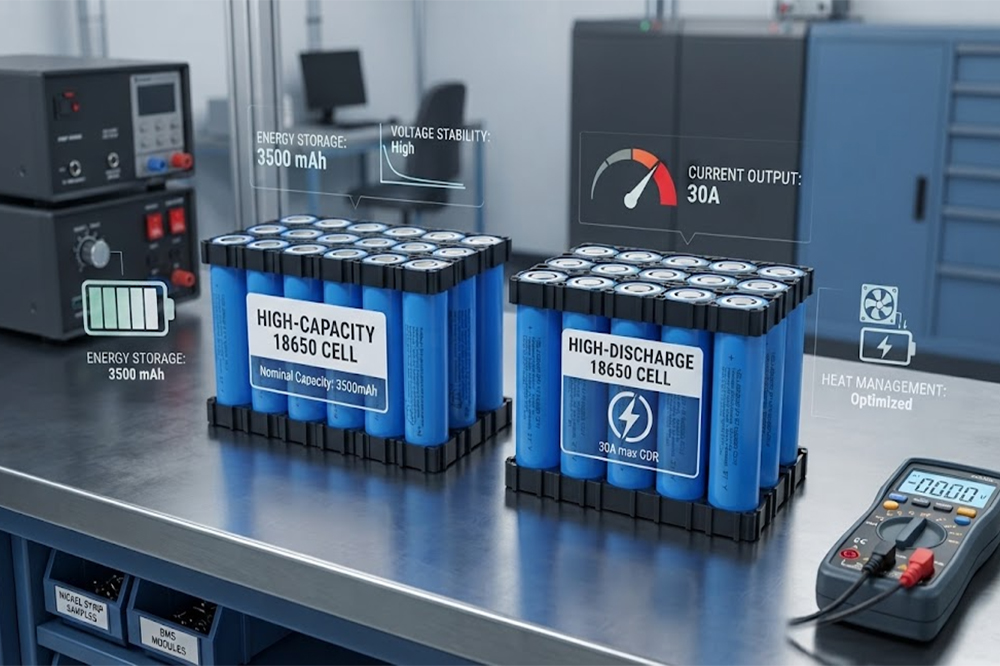
When buying 18650 lithium-ion battery cells, capacity is often the first specification people compare. A 3500mAh cell appears more attractive than a 2500mAh cell because it can store more energy. However, a high-capacity cell is not always the right choice for equipment that requires strong current output.
Some applications need longer operating time, while others need short bursts of high power. This is the main difference between high-capacity 18650 batteries and high-discharge 18650 batteries.
For OEM battery pack manufacturers, distributors, and engineering teams, the correct choice depends on the load, operating time, thermal conditions, pack configuration, and protection design. This guide explains the differences and shows how to evaluate cells before placing a bulk order.
What Is High-Capacity 18650 Battery?
A high-capacity 18650 battery is designed to store more energy within the standard 18mm × 65mm cylindrical format.
Common capacity ranges include:
- 2000mAh to 2600mAh
- 2800mAh to 3000mAh
- 3200mAh to 3500mAh
- Higher-capacity models developed for specific applications
The actual capacity depends on the cell chemistry, electrode design, manufacturing process, discharge conditions, and testing method.
A high-capacity cell is generally suitable when the equipment operates at a moderate current and needs longer runtime. Typical applications include:
- Portable lighting
- Low-power electronics
- Measuring instruments
- Backup power devices
- Moderate-current battery packs
- Consumer and industrial equipment with extended operating time
However, higher capacity does not automatically mean higher power output. Some high-capacity cells are designed for moderate discharge rates rather than demanding loads.
What Is High-Discharge 18650 Battery?
A high-discharge 18650 battery is designed to deliver a relatively high current without excessive voltage drop or heat under specified operating conditions.
These cells often have:
- Lower internal resistance
- Stronger current delivery capability
- Better performance under heavy loads
- More stable voltage during high-current discharge
- A capacity that may be lower than high-capacity alternatives
For example, a high-discharge 18650 cell may have a capacity of 2000mAh to 3000mAh but support a higher continuous discharge current than a 3500mAh high-capacity cell.

High-discharge cells are often considered for:
- Power tools
- High-output flashlights
- Cordless equipment
- RC and hobby equipment
- Portable power devices
- High-current industrial products
- Battery packs with demanding motors or inverters
The important point is that “high discharge” must be supported by a real specification. A seller’s marketing description is not enough. Buyers should check the continuous discharge current, pulse current conditions, test temperature, and discharge cutoff voltage.
High Capacity vs High Discharge: Main Differences
| Specification | High-Capacity 18650 Cell | High-Discharge 18650 Cell |
|---|---|---|
| Main design goal | Longer runtime | Higher current output |
| Typical capacity | Often higher | Often moderate |
| Internal resistance | Usually moderate or higher | Usually lower |
| Voltage sag under load | May be more noticeable | Usually better controlled |
| Heat under heavy load | Can increase quickly | Generally better suited to high current |
| Best application | Moderate-current equipment | High-power equipment |
| Runtime at low current | Usually favorable | Depends on capacity |
| High-current performance | Model-dependent | Usually stronger |
| Energy density | Often prioritized | Balanced with power capability |
| Cost | Depends on chemistry and brand | Depends on cell design and grade |
These are general tendencies, not universal rules. Some newer cells can provide both relatively high capacity and strong discharge performance. The datasheet and verified test results should always take priority over the category name.
Capacity and Discharge Current Are Different Specifications
Capacity is normally measured in milliamp-hours, or mAh. It indicates how much charge a cell can deliver under a specified test condition.
Discharge current is measured in amperes, or A. It indicates how much current the cell can provide under defined operating conditions.
For example:
- A 3500mAh cell may be suitable for a moderate-current device.
- A 2500mAh cell may be designed for a much higher continuous current.
- A 3000mAh cell may offer a balance between runtime and power output.
A simple runtime estimate is:
Runtime in hours ≈ Battery capacity in Ah ÷ Load current in A
For example, a 3000mAh cell has a nominal capacity of 3Ah. At a theoretical continuous load of 1A, the basic estimate is approximately 3 hours. Actual runtime will be lower or different because of discharge cutoff voltage, temperature, efficiency, aging, and the cell’s rated test conditions.
At a higher current, the available capacity may decrease. This is one reason why a high-capacity cell tested at a low current may not perform as expected in a high-power device.
Why Internal Resistance Matters
Internal resistance is one of the most important specifications when comparing high-capacity and high-discharge cells.
When current flows through a battery, part of the voltage is lost inside the cell. This voltage drop can be estimated using:
Voltage drop ≈ Current × Internal resistance
For example, if a cell has an internal resistance of 40mΩ and the load draws 5A:
Voltage drop ≈ 5A × 0.04Ω = 0.20V
A cell with lower internal resistance may experience less voltage sag at the same current. It may also generate less internal heat under comparable conditions.
Internal resistance is affected by:
- Cell chemistry
- Electrode design
- Temperature
- State of charge
- Cell age
- Testing equipment
- Measurement method
For bulk buyers, resistance values should be compared using the same test method. A resistance number without a test condition may not be useful for evaluating different suppliers.

Voltage Sag Can Affect Equipment Performance
Voltage sag occurs when the cell voltage drops under load. It is more noticeable when the equipment draws a high current.
A device may appear to have enough capacity but still shut down early if the battery voltage falls below its operating threshold. This can happen with:
- Motors starting under load
- High-power LED drivers
- Inverters
- Power tools
- Wireless transmitters
- Portable devices with sudden current peaks
A high-discharge cell may maintain a more stable voltage during these events. On the other hand, a high-capacity cell may provide longer runtime when the current remains moderate.
The correct cell is therefore not determined by mAh alone. The equipment’s minimum operating voltage and peak current should be checked together.
Continuous Current and Peak Current Are Not the Same
Battery suppliers may list several current values, including:
- Maximum continuous discharge current
- Recommended continuous discharge current
- Pulse discharge current
- Short-duration peak current
- Cutoff current
- Current at a specified temperature
These values should not be treated as interchangeable.
A pulse current may only be permitted for a few seconds under a specific temperature and state-of-charge condition. It does not mean the cell can safely deliver that current continuously.
When reviewing a datasheet, check:
- The continuous discharge rating
- The duration of the pulse rating
- The temperature used during testing
- The starting state of charge
- The discharge cutoff voltage
- Whether the value is tested or only claimed
- Whether the rating applies to a new cell or an aged cell
For OEM battery packs, the continuous current rating is usually more important than an attractive peak-current number.
C-Rate Provides Another Way to Compare Cells
The C-rate expresses discharge current relative to the cell’s capacity.
For a 3000mAh cell:
- 1C = 3A
- 2C = 6A
- 5C = 15A
For a 3500mAh cell:
- 1C = 3.5A
- 2C = 7A
- 5C = 17.5A
However, a C-rate should only be used when it is supported by the cell’s specifications. A high capacity does not automatically mean the cell can deliver a high current at that rate.
When comparing two cells, review both the absolute current rating and the C-rate. The absolute current value is especially useful when designing a battery pack for a known load.
Which Cell Is Better for Power Tools?
Power tools often require high current, especially during motor startup, drilling, cutting, or sudden changes in resistance.
For these applications, buyers usually need to examine:
- Continuous discharge current
- Short-duration current capability
- Internal resistance
- Voltage sag
- Cell temperature
- Cycle life under high load
- Pack configuration
- BMS or protection design
- Welding and interconnection quality
A high-capacity cell may provide longer runtime during light use, but it may not be suitable for a tool that frequently draws high current. A high-discharge cell with slightly lower capacity may offer more stable operation.
The final decision should be based on the actual motor current and operating profile rather than the capacity printed on the label.

Which Cell Is Better for Flashlights?
The answer depends on the flashlight design.
A low-power flashlight may benefit from a higher-capacity cell because the current demand is moderate. A high-output flashlight may need a cell with stronger discharge performance, especially when the driver draws several amperes.
Buyers should check:
- Flat-top or button-top terminal
- Protected or unprotected construction
- Maximum cell length
- Continuous current requirement
- Driver compatibility
- Thermal management
- Battery holder contact quality
The difference between flat-top and button-top cells is explained in more detail in the guide to flat-top vs button-top 18650 batteries.
A high-capacity cell should not be selected only because it has the largest mAh rating. The flashlight driver must be compatible with the cell’s voltage and current characteristics.
How Series and Parallel Configurations Change the Requirement
Battery pack configuration affects both voltage and current.
In a series connection:
- Voltage increases
- Capacity in Ah remains approximately the same
- The current requirement applies to each cell in the series string
In a parallel connection:
- Capacity increases
- Available current may increase
- Current sharing depends on cell matching, resistance, connections, and pack design
For example, a 4S2P battery pack uses four cell groups in series and two cells in parallel in each group. The pack voltage is determined by the four series groups, while the parallel arrangement increases capacity and current capability.
More parallel cells do not remove the need for proper cell selection. The cells should have compatible capacity, internal resistance, state of charge, and age. The BMS, nickel strip, fuse, wiring, connector, and enclosure must also be designed for the intended current.
For a broader explanation, see the guide to 18650 battery series and parallel configurations after it is published.
High-Capacity Cells May Produce More Heat at High Current
Heat generation is closely related to internal resistance and current. A simplified relationship is:
Heat generation ≈ Current² × Internal resistance
This means that increasing current can increase heat significantly. For example, doubling the current can increase resistive heat by approximately four times when resistance remains constant.
Excessive heat may affect:
- Cell aging
- Available capacity
- Cycle life
- Voltage stability
- Safety margins
- Pack reliability
A battery pack designed for high current should include appropriate spacing, thermal paths, insulation, temperature monitoring where needed, and a suitable protection system.
A high-discharge cell is not a replacement for proper pack engineering. It only provides a better starting point for demanding current conditions.
Does High Discharge Mean Lower Cycle Life?
Not necessarily. Cycle life depends on many factors, including:
- Charge and discharge current
- Depth of discharge
- Operating temperature
- Charging voltage
- Storage conditions
- Cell chemistry
- Manufacturing quality
- Mechanical stress
- Protection settings
A high-discharge cell may experience more stress when operated continuously near its maximum rating. Likewise, a high-capacity cell may age quickly if it is repeatedly used beyond its recommended current range.
For commercial battery packs, it is better to operate cells within a suitable working range rather than designing around the maximum advertised rating.
How OEM Buyers Should Compare 18650 Cells
Before selecting a cell for a custom battery pack, request the following information from the supplier:
1. Nominal Capacity
Confirm the rated capacity, test current, cutoff voltage, and testing temperature.
2. Continuous Discharge Current
Ask for the recommended working current, not only the maximum short-duration value.
3. Pulse Discharge Conditions
Check the permitted pulse duration, rest interval, temperature, and state of charge.
4. Internal Resistance
Compare resistance values measured using the same method and equipment type.
5. Voltage Curve
A discharge curve can show how the cell behaves at different current levels.
6. Cell Dimensions
Confirm the diameter, length, terminal design, and tolerance. Protected cells may be longer than standard unprotected cells.
7. Cycle Life
Ask under which charge, discharge, temperature, and capacity-retention conditions the cycle-life result was obtained.
8. Batch Consistency
For series-parallel packs, capacity and resistance matching can be more important than choosing the highest individual specification.
9. Certifications and Documents
Depending on the destination market and application, buyers may require documents such as UN38.3, MSDS, CE, RoHS, or other applicable compliance records.
10. Sample Testing
A sample batch should be tested under the actual load profile before a large production order is confirmed.
Common Mistakes When Choosing Between Capacity and Discharge
Choosing the Highest mAh Number
The highest capacity may not provide the best performance if the device needs high current.
Using Peak Current as the Continuous Rating
A short pulse specification should not be used as the normal operating current.
Ignoring Voltage Sag
A battery can have enough nominal capacity but still fail to keep the equipment above its minimum operating voltage.
Comparing Different Test Conditions
Capacity and resistance values measured at different temperatures or cutoff voltages may not be directly comparable.
Forgetting Pack-Level Losses
Nickel strips, wires, connectors, BMS components, and welding points all contribute resistance and voltage loss.
Selecting Cells Before Understanding the Load
The battery should be selected after the equipment’s voltage, current, runtime, and thermal requirements are known.
A Practical Selection Guide
Choose a high-capacity 18650 cell when:
- The load current is moderate
- Longer runtime is the main goal
- The equipment does not experience large current peaks
- Thermal conditions are controlled
- The application prioritizes energy storage
Consider a high-discharge 18650 cell when:
- The equipment draws high continuous current
- Motor startup current is significant
- Voltage sag affects operation
- The pack must deliver short bursts of power
- Heat and internal resistance need closer control
Consider a balanced cell when:
- The application needs both reasonable runtime and current capability
- The load changes during operation
- The pack will be used in industrial equipment
- The buyer wants to avoid over-sizing either capacity or discharge performance
Conclusion
High-capacity and high-discharge 18650 batteries are designed around different performance priorities. High-capacity cells focus on storing more energy, while high-discharge cells focus on delivering current with controlled voltage drop and heat.
Neither type is suitable for every application. The correct choice depends on the actual load, runtime target, current peaks, voltage range, thermal design, and battery pack configuration.
For OEM and wholesale projects, compare the complete datasheet rather than relying on the mAh number or a “high-drain” label. A properly matched cell can improve runtime, stability, cycle life, and overall pack reliability.
For standard 18650 battery sourcing and custom pack development, explore the available 18650 lithium battery cells and discuss your voltage, capacity, current, dimensions, and application requirements with the supplier.
Before comparing capacity and discharge performance, buyers should understand the basic specifications covered in our guide to standard 18650 battery specifications.
The physical format, nominal voltage, and dimensions of the cell should be confirmed before evaluating its capacity or current rating. See our guide to standard 18650 battery size and voltage.
For a closer look at common capacity options, compare 2000mAh, 2600mAh, 3000mAh, and 3500mAh 18650 batteries.
-

12V 4400 mah Lithium ion 3S2P 18650 Battery Pack
-

18650 2000mAh 3.7 volt Lithium-ion Battery
-

18650 20V 3.0Ah Cordless Drill battery
-

18650 22.2V 7.8Ah 2600Mah 6S3P Rechargeable Battery Pack
-

18650 2600mAh Rechargeable Lithium-Ion Battery 3.7V
-

18650 3.7V 10Ah Li-Ion Power Battery Pack
-

18650 3.7V 3300mah Rechargeable Lithium ion Battery
-

18650 7S7P 24V 14Ah Lithium ion Electric Scooter Battery Pack
-

18650 battery 3.7V 1500mAh Lithium-Ion Battery
-

18650 Battery 3500 mah Rechargeable Battery Cells
-

18650 Electric Scooter 48V 13000mAh Lithium Battery
-

2600mAh 3S1P 11.1V 18650 Battery Packs
-

3.7V Li ion Rechargeable 3000mah 18650 Battery Cell
-

36V 5200mAh 10S2P 18650 Battery Pack
-

48v 4400mah 13S2P 18650 Rechargeable Battery Pack
-

7S2P 24V 18650 Lithium Battery Pack
-

Electric Scooter 36V 4400mAH 10S2P 18650 Battery Pack
-

ICR 18650 Battery 2200mah 3.7V
Leave a Reply