
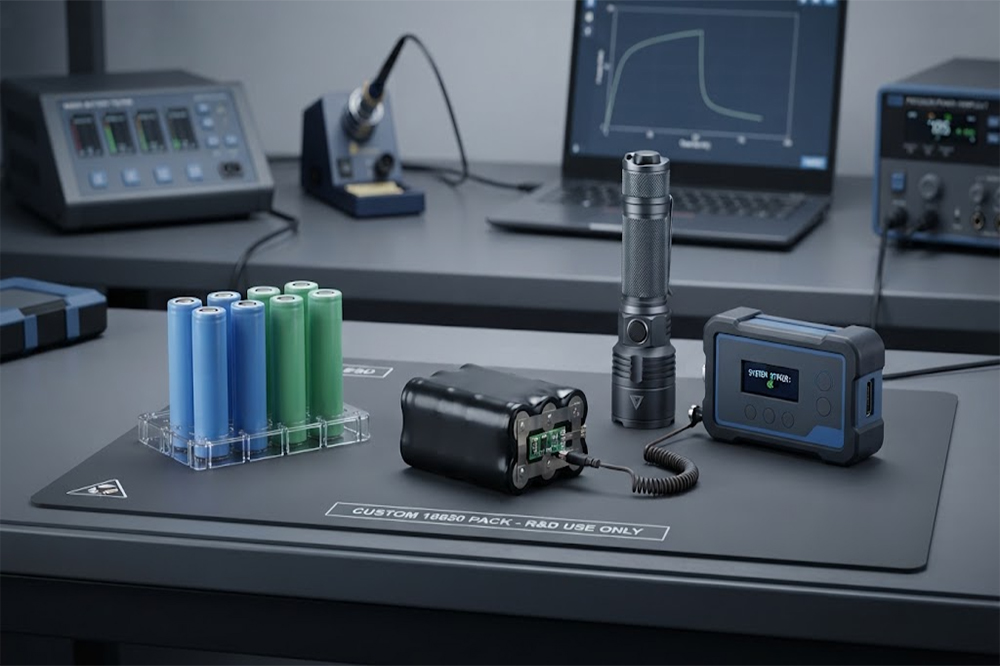
18650 lithium-ion batteries are widely used in flashlights and portable electronic equipment because they offer a useful combination of compact size, rechargeable energy storage, and flexible battery pack design.
For a flashlight manufacturer, electronics developer, or OEM buyer, however, choosing an 18650 cell is not simply about finding the highest mAh rating. The required current, operating voltage, physical dimensions, terminal type, protection design, and expected runtime all affect compatibility.
A compact flashlight with a moderate-power LED driver may have very different battery requirements from a high-output flashlight that draws several amperes. Portable electronics such as measuring instruments, communication equipment, handheld devices, and industrial terminals may have another set of requirements.
This guide explains how to evaluate 18650 cells for flashlights and portable electronics, with practical considerations for OEM development and bulk purchasing.
Why 18650 Batteries Are Used in Portable Devices
The 18650 format has a relatively compact cylindrical shape while providing more energy than many smaller cylindrical rechargeable cells.
For product designers, this can make it easier to develop:
- Rechargeable flashlights
- Portable inspection lights
- Industrial handheld devices
- Measuring instruments
- Portable displays
- Communication equipment
- GPS and navigation devices
- Backup power modules
- Custom portable electronics
- Battery-powered monitoring equipment
Another advantage is the wide range of cell specifications available.
Manufacturers can select cells according to:
- Capacity
- Discharge current
- Voltage characteristics
- Internal resistance
- Dimensions
- Cycle life
- Temperature requirements
The same physical 18650 format can therefore be used in very different products, provided that the selected cell matches the electrical and mechanical requirements.
For a basic explanation of the format, see what a standard 18650 battery is.
What Should You Check Before Choosing an 18650 Cell?
The correct cell depends on the actual product.
For a flashlight or portable electronic device, start with these specifications:
- Nominal voltage
- Full-charge voltage
- Capacity
- Continuous discharge current
- Peak current requirement
- Internal resistance
- Cell dimensions
- Terminal type
- Protection requirements
- Operating temperature
- Cycle-life requirements
Not every specification has the same importance.
For example, a low-current measuring device may place greater emphasis on capacity and cycle life. A high-output flashlight may care more about discharge current and voltage stability.
A good cell selection process begins with the load rather than the product label.
18650 Batteries for Flashlights
Flashlights are one of the most recognizable applications for 18650 cells.
A typical rechargeable flashlight may contain one 18650 cell, while higher-voltage or higher-capacity designs may use multiple cells.
The battery must work with the flashlight’s:
- LED driver
- Current regulation system
- Battery compartment
- Charging circuit
- Protection system
- Contact design
The driver’s current requirement is particularly important.
A flashlight that draws a relatively low current may work well with a higher-capacity cell designed for moderate discharge. A high-output flashlight may require a high-discharge cell with lower internal resistance.
The largest capacity available is therefore not automatically the right choice.

High-Output Flashlights Need More Than High Capacity
flashlight’s brightness is controlled by the LED and driver, but the battery must supply the electrical power demanded by the system.
high-output flashlight can produce a substantial current load. As current increases, voltage sag and heat become more important.
simplified relationship is:
Voltage drop ≈ Current × Internal resistance
A cell with lower internal resistance can generally maintain a higher voltage under the same current load.
For example, two 18650 cells may have similar nominal voltage but behave differently when the flashlight draws several amperes.
One cell may experience greater voltage sag and heat, while another may maintain more stable output.
This is why high-output flashlight designers should evaluate discharge curves and internal resistance rather than comparing only capacity.
For a detailed comparison, see high-capacity vs high-discharge 18650 batteries.
Capacity and Flashlight Runtime
Battery capacity is usually expressed in mAh.
A 3000mAh cell contains approximately 3Ah of rated charge under its specified test conditions.
A simplified runtime calculation is:
Runtime ≈ Capacity (Ah) ÷ Load current (A)
For example, a 3Ah cell operating at a theoretical 1A load would give a basic estimate of about 3 hours.
Real runtime can be different because of:
- Driver efficiency
- Battery voltage
- Discharge cutoff
- Current variation
- Temperature
- Cell aging
- Actual capacity
- Operating mode
A flashlight may also have several brightness levels. The same battery can therefore provide very different runtimes depending on how the device is used.
When developing a flashlight for commercial production, runtime should be tested with the actual driver and selected cell rather than calculated from mAh alone.
For a deeper look at common 18650 capacities, see standard 18650 battery capacity.

Battery Voltage and LED Driver Compatibility
A typical lithium-ion 18650 cell has a nominal voltage around 3.6V or 3.7V and a full-charge voltage around 4.2V.
The LED driver must be designed for this voltage range.
A driver may use:
- Buck conversion
- Boost conversion
- Buck-boost conversion
- Direct-current regulation
- Other power-control architectures
The battery voltage changes during discharge, so the driver must maintain the required LED operating conditions over the usable battery voltage range.
For multi-cell flashlights, the series configuration changes the voltage.
For example:
2S pack → approximately twice the nominal voltage of one cell
The exact voltage depends on the selected cell and charging limits.
Read 18650 battery voltage and charging limits before selecting a multi-cell configuration.
Flat-Top vs Button-Top Cells in Flashlights
Terminal shape is especially important for flashlights.
A flat-top cell has a relatively flat positive terminal, while a button-top cell has a raised positive terminal.
Some flashlight battery compartments are designed specifically for one terminal type.
The wrong cell can cause:
- Poor electrical contact
- Intermittent operation
- Excessive contact resistance
- Mechanical fit problems
- Excessive length
- Failure to make contact
The difference becomes even more important when a flashlight uses springs, fixed contacts, or a battery carrier.
Review flat-top vs button-top 18650 batteries before selecting the cell terminal design.
Protected vs Unprotected 18650 Batteries
Protection is another important consideration.
A protected 18650 cell may contain an electronic protection circuit that can help control certain abnormal electrical conditions.
Depending on the cell design, protection may address conditions such as:
- Overcharge
- Over-discharge
- Overcurrent
- Short circuit
However, protection does not make a battery suitable for every application.
A protection circuit can also increase the overall cell length and may limit current depending on its design.
Some flashlights are designed to work with protected cells, while others are designed around unprotected high-drain cells and have their own electronic protection.
For OEM products, the cell protection strategy should be considered together with the device’s charging and power-management circuit.
See protected vs unprotected 18650 batteries for a detailed comparison.
Cell Dimensions Matter More Than Expected
The name “18650” gives an approximate format, but it does not mean every cell has exactly the same dimensions.
Length can vary depending on:
- Protection circuit
- Terminal construction
- Insulation
- Manufacturing design
- Cell holder requirements
A protected 18650 can be noticeably longer than a standard unprotected cell.
This matters when the battery compartment has limited space.
Before placing a large OEM order, check:
- Cell diameter
- Cell length
- Positive terminal height
- Negative terminal structure
- Insulation thickness
- Required clearance
For more information, see 18650 battery dimensions and size tolerance.
18650 Batteries for Portable Electronics
Flashlights are only one application.
18650 cells are also considered for many portable electronic products where rechargeable energy storage is required.
Examples include:
- Portable test equipment
- Handheld scanners
- Industrial terminals
- Portable monitors
- Data collection devices
- Communication equipment
- Portable displays
- Inspection equipment
- Electronic instruments
The current requirement of these devices can vary substantially.
A handheld instrument that consumes 500mA continuously may prioritize energy capacity. Another device with a motor, pump, radio transmitter, or powerful processor may experience higher current peaks.
The battery should therefore be selected from the complete power budget.
Calculate the Device’s Actual Power Requirement
A useful starting point is:
Power (W) = Voltage (V) × Current (A)
For example, if an electronic device operates at 3.7V and draws 2A:
Power ≈ 3.7V × 2A = 7.4W
This does not mean a single 18650 cell will always be the correct solution. The device may require voltage conversion, multiple cells, or additional regulation.
The power budget should include:
- Average current
- Peak current
- Startup current
- Standby current
- Converter efficiency
- Battery cutoff voltage
- Expected operating time
This information gives the battery supplier a much clearer picture of the required cell performance.
Average Current vs Peak Current
Portable electronics often have changing power demands.
A device may spend most of its time at a low current but periodically require a much higher current.
For example:
- Display operation may use moderate current
- Wireless transmission may create a temporary peak
- motor may require high startup current
- processor may briefly increase consumption
- flashlight driver may change current according to brightness mode
The battery therefore needs to support the peak without causing unacceptable voltage sag.
When requesting an OEM cell, provide both average and peak current whenever possible.
When Is a High-Capacity 18650 a Better Choice?
A high-capacity cell may be useful when:
- Current demand is moderate
- Long runtime is important
- The device spends most of its time at low or medium power
- The enclosure can accommodate the selected cell
- The discharge current requirement is within the cell’s specification
Portable measuring equipment and moderate-power electronics can sometimes benefit from this approach.
The important point is that capacity should be considered together with discharge conditions.
A 3500mAh cell tested at a relatively low current does not necessarily provide the same practical performance as a 3000mAh cell designed for a higher current load.
When Is a High-Discharge 18650 a Better Choice?
A high-discharge cell may be more appropriate when the product has:
- High continuous current
- Significant startup current
- Short high-power bursts
- Strict voltage requirements
- High-power LED drivers
- Motors or pumps
- Inverters or converters with substantial current demand
The trade-off can be lower capacity compared with some high-capacity cells.
For product developers, the decision should be based on the complete load profile.
A slightly lower-capacity cell that maintains better voltage under load may provide better real-world performance than a higher-capacity cell that experiences excessive voltage sag.
Internal Resistance and Contact Resistance
Internal resistance is not the only resistance in a portable device.
The complete electrical path may include resistance from:
- Battery contacts
- Springs
- Holders
- PCB traces
- Switches
- Connectors
- Wires
- Protection circuits
This becomes important at higher current.
Suppose a flashlight draws 5A. Even a small additional resistance in the battery contacts can produce noticeable voltage loss and heat.
For OEM designs, contact resistance should therefore be considered during prototype testing.
A good cell can still perform poorly if the device uses undersized wires, weak contacts, or poorly designed connectors.
Battery Holders vs Spot-Welded Packs
Portable electronics can use either removable cells or permanently assembled battery packs.
Removable Cell Design
A removable cell can make replacement easier and may simplify certain product designs.
However, the holder must provide:
- Reliable contact pressure
- Low contact resistance
- Mechanical retention
- Suitable current capability
- Correct polarity protection
Spot-Welded Battery Pack
A welded pack can provide a more integrated solution for OEM products.
It may include:
- Multiple 18650 cells
- Nickel strips
- BMS
- Temperature sensors
- Custom wiring
- Connector
- Custom enclosure
Welded packs are useful when the manufacturer wants a dedicated battery shape and electrical interface.
For multi-cell products, the quality of cell matching and welding becomes increasingly important.
Series and Parallel Configurations
Portable electronic products may require more voltage or capacity than one cell can provide.
Series connections increase voltage.
Parallel connections increase capacity and can increase current capability when properly designed.
For example:
2S1P
Two cells connected in series provide a higher nominal voltage than one cell.
2S2P
Four cells are arranged as two series groups, with two cells in parallel in each group.
The actual configuration should be based on the device voltage, current, runtime, and available space.
For a deeper explanation, see 18650 battery series and parallel configurations after publication.
Temperature and Portable Electronics
Temperature can affect battery performance significantly.
Cold conditions can increase internal resistance and reduce available performance. High temperatures can accelerate battery aging and may affect cycle life.
Portable products may be used in:
- Outdoor environments
- Warehouses
- Vehicles
- Industrial workshops
- Cold storage areas
- Hot climates
The expected operating temperature should therefore be included in the battery specification.
For an OEM project, test the battery and product together at the expected temperature range rather than testing the cell only at room temperature.
Charging Design
The charging system must be compatible with the selected 18650 cell and pack configuration.
For a single common lithium-ion cell, the charging system is generally designed around a maximum charging voltage of approximately 4.2V.
Multi-cell packs require an appropriate charging voltage based on the number of series cells.
The charging design should consider:
- Cell chemistry
- Series count
- Maximum charge voltage
- Charging current
- BMS
- Temperature
- Connector
- Charger communication
The battery and charger should be evaluated as a complete system.
Quality Testing for OEM Flashlight and Electronics Batteries
Before mass production, OEM buyers should consider sample testing.
Useful tests include:
Capacity Test
Measure actual capacity under defined conditions.
Internal Resistance Test
Check consistency between cells or batches.
Discharge Test
Evaluate the cell under the actual current profile.
Temperature Test
Monitor cell and pack temperature during high-load operation.
Runtime Test
Operate the complete product until the specified cutoff.
Charging Test
Confirm the battery and charger operate correctly throughout the charging cycle.
Cycle Test
Evaluate capacity retention over repeated charge and discharge cycles when long service life is important.
The test method should be documented so that different suppliers and batches can be compared consistently.
What Wholesale and OEM Buyers Should Ask Suppliers
When sourcing 18650 cells for flashlights or portable electronics, request:
- Nominal voltage
- Rated capacity
- Continuous discharge current
- Peak discharge conditions
- Internal resistance
- Cell dimensions
- Terminal type
- Protected or unprotected construction
- Operating temperature
- Cycle-life test conditions
- Production batch information
- Capacity test data
- Resistance test data
- Applicable compliance documents
For custom battery packs, also provide:
- Device voltage
- Average current
- Peak current
- Required runtime
- Maximum battery dimensions
- Connector type
- Housing drawing
- Charging method
- Annual demand
The more complete the application information, the easier it is for the supplier to recommend an appropriate cell and pack configuration.
Common Mistakes When Choosing 18650 Batteries
Choosing the Highest Capacity
The highest mAh rating may not be suitable for a high-current device.
Ignoring Terminal Type
A flat-top and button-top cell may not be mechanically interchangeable.
Forgetting Protected Cell Length
Protection circuits can increase the overall length of an 18650 cell.
Looking Only at Nominal Voltage
The device must work across the cell’s actual operating voltage range.
Ignoring Peak Current
Short current peaks can still cause voltage sag and unexpected shutdowns.
Testing the Cell Without the Device
The actual driver, holder, wiring, and PCB all affect battery performance.
Comparing Specifications Without Test Conditions
Capacity and resistance figures should be compared using consistent measurement conditions.
Practical Selection Guide
For low-power portable electronics, prioritize:
- Suitable capacity
- Low self-discharge
- Stable voltage
- Appropriate dimensions
- Required cycle life
For high-output flashlights, prioritize:
- Suitable continuous current
- Peak current capability
- Low internal resistance
- Voltage stability
- Driver compatibility
- Correct terminal type
For industrial portable equipment, consider:
- Capacity
- Current profile
- Temperature range
- Mechanical design
- BMS requirements
- Cycle life
- Documentation
For OEM battery packs, evaluate:
- Cell consistency
- Series-parallel configuration
- BMS
- Welding
- Insulation
- Connector
- Housing
- Thermal behavior
- Production testing
Conclusion
18650 batteries can be a practical power source for flashlights and portable electronic equipment, but the right cell depends on the product’s actual electrical and mechanical requirements.
moderate-current devices, a high-capacity cell may provide useful runtime. High-output flashlights and other demanding equipment may require a high-discharge cell with suitable current capability and lower voltage sag.
Terminal type, dimensions, protection architecture, internal resistance, temperature, and charging requirements also need to be considered.
OEM and wholesale buyers, the most reliable approach is to provide the supplier with the device’s voltage, average current, peak current, required runtime, dimensions, and operating environment. Sample testing with the complete product can then confirm whether the selected 18650 cell performs as expected.
For standard 18650 cell sourcing and custom battery pack development, explore our 18650 lithium battery cells.
-

12V 4400 mah Lithium ion 3S2P 18650 Battery Pack
-

18650 2000mAh 3.7 volt Lithium-ion Battery
-

18650 20V 3.0Ah Cordless Drill battery
-

18650 22.2V 7.8Ah 2600Mah 6S3P Rechargeable Battery Pack
-

18650 2600mAh Rechargeable Lithium-Ion Battery 3.7V
-

18650 3.7V 10Ah Li-Ion Power Battery Pack
-

18650 3.7V 3300mah Rechargeable Lithium ion Battery
-

18650 7S7P 24V 14Ah Lithium ion Electric Scooter Battery Pack
-

18650 battery 3.7V 1500mAh Lithium-Ion Battery
-

18650 Battery 3500 mah Rechargeable Battery Cells
-

18650 Electric Scooter 48V 13000mAh Lithium Battery
-

2600mAh 3S1P 11.1V 18650 Battery Packs
-

3.7V Li ion Rechargeable 3000mah 18650 Battery Cell
-

36V 5200mAh 10S2P 18650 Battery Pack
-

48v 4400mah 13S2P 18650 Rechargeable Battery Pack
-

7S2P 24V 18650 Lithium Battery Pack
-

Electric Scooter 36V 4400mAH 10S2P 18650 Battery Pack
-

ICR 18650 Battery 2200mah 3.7V
Leave a Reply