
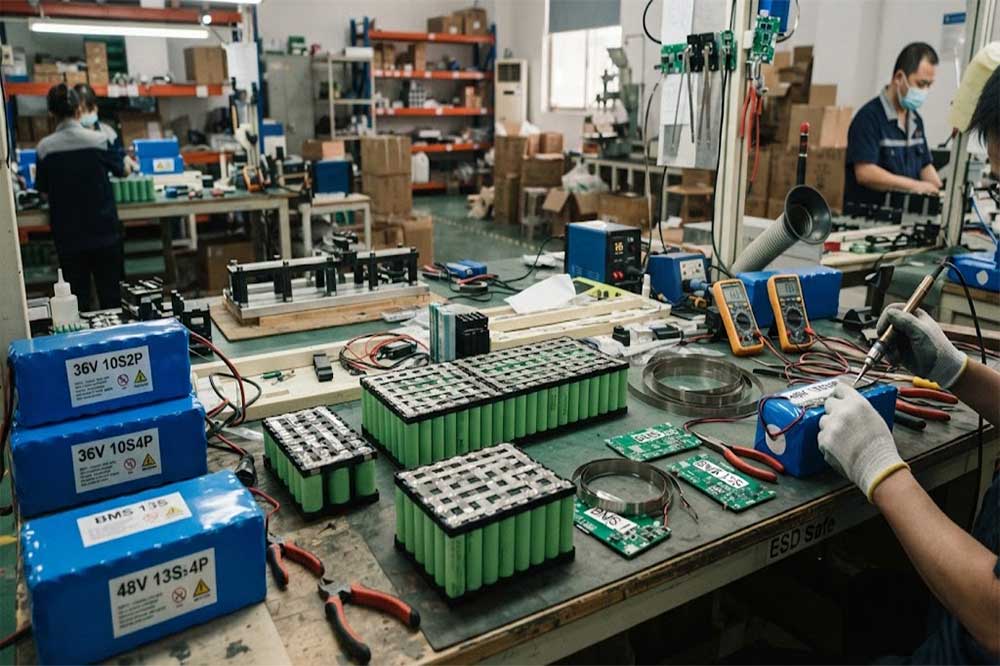
How many 18650 cells do you need for a battery pack? It depends on more than the battery voltage.
The required cell count is mainly determined by the series and parallel configuration, but capacity, discharge current, available space, BMS requirements, and cell specifications also matter.
For example, a 36V-class battery may use 10 cells in series, while a 48V-class lithium-ion battery commonly uses 13 cells in series. The number of cells connected in parallel then determines how much capacity the pack can provide.
Understanding this basic relationship makes it much easier to plan 18650 battery pack for an e-bike, power tool, portable device, or custom OEM project.
The Basic Rule: S × P = Total Cells
An 18650 battery pack is usually described using S and P.
- S = cells connected in series
- P = cells connected in parallel
- S × P = total number of cells
For example, a 10S2P battery pack contains:
10 cells in series × 2 cells in parallel = 20 cells
A 13S4P pack contains:
13 × 4 = 52 cells
This is the simplest way to calculate the physical cell count.
However, the harder question is deciding how many cells should be connected in series and parallel in the first place.

Series Determines Battery Voltage
When 18650 cells are connected in series, their voltage adds together.
Suppose the selected cell has a nominal voltage of 3.6V.
A 10S configuration gives:
3.6V × 10 = 36V nominal
If the cell is charged to 4.2V:
4.2V × 10 = 42V maximum
So this battery would normally be described as a 36V-class lithium-ion battery, with a maximum charging voltage of 42V.
The exact voltage depends on the cell chemistry and the charging specification.
This is important when replacing or designing a battery. The label “36V” does not tell you the complete electrical specification.
For a more detailed explanation, see [18650 Battery Voltage: 3.6V vs 3.7V and 4.2V Explained].
Parallel Determines Capacity
Parallel connections work differently.
When identical cells are connected in parallel, their capacity is added.
For example, if one 18650 cell has a capacity of 3000mAh:
- 1P = 3000mAh
- 2P = 6000mAh
- 3P = 9000mAh
- 4P = 12000mAh
So a 10S4P pack using 3000mAh cells has a nominal capacity of:
3Ah × 4 = 12Ah
The series count remains 10, so the nominal voltage is still about 36V.
That gives a simplified specification of:
10S4P — 36V nominal — 12Ah — 40 cells
The capacity of the individual cell therefore has a direct effect on the number of parallel cells required.
Our guide to [Standard 18650 Battery Capacity: 2000mAh, 2600mAh, 3000mAh or 3500mAh?] explains the differences between common capacity options.
How Many Cells Are in 36V Battery?
A common lithium-ion configuration for a 36V-class battery is 10S.
The parallel count depends on the required capacity.
Using 3000mAh cells:
| Configuration | Nominal Voltage | Capacity | Total Cells |
|---|---|---|---|
| 10S1P | 36V | 3Ah | 10 |
| 10S2P | 36V | 6Ah | 20 |
| 10S3P | 36V | 9Ah | 30 |
| 10S4P | 36V | 12Ah | 40 |
| 10S5P | 36V | 15Ah | 50 |
The important point is that 36V does not mean 10 cells total.
It tells you approximately how many cells are needed in series. The final cell count depends on the required capacity and current.
For example, a 36V 12Ah pack using 3000mAh cells would need approximately:
10S4P = 40 cells
How Many Cells Are in 48V Battery?
A common configuration for a 48V-class lithium-ion battery is 13S.
With 3.6V nominal cells:
13 × 3.6V = 46.8V nominal
At 4.2V per cell:
13 × 4.2V = 54.6V maximum
The “48V” label is therefore a commercial voltage class rather than the exact nominal voltage.
Using 3000mAh cells:
| Configuration | Nominal Voltage | Capacity | Total Cells |
|---|---|---|---|
| 13S1P | 46.8V | 3Ah | 13 |
| 13S2P | 46.8V | 6Ah | 26 |
| 13S3P | 46.8V | 9Ah | 39 |
| 13S4P | 46.8V | 12Ah | 52 |
| 13S5P | 46.8V | 15Ah | 65 |
| 13S6P | 46.8V | 18Ah | 78 |
For example, a 48V-class 15Ah battery using 3000mAh cells could use:
13S5P = 65 cells
The final design still needs to be checked against the required discharge current, enclosure size, BMS and thermal conditions.
What About 52V Battery?
A 52V-class lithium-ion battery commonly uses 14S.
Using 3.6V cells:
14 × 3.6V = 50.4V nominal
And:
14 × 4.2V = 58.8V maximum
For example, a 14S4P pack using 3000mAh cells contains:
14 × 4 = 56 cells
Its simplified nominal capacity is:
3Ah × 4 = 12Ah
So the pack can be described approximately as:
14S4P / 50.4V nominal / 12Ah / 56 cells
As with a 48V-class battery, the actual charger and equipment specifications should be checked before finalizing the design.
A Quick Voltage Reference
For a typical lithium-ion design using 3.6V nominal and 4.2V maximum per cell:
| Battery Class | Series Configuration | Nominal Voltage | Maximum Voltage |
|---|---|---|---|
| 24V-class | 7S | 25.2V | 29.4V |
| 36V-class | 10S | 36.0V | 42.0V |
| 48V-class | 13S | 46.8V | 54.6V |
| 52V-class | 14S | 50.4V | 58.8V |
These configurations are common reference points for lithium-ion battery design. They are not universal rules for every battery chemistry.
The actual series count should follow the cell chemistry, equipment, charger and BMS requirements.
How Do You Calculate the Required Parallel Count?
Once the series count is known, the next question is usually capacity.
The basic calculation is:
Parallel Count = Required Capacity ÷ Cell Capacity
For example, suppose the project requires approximately 10Ah and the selected 18650 cell is rated at 3000mAh.
3000mAh = 3Ah.
Therefore:
10Ah ÷ 3Ah = 3.33
You cannot build a battery with 3.33 cells in parallel.
The design therefore needs a whole-number configuration, such as 4P.
With a 10S arrangement:
10S4P = 40 cells
The finished pack would provide approximately:
36V nominal / 12Ah / 40 cells
This is why the final capacity is sometimes higher than the original target.
Capacity Is Not the Only Reason to Add Parallel Cells
It is tempting to select the P count only from the desired Ah rating.
That can be a problem for high-current applications.
Suppose a device requires a relatively high continuous current. Adding cells in parallel can help distribute the load across more cells, depending on the cell’s actual specifications and the complete pack design.
A simplified estimate is:
Pack current capability ≈ Cell current capability × Parallel count
But this is only a starting point.
Actual performance also depends on:
- Cell temperature
- Internal resistance
- BMS current limit
- Connection resistance
- Nickel strip or busbar design
- Peak versus continuous current
- Cell aging
- Thermal management
For high-current applications, do not select the cells based only on the mAh number.
See [18650 Battery Discharge Current: What Buyers Should Check] for a closer look at current requirements.

High Capacity Does Not Always Mean More Suitable
Consider two possible 18650 cells:
Cell A: 3500mAh
Cell B: 3000mAh
Cell A provides more capacity per cell, but that does not automatically make it the better choice for every battery pack.
The application may require higher discharge capability, different internal resistance, or a different balance between energy density and thermal performance.
For this reason, OEM battery design often starts with the application requirements rather than simply choosing the highest mAh cell available.
Read [High Capacity vs High Discharge 18650 Batteries] before selecting cells for a high-load battery.
How Much Energy Will the Pack Store?
Capacity in Ah is useful, but energy in Wh often gives a clearer picture of the complete battery.
A simplified calculation is:
Energy (Wh) ≈ Nominal Voltage × Capacity (Ah)
For example:
36V × 12Ah = 432Wh
A 48V-class pack using 46.8V nominal voltage and 12Ah capacity would be:
46.8V × 12Ah = 561.6Wh
This does not mean all of that energy will necessarily be available to the equipment.
Usable energy can be affected by discharge conditions, temperature, cutoff settings, cell aging, BMS behavior and other factors.
For more detail, see [How Much Energy Does 18650 Battery Hold? A Simple Wh Guide].
Physical Size Can Change the Battery Design
The mathematical answer is only the beginning.
Imagine that the electrical calculation gives you a 13S6P configuration.
That means:
13 × 6 = 78 cells
But will 78 cells actually fit inside the product?
The answer depends on the available enclosure.
The battery designer may need to consider:
- Cell arrangement
- Pack length
- Pack width
- Pack height
- BMS location
- Connector location
- Wiring
- Insulation
- Cell holders or spacers
- Cooling requirements
- Mounting points
The 18650 format gives a useful starting point, but individual cells can have different dimensions and terminal designs.
See [18650 Battery Dimensions: What Does 18650 Really Mean?] before fixing the mechanical layout.
Cell Matching Matters in Larger Packs
A battery pack containing dozens of cells needs consistent cell performance.
Manufacturers may check characteristics such as:
- Capacity
- Internal resistance
- Voltage
- Appearance
- Batch information
- Self-discharge behavior
This process is commonly referred to as cell matching.
The purpose is to build a more consistent battery pack rather than combining cells with significantly different characteristics.
For OEM production, matching becomes especially important when the same battery configuration will be produced repeatedly.
What Role Does the BMS Play?
The BMS should be considered as part of the battery design from the beginning.
For a multi-cell lithium-ion pack, the BMS may manage functions such as:
- Overcharge protection
- Over-discharge protection
- Over-current protection
- Short-circuit protection
- Cell balancing
- Temperature monitoring
The required BMS configuration depends on the battery’s series count, current requirements and cell chemistry.
For example, a 13S battery needs a BMS designed for the corresponding series configuration.
A BMS cannot compensate for an unsuitable cell selection or poor pack construction. The cells, electrical connections, insulation, charging system and thermal design all need to work together.
A Practical Example: 36V 10Ah
Let’s take a simple OEM example.
The project requires:
- 36V-class battery
- Around 10Ah
- 3000mAh 18650 cells
Step 1: Select the series count
A 36V-class lithium-ion battery commonly uses:
10S
Step 2: Calculate parallel count
Each cell is 3Ah.
Required capacity:
10Ah ÷ 3Ah = 3.33P
The practical whole-number choice is:
4P
Step 3: Calculate total cells
10S × 4P = 40 cells
Step 4: Calculate capacity
3Ah × 4 = 12Ah
So the resulting configuration is:
10S4P / 40 cells / approximately 36V 12Ah
The pack exceeds the original 10Ah target because the selected cells are discrete components.
This is a normal part of battery pack design.
Another Example: 48V 20Ah
Now consider a larger battery.
Required:
- 48V-class
- Around 20Ah
- 3500mAh cells
A common series configuration is:
13S
Each cell provides approximately 3.5Ah.
Required parallel count:
20Ah ÷ 3.5Ah = 5.71P
A practical configuration would therefore be:
6P
Total cell count:
13 × 6 = 78 cells
Nominal capacity:
3.5Ah × 6 = 21Ah
So the simplified configuration is:
13S6P / 78 cells / approximately 46.8V 21Ah
The final design still needs to be reviewed for current, size, weight, thermal behavior and BMS compatibility.
The Battery Enclosure Should Be Checked Early
One common mistake is to calculate the electrical configuration first and think about the enclosure later.
For a small battery, this may be manageable.
For a 40-, 60- or 80-cell pack, the mechanical layout can become a major part of the project.
The manufacturer may need to change the cell arrangement to fit:
- An existing enclosure
- A device housing
- A battery compartment
- Mounting rails
- A specific connector position
- Required insulation and spacing
This is why OEM buyers should provide drawings whenever possible.
A simple enclosure drawing can save several rounds of battery design changes.
What Should You Tell an OEM Battery Supplier?
Instead of sending only:
48V 20Ah battery
provide as much of the following information as possible:
Voltage:
36V, 48V-class, 52V-class, etc.
Capacity:
10Ah, 15Ah, 20Ah, etc.
Continuous current:
The expected continuous load.
Peak current:
Include the peak value and duration if available.
Cell type:
18650 lithium-ion, preferred capacity, discharge requirements, etc.
Maximum dimensions:
Length × width × height.
BMS:
Required current rating and functions.
Connector:
Connector model, cable length and polarity where applicable.
Charger:
Charging voltage and current.
Quantity:
Prototype quantity and expected production volume.
Application:
E-bike, power tool, portable equipment, industrial equipment, or another application.
Drawings:
Mechanical drawings, battery compartment dimensions or samples.
This information gives the battery manufacturer a much clearer starting point for cell selection and pack design.
Common Mistakes When Calculating 18650 Cell Count
Only calculating the voltage
Voltage determines the series count, but not the complete battery design.
Choosing the P count from capacity alone
High-current equipment may need a different configuration even when the Ah requirement looks acceptable.
Forgetting maximum charging voltage
A 48V-class lithium-ion battery can have a full-charge voltage significantly higher than its nominal voltage.
Ignoring physical dimensions
A configuration that works on paper may not fit inside the product.
Using cells with different characteristics
Cell consistency becomes increasingly important as the number of cells increases.
Selecting the BMS too late
The BMS should match the series count, current requirements and battery chemistry.
Quick Formula Guide
For a typical lithium-ion 18650 battery pack:
Total cells
S × P
Pack capacity
Cell capacity × P
Approximate energy
Nominal voltage × Ah
Approximate nominal voltage
Cell nominal voltage × S
These formulas are useful for initial planning.
They should not replace detailed battery engineering when the pack will be used in high-current, high-power or safety-critical applications.

From Cell Count to a Complete Battery Pack
Calculating the number of 18650 cells is an important first step, but it is not the entire battery design.
A production battery may involve:
Cell selection → cell matching → S/P configuration → welding or busbar connection → insulation → BMS → wiring → enclosure → charging → testing
Each stage can affect the final performance of the pack.
For a simple consumer device, the calculation may be relatively straightforward. For an OEM project, the electrical and mechanical requirements should be considered together from the beginning.
Conclusion
So, how many 18650 cells do you need for a battery pack?
Start with the required voltage and capacity.
Determine the series count from the target voltage, then determine the parallel count from the required capacity and current. Finally, multiply the two numbers:
Total Cell Count = S × P
For example:
- 10S4P = 40 cells
- 13S4P = 52 cells
- 13S6P = 78 cells
- 14S4P = 56 cells
But the cell count alone does not define a good battery pack.
Cell performance, discharge current, dimensions, BMS, thermal conditions, charger requirements and mechanical layout all need to be checked before production.
For OEM buyers, providing these details early makes it much easier for a battery manufacturer to recommend a practical 18650 battery configuration.
-

12V 4400 mah Lithium ion 3S2P 18650 Battery Pack
-

18650 2000mAh 3.7 volt Lithium-ion Battery
-

18650 20V 3.0Ah Cordless Drill battery
-

18650 22.2V 7.8Ah 2600Mah 6S3P Rechargeable Battery Pack
-

18650 2600mAh Rechargeable Lithium-Ion Battery 3.7V
-

18650 3.7V 10Ah Li-Ion Power Battery Pack
-

18650 3.7V 3300mah Rechargeable Lithium ion Battery
-

18650 7S7P 24V 14Ah Lithium ion Electric Scooter Battery Pack
-

18650 battery 3.7V 1500mAh Lithium-Ion Battery
-

18650 Battery 3500 mah Rechargeable Battery Cells
-

18650 Electric Scooter 48V 13000mAh Lithium Battery
-

2600mAh 3S1P 11.1V 18650 Battery Packs
-

3.7V Li ion Rechargeable 3000mah 18650 Battery Cell
-

36V 5200mAh 10S2P 18650 Battery Pack
-

48v 4400mah 13S2P 18650 Rechargeable Battery Pack
-

7S2P 24V 18650 Lithium Battery Pack
-

Electric Scooter 36V 4400mAH 10S2P 18650 Battery Pack
-

ICR 18650 Battery 2200mah 3.7V
Leave a Reply