
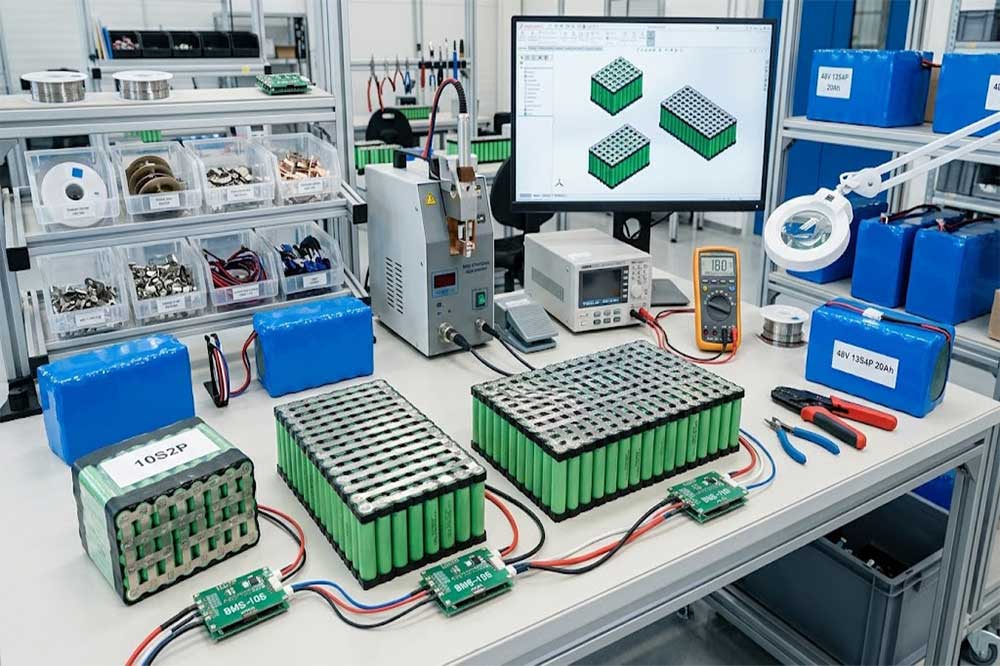
When several 18650 cells are combined into one battery pack, the cells can be connected in series, parallel, or a combination of both.
This is where terms such as 10S2P, 10S4P, and 13S4P come from.
The basic idea is simple. Series connections increase voltage, while parallel connections increase capacity and help distribute the load across more cells. A battery pack can then combine both methods to reach the voltage, capacity, and current required by the application.
For anyone designing or sourcing a custom 18650 battery pack, understanding S and P configurations is one of the most useful starting points.
What Do S and P Mean on 18650 Battery Pack?
The letters are straightforward:
- S = Series
- P = Parallel
The number before S tells you how many cells or parallel groups are connected in series.
The number before P tells you how many cells are connected in parallel within each group.
For example:
10S2P
means 10 series groups, with 2 cells in parallel in each group.
The total number of cells is:
10 × 2 = 20 cells
A 13S4P pack contains:
13 × 4 = 52 cells
The S/P notation therefore gives engineers a quick way to describe the basic structure of a battery pack.

What Happens When 18650 Cells Are Connected in Series?
A series connection adds the voltage of the cells.
Suppose one 18650 cell has a nominal voltage of 3.6V.
Two cells in series provide approximately:
3.6V × 2 = 7.2V
Ten cells in series provide:
3.6V × 10 = 36V
Thirteen cells provide:
3.6V × 13 = 46.8V
The same principle applies to the maximum charging voltage.
If the cell’s specified maximum charging voltage is 4.2V, a 10S configuration reaches:
4.2V × 10 = 42V
A 13S configuration reaches:
4.2V × 13 = 54.6V
This is why the series count must match the charger, BMS, and equipment.
For a more detailed explanation of nominal and full-charge voltage, see [18650 Battery Voltage: 3.6V vs 3.7V and 4.2V Explained].
What Happens When 18650 Cells Are Connected in Parallel?
Parallel connections work mainly with capacity and current sharing.
Suppose one cell has a capacity of 3000mAh.
Two cells in parallel provide approximately:
3000mAh × 2 = 6000mAh
Four cells provide:
3000mAh × 4 = 12000mAh
The voltage remains approximately the same as one cell.
So a 1P group made from a 3.6V 3000mAh cell is approximately:
3.6V / 3Ah
A 4P group is approximately:
3.6V / 12Ah
The voltage has not become 14.4V. The capacity has increased instead.
This difference between series and parallel is the key concept behind most multi-cell battery packs.
Series vs Parallel at a Glance
| Connection | Main Effect | Voltage | Capacity |
|---|---|---|---|
| 1S1P | Single cell | Cell voltage | Cell capacity |
| Series | Increases voltage | Higher | Essentially unchanged |
| Parallel | Increases capacity | Essentially unchanged | Higher |
| Series + Parallel | Adjusts both | Higher | Higher |
This simple table explains why most practical 18650 packs use both S and P.
A battery for a low-voltage device may require only a few cells, while an e-bike or industrial battery may use dozens of cells in a larger S/P arrangement.
How Does 10S4P Battery Pack Work?
10S4P is a useful example because it shows both connections at the same time.
Imagine four 18650 cells connected in parallel.
That creates one 4P group.
Now create ten identical groups and connect those groups in series.
The result is:
10S4P
Using 3.6V, 3000mAh cells:
- Nominal voltage: 36V
- Capacity: 12Ah
- Total cells: 40
The physical cell count is:
10 × 4 = 40 cells
The 10 series groups determine the voltage.
The four cells in each group determine the capacity and help share the load.
How Does a 13S4P Battery Pack Work?
A 13S4P battery uses the same basic idea but has more series groups.
Using 3.6V, 3000mAh cells:
13 × 3.6V = 46.8V nominal
And:
4 × 3Ah = 12Ah
The total cell count is:
13 × 4 = 52 cells
So the simplified configuration is:
13S4P / 46.8V / 12Ah / 52 cells
This is a common type of configuration for a 48V-class lithium-ion battery.
The commercial label may say “48V,” while the detailed engineering specification uses the actual nominal voltage and maximum charging voltage.

Why Not Simply Connect More Cells in Series?
Adding more cells in series increases voltage.
That sounds useful, but it also changes the requirements for the entire battery system.
A higher series count can require:
- A different BMS
- A different charger
- More cell voltage monitoring
- Different insulation requirements
- Different equipment voltage compatibility
- More attention to cell balancing
The series count should therefore be selected from the requirements of the equipment rather than simply adding cells to obtain a higher voltage.
Why Add More Cells in Parallel?
There are two common reasons.
The first is higher capacity.
If one cell provides 3Ah, four cells in parallel provide approximately 12Ah.
The second is load sharing.
A larger parallel group can distribute current across more cells. This can be important for applications with higher continuous or peak current demands.
However, the actual current capability of the pack depends on the cell’s specifications, temperature, BMS, connections, thermal design, and other factors.
The P count should not be selected from a simple current multiplication alone.
For more information, see [18650 Battery Discharge Current: What Buyers Should Check].
How S/P Configuration Affects Battery Capacity
The basic capacity relationship is:
Pack Capacity ≈ Cell Capacity × P
The series count does not directly multiply the Ah rating.
For example, using 3000mAh cells:
10S1P = 3Ah
10S2P = 6Ah
10S3P = 9Ah
10S4P = 12Ah
The voltage changes with the S count, while the capacity changes with the P count.
This is why a 10S4P pack and a 13S4P pack can both have 12Ah when they use the same 3000mAh cells, even though their voltage is different.
How S/P Configuration Affects Energy
Battery energy is approximately:
Energy (Wh) = Nominal Voltage × Capacity (Ah)
For a 10S4P pack using 3000mAh cells:
36V × 12Ah = 432Wh
For a 13S4P pack:
46.8V × 12Ah = 561.6Wh
Both packs have the same nominal capacity of 12Ah.
The 13S4P pack contains more energy because its nominal voltage is higher.
This is an important distinction when comparing battery specifications. Looking only at Ah can give an incomplete picture.
For a detailed explanation, see [How Much Energy Does an 18650 Battery Hold? A Simple Wh Guide].

Common 18650 S/P Configurations
Here are some simplified examples using 3.6V, 3000mAh cells:
| Configuration | Nominal Voltage | Capacity | Total Cells |
|---|---|---|---|
| 5S2P | 18V | 6Ah | 10 |
| 7S2P | 25.2V | 6Ah | 14 |
| 10S2P | 36V | 6Ah | 20 |
| 10S4P | 36V | 12Ah | 40 |
| 13S2P | 46.8V | 6Ah | 26 |
| 13S4P | 46.8V | 12Ah | 52 |
| 13S6P | 46.8V | 18Ah | 78 |
| 14S4P | 50.4V | 12Ah | 56 |
These numbers are simplified examples.
The actual battery design needs to consider the selected cell, operating current, charger, BMS and mechanical layout.
10S2P vs 10S4P: What Is the Difference?
Both configurations have the same series count.
Therefore, assuming the same cells, they have approximately the same nominal voltage.
The difference is the parallel count.
10S2P
Using 3000mAh cells:
- 36V nominal
- 6Ah
- 20 cells
10S4P
Using the same cells:
- 36V nominal
- 12Ah
- 40 cells
The 10S4P battery has twice the capacity and twice the number of cells.
It will also normally be larger and heavier.
This is a simple example of how the P count changes the physical size of a battery.
13S2P vs 13S4P
The same comparison can be made with a 48V-class battery.
13S2P
26 cells
Approximately:
46.8V / 6Ah
13S4P
52 cells
Approximately:
46.8V / 12Ah
Again, the voltage remains approximately the same because the S count has not changed.
The capacity doubles because the P count doubles.
Does More P Always Mean a Better Battery?
No.
A larger parallel count can increase capacity and help distribute current, but it also increases:
- Cell count
- Pack size
- Weight
- Cost
- Assembly work
- Connection points
- Potential thermal load
The right P count is therefore a balance between the electrical requirements and the physical limitations of the product.
A battery manufacturer may recommend a different cell capacity or configuration if the enclosure is too small for the initial design.
Does a Higher-Capacity Cell Reduce the Cell Count?
It can.
Suppose a battery requires approximately 12Ah.
Using 3000mAh cells:
12Ah ÷ 3Ah = 4P
So the pack needs 4 cells in parallel.
Using 3500mAh cells:
12Ah ÷ 3.5Ah ≈ 3.43P
A practical design would need a suitable whole-number parallel configuration, such as 4P, giving approximately 14Ah.
Alternatively, another cell specification or pack architecture may be considered depending on the project.
This is why selecting the cell and selecting the S/P configuration are closely related decisions.
See [Standard 18650 Battery Capacity: 2000mAh, 2600mAh, 3000mAh or 3500mAh?] for a comparison of common cell capacities.
High Capacity vs High Discharge Cells
An OEM battery designer also needs to consider how the battery will be used.
A cell with high capacity may be attractive for applications where long runtime is the main requirement.
A high-discharge cell may be more appropriate when the equipment regularly demands high current.
The choice can affect the required P count.
For example, a high-current application may need more cells in parallel even if the capacity target is relatively modest.
That is why the S/P configuration should be designed together with the cell specification rather than selected independently.
See [High Capacity vs High Discharge 18650 Batteries] for a more detailed comparison.
Cell Matching Is Important in S/P Packs
A battery pack may contain 20, 40, 52, 60 or more cells.
Those cells should not simply be selected at random.
For production packs, manufacturers may check:
- Capacity
- Internal resistance
- Voltage
- Appearance
- Batch consistency
- Self-discharge characteristics
Matching helps reduce differences between cells used in the same battery pack.
This becomes particularly important when the pack contains many series groups.
How Does the BMS Relate to S/P Configuration?
The BMS must match the battery architecture.
A 10S battery requires a BMS designed for a 10-series configuration.
A 13S battery requires a corresponding 13-series BMS.
The BMS may monitor individual series groups and provide functions such as:
- Overcharge protection
- Over-discharge protection
- Over-current protection
- Short-circuit protection
- Cell balancing
- Temperature monitoring
The parallel count also affects the current requirements of the BMS and the rest of the electrical system.
For an OEM project, it is better to select the BMS as part of the complete battery design rather than adding it after the cell arrangement has already been fixed.
Mechanical Layout Matters Too
A 13S4P battery contains 52 cells.
But 52 cells can be arranged in different physical layouts.
The designer may need to work around:
- A long and narrow enclosure
- A compact rectangular housing
- A curved battery compartment
- A mounting bracket
- A fixed connector position
- Limited cooling space
This means there is not always one universal physical layout for a particular S/P configuration.
The electrical configuration may stay the same while the physical arrangement changes.
For more information about the cell format itself, see [18650 Battery Dimensions: What Does 18650 Really Mean?].
Series and Parallel Connections Need Consistent Cells
The cells used in a pack should be appropriate for the same application and configuration.
Mixing cells with different capacities, ages, chemistries or electrical characteristics can create design and performance problems.
For OEM production, it is better to establish the cell specification before assembly and maintain consistency between production batches.
This is particularly important for large-volume battery projects where the same S/P configuration may be manufactured repeatedly.
How Many Cells Does a Battery Pack Need?
Once the S and P configuration is known, the physical cell count is straightforward:
Total Cells = S × P
For example:
10S2P
10 × 2 = 20 cells
10S4P
10 × 4 = 40 cells
13S4P
13 × 4 = 52 cells
13S6P
13 × 6 = 78 cells
This calculation is simple.
Choosing the correct S/P configuration is the more important engineering decision.
For a complete step-by-step calculation, see [How Many 18650 Cells Do You Need for Battery Pack?].
S/P Configuration for OEM Battery Packs
For a custom battery project, the manufacturer normally needs more information than just “10S4P.”
A useful OEM specification can include:
Battery voltage:
Nominal and maximum voltage.
Capacity:
Required Ah.
Continuous current:
Normal operating current.
Peak current:
Maximum current and duration.
Cell type:
18650 and preferred cell characteristics.
Dimensions:
Maximum battery length, width and height.
BMS:
Required series count and current rating.
Connector:
Connector model and cable requirements.
Charger:
Output voltage and current.
Application:
E-bike, power tool, industrial equipment, portable electronics, etc.
Quantity:
Prototype quantity and expected production volume.
This information allows the supplier to evaluate whether the proposed S/P configuration is practical.

Common S/P Configuration Mistakes
Mistake 1: Thinking S and P mean the same thing
They do not.
S mainly affects voltage. P mainly affects capacity and current sharing.
Mistake 2: Choosing P only from the capacity
Current demand may require a different parallel configuration.
Mistake 3: Ignoring the charger
The charger must match the battery’s actual maximum charging voltage.
Mistake 4: Forgetting the BMS
The BMS must match the series configuration and electrical requirements.
Mistake 5: Ignoring the enclosure
More parallel cells usually mean more physical volume and weight.
Mistake 6: Mixing unsuitable cells
Cells should be appropriately matched for the battery configuration and production requirements.
A Simple Way to Think About S/P
If the terminology still seems confusing, remember it this way:
S controls voltage.
P controls capacity.
S × P gives the number of cells.
For example:
13S4P
means:
13 series groups
4 cells per group
52 cells total
Using 3.6V, 3000mAh cells, the simplified result is:
46.8V / 12Ah / 52 cells
That is the basic logic behind many 18650 battery pack configurations.
Conclusion
Series and parallel connections are the foundation of multi-cell 18650 battery pack design.
A series connection increases voltage, while a parallel connection increases capacity and helps distribute current across more cells.
The two are combined to create configurations such as 10S2P, 10S4P, 13S4P and 13S6P.
The right configuration depends on more than the desired voltage. Cell capacity, discharge current, energy requirements, BMS, charger, dimensions, thermal conditions and the application all need to be considered.
For OEM battery projects, understanding S/P terminology makes it much easier to discuss specifications with a battery manufacturer and evaluate whether a proposed 18650 pack configuration fits the actual product requirements.
-

12V 4400 mah Lithium ion 3S2P 18650 Battery Pack
-

18650 2000mAh 3.7 volt Lithium-ion Battery
-

18650 20V 3.0Ah Cordless Drill battery
-

18650 22.2V 7.8Ah 2600Mah 6S3P Rechargeable Battery Pack
-

18650 2600mAh Rechargeable Lithium-Ion Battery 3.7V
-

18650 3.7V 10Ah Li-Ion Power Battery Pack
-

18650 3.7V 3300mah Rechargeable Lithium ion Battery
-

18650 7S7P 24V 14Ah Lithium ion Electric Scooter Battery Pack
-

18650 battery 3.7V 1500mAh Lithium-Ion Battery
-

18650 Battery 3500 mah Rechargeable Battery Cells
-

18650 Electric Scooter 48V 13000mAh Lithium Battery
-

2600mAh 3S1P 11.1V 18650 Battery Packs
-

3.7V Li ion Rechargeable 3000mah 18650 Battery Cell
-

36V 5200mAh 10S2P 18650 Battery Pack
-

48v 4400mah 13S2P 18650 Rechargeable Battery Pack
-

7S2P 24V 18650 Lithium Battery Pack
-

Electric Scooter 36V 4400mAH 10S2P 18650 Battery Pack
-

ICR 18650 Battery 2200mah 3.7V
Leave a Reply