
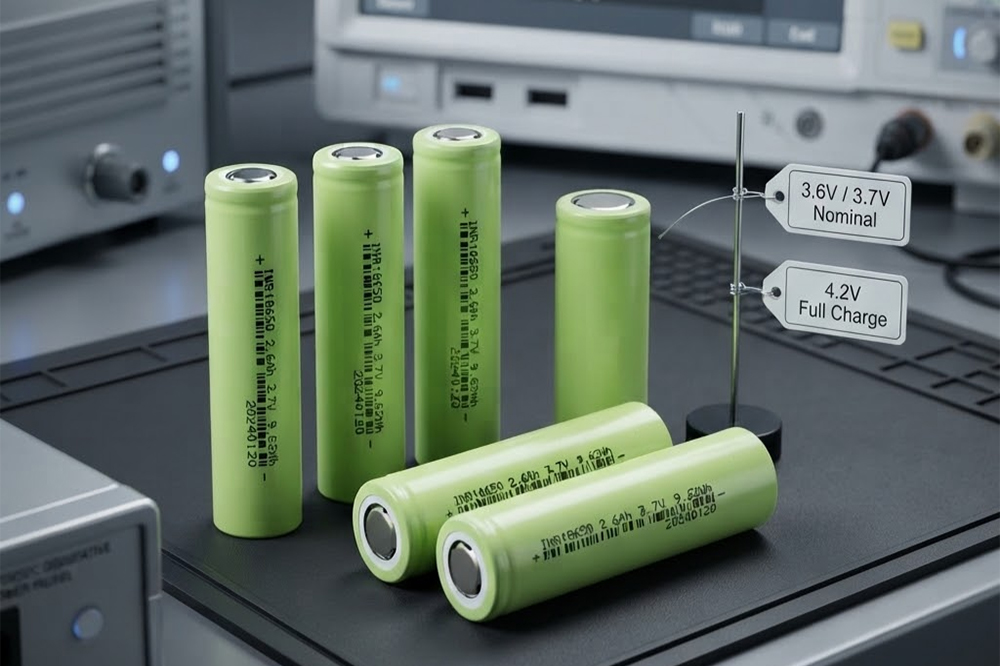
When buying 18650 lithium-ion battery cells, voltage is one of the first specifications to check. However, many product listings show several different voltage values, such as 3.6V, 3.7V, and 4.2V. For new buyers, these numbers can be confusing.
A standard 18650 battery may be described as a 3.6V cell, a 3.7V cell, or a 4.2V lithium battery. In most cases, these values refer to different points in the battery’s operating range rather than completely different battery types.
Understanding the difference is important when selecting cells for portable electronics, power tools, e-bike batteries, industrial equipment, and custom OEM battery packs.
Voltage is only one part of the selection process. For a broader overview of cell capacity, discharge current, dimensions, terminal types, and application requirements, read our standard 18650 batteries buying guide.
What Voltage Does an 18650 Battery Really Have?
A typical standard 18650 lithium-ion battery has three important voltage values:
- Nominal voltage: usually 3.6V or 3.7V
- Fully charged voltage: usually 4.2V
- Recommended discharge cutoff: commonly around 2.5V to 3.0V, depending on the cell
These values describe different operating conditions.
The nominal voltage is the reference value used for product specifications and battery pack calculations. It is not the voltage measured at every moment during use.
A fully charged cell normally reaches approximately 4.2V. As the battery supplies power, its voltage gradually decreases. Near the end of discharge, the voltage may approach the cutoff value set by the battery management system or protection circuit.
For this reason, a battery marked “3.7V” is not expected to remain at exactly 3.7V during operation.
3.6V vs 3.7V: Is There a Real Difference?
For standard lithium-ion 18650 cells, 3.6V and 3.7V usually describe the same general voltage class.
Some manufacturers specify their cells with a nominal voltage of 3.6V. Others use 3.7V. The difference is normally related to the manufacturer’s specification method, chemistry details, or rounding convention.
Both types generally have:
- A fully charged voltage of approximately 4.2V
- A similar discharge voltage range
- The same basic lithium-ion operating principle
- Compatibility with many of the same battery pack designs, provided the other specifications match
However, buyers should not assume that two cells are interchangeable only because both are marked 3.6V or 3.7V. Capacity, discharge current, internal resistance, dimensions, terminal type, and protection requirements must also be checked.
The voltage label is only one part of the specification.
Why Is a Fully Charged 18650 Battery 4.2V?
A standard lithium-ion 18650 cell is normally charged to 4.2V.
This is the upper voltage limit for many common cobalt-based, nickel-manganese-cobalt, and other conventional lithium-ion cell designs. A suitable charger uses a constant-current and constant-voltage charging process to bring the cell to this level.
The charging process generally includes two stages:
- Constant-current charging: The charger supplies a controlled current while the cell voltage rises.
- Constant-voltage charging: The charger holds the voltage near 4.2V while the charging current gradually decreases.
The cell should not be charged above its specified maximum voltage. Overcharging can cause overheating, swelling, leakage, or thermal failure.
For a battery pack, the charger and BMS must be matched to the number of cells connected in series.
18650 Battery Voltage During Discharge
The voltage of an 18650 cell changes during use. A simplified discharge pattern may look like this:
| Battery Condition | Approximate Cell Voltage |
|---|---|
| Fully charged | 4.2V |
| High state of charge | 4.0V–4.1V |
| Normal operating range | 3.6V–3.8V |
| Lower state of charge | 3.3V–3.5V |
| Near discharge cutoff | 2.5V–3.0V |
The actual voltage curve depends on the cell chemistry, load current, temperature, age, and internal resistance.
A battery under heavy load may show a lower voltage because of voltage sag. When the load is removed, the voltage may rise again. This does not necessarily mean the battery has been recharged. It is a normal recovery effect caused by the cell’s internal characteristics.
For engineering projects, it is better to evaluate the complete discharge curve rather than rely only on the nominal voltage.

18650 Battery Voltage Under Load
A cell’s open-circuit voltage and working voltage are not always the same.
For example, an 18650 cell may measure 3.8V when no equipment is connected. When a high-current motor or power tool starts, the voltage may temporarily drop because of internal resistance.
The approximate relationship is:
Voltage drop = Load current × Internal resistance
A cell with higher internal resistance may experience more voltage sag. This can lead to:
- Lower equipment performance
- Shorter usable runtime
- Unexpected low-voltage protection
- Higher heat generation
- Reduced power output
This is why high-drain applications require more than a suitable nominal voltage. The selected cells must also support the required continuous and peak discharge current.
Before selecting a voltage configuration, it is useful to understand the basic structure and specifications of the cell. Our guide explains what is standard 18650 battery, including its dimensions, nominal voltage, capacity options, and common terminal types.
Series Battery Pack Voltage Calculation
When 18650 cells are connected in series, their voltages add together.
For example:
| Series Configuration | Nominal Voltage | Full Charge Voltage |
|---|---|---|
| 1S | 3.6V–3.7V | 4.2V |
| 2S | 7.2V–7.4V | 8.4V |
| 3S | 10.8V–11.1V | 12.6V |
| 4S | 14.4V–14.8V | 16.8V |
| 5S | 18.0V–18.5V | 21.0V |
| 6S | 21.6V–22.2V | 25.2V |
| 10S | 36.0V–37.0V | 42.0V |
The exact nominal value depends on whether the manufacturer uses 3.6V or 3.7V as the reference.
For example, a 4S battery pack made with 3.7V cells has:
- Nominal voltage: 3.7V × 4 = 14.8V
- Full charge voltage: 4.2V × 4 = 16.8V
A device designed for a 4S lithium-ion pack must be able to tolerate the full 16.8V charging voltage, not only the nominal 14.8V.
Parallel Connections Do Not Increase Nominal Voltage
When cells are connected in parallel, the voltage remains the same while capacity and current capability increase.
For example, a 4S2P battery pack contains:
- Four cell groups connected in series
- Two cells connected in parallel in each group
- Eight 18650 cells in total
The voltage is still approximately:
- 14.8V nominal
- 16.8V fully charged
If each cell has a capacity of 2600mAh, the pack capacity is approximately:
2600mAh × 2 = 5200mAh
The series connection determines voltage. The parallel connection determines capacity and can also increase the available current.
18650 Voltage and Battery Management Systems
A battery management system, or BMS, must match the battery pack configuration and chemistry.
For a standard lithium-ion 4S pack, the BMS generally needs to support:
- Four cells or cell groups in series
- A maximum charging voltage of 16.8V
- Individual cell overvoltage protection
- Over-discharge protection
- Overcurrent protection
- Short-circuit protection
- Cell balancing, depending on the design
Using a BMS designed for a different series count can create serious safety and performance problems.
For example, a 3S BMS is not suitable for a 4S battery pack. The charger must also be selected according to the complete pack voltage. A 4S lithium-ion pack normally requires a 16.8V charger, not a 12.6V charger.

Do Not Confuse Standard Lithium-Ion Cells with LiFePO4 Cells
Not all cylindrical lithium batteries use the same voltage system.
A conventional 18650 lithium-ion cell generally has:
- Nominal voltage: 3.6V or 3.7V
- Full charge voltage: 4.2V
A LiFePO4 cell generally has:
- Nominal voltage: approximately 3.2V
- Full charge voltage: approximately 3.6V to 3.65V
Although both are rechargeable lithium batteries, their charging requirements are different.
A charger or BMS designed for a standard 3.7V lithium-ion cell should not automatically be used with a LiFePO4 cell. Battery chemistry must be confirmed before selecting the charging system, protection board, and pack configuration.
How Voltage Affects OEM Battery Pack Design
For OEM battery pack projects, voltage affects nearly every part of the design.
The required voltage determines:
- The number of cells connected in series
- The charger specification
- The BMS series count
- The wire and connector selection
- The insulation and protection design
- The equipment’s operating compatibility
- The battery pack’s maximum voltage
- The required testing procedures
For example, a project requiring approximately 24V may use a 6S lithium-ion configuration:
- Nominal voltage: 21.6V–22.2V
- Full charge voltage: 25.2V
A project requiring approximately 36V may use a 10S configuration:
- Nominal voltage: 36V–37V
- Full charge voltage: 42V
The equipment manufacturer should confirm both the nominal voltage and the maximum charging voltage before the battery design begins.

What Wholesale Buyers Should Check
When purchasing standard 18650 batteries in bulk, voltage should be reviewed together with the following specifications:
1. Nominal Voltage
Confirm whether the supplier lists the cell as 3.6V or 3.7V. In many cases, both refer to the same nominal voltage class, but the datasheet should provide the complete operating range.
2. Maximum Charging Voltage
For many standard lithium-ion 18650 cells, the maximum charging voltage is 4.2V. Do not assume this value applies to every lithium battery chemistry.
3. Discharge Cutoff Voltage
Check the manufacturer’s recommended cutoff voltage. Discharging below the specified limit can damage the cell and reduce its service life.
4. Continuous and Peak Discharge Current
Voltage alone does not indicate whether a cell can power a high-current device. Review the continuous discharge rating and, when relevant, the peak discharge performance.
5. Capacity and Energy
Capacity is normally listed in mAh or Ah. To estimate energy:
Energy in Wh = Nominal voltage × Capacity in Ah
For example, a 3.7V, 2600mAh cell has an approximate nominal energy of:
3.7V × 2.6Ah = 9.62Wh
6. Cell Consistency
For multi-cell battery packs, cells should be matched by capacity, internal resistance, voltage, and production batch when possible. Consistent cells help improve balancing performance and pack reliability.
7. Charger and BMS Compatibility
The charger and BMS must match the cell chemistry and series configuration. This is especially important for custom battery packs and industrial applications.
Standard 18650 Batteries for Wholesale and OEM Applications
A standard 18650 lithium battery can be used in many different battery pack designs, but the final voltage depends on how the cells are connected.
For wholesale and OEM projects, suppliers may provide cells with different capacities, discharge rates, terminal types, and customization options. The battery pack can then be designed according to the equipment’s voltage, runtime, current, size, and safety requirements.
Apsenx supplies standard 18650 battery cells and custom lithium battery packs for B2B applications. Buyers can discuss cell capacity, voltage configuration, discharge performance, BMS selection, connectors, casing, labels, and packaging according to their project requirements.
For more information about available cell options, visit the standard 18650 lithium battery product category.
Final Thoughts
The terms 3.6V, 3.7V, and 4.2V describe different aspects of a standard 18650 lithium-ion battery.
- 3.6V or 3.7V usually refers to nominal voltage.
- 4.2V normally refers to the fully charged voltage.
- The operating voltage decreases as the battery discharges.
- Series connections increase voltage.
- Parallel connections increase capacity and current capability.
- The charger and BMS must match the battery chemistry and pack configuration.
For a reliable battery design, do not select cells based on the voltage label alone. Review the complete datasheet and confirm the voltage, capacity, discharge current, dimensions, charging limits, and application requirements together.
Voltage alone does not determine how much energy a battery stores. For a detailed comparison of capacity and runtime, see our guide to 18650 battery capacity and energy.
A higher mAh rating generally means more stored charge, but the nominal voltage is also needed to estimate total energy. Learn how to calculate 18650 battery energy using the Wh formula.
In addition to size, voltage, and capacity, the 18650 battery discharge rating determines whether a cell can support the current demand of the device.
-

12V 4400 mah Lithium ion 3S2P 18650 Battery Pack
-

18650 2000mAh 3.7 volt Lithium-ion Battery
-

18650 20V 3.0Ah Cordless Drill battery
-

18650 22.2V 7.8Ah 2600Mah 6S3P Rechargeable Battery Pack
-

18650 2600mAh Rechargeable Lithium-Ion Battery 3.7V
-

18650 3.7V 10Ah Li-Ion Power Battery Pack
-

18650 3.7V 3300mah Rechargeable Lithium ion Battery
-

18650 7S7P 24V 14Ah Lithium ion Electric Scooter Battery Pack
-

18650 battery 3.7V 1500mAh Lithium-Ion Battery
-

18650 Battery 3500 mah Rechargeable Battery Cells
-

18650 Electric Scooter 48V 13000mAh Lithium Battery
-

2600mAh 3S1P 11.1V 18650 Battery Packs
-

3.7V Li ion Rechargeable 3000mah 18650 Battery Cell
-

36V 5200mAh 10S2P 18650 Battery Pack
-

48v 4400mah 13S2P 18650 Rechargeable Battery Pack
-

7S2P 24V 18650 Lithium Battery Pack
-

Electric Scooter 36V 4400mAH 10S2P 18650 Battery Pack
-

ICR 18650 Battery 2200mah 3.7V
Leave a Reply