
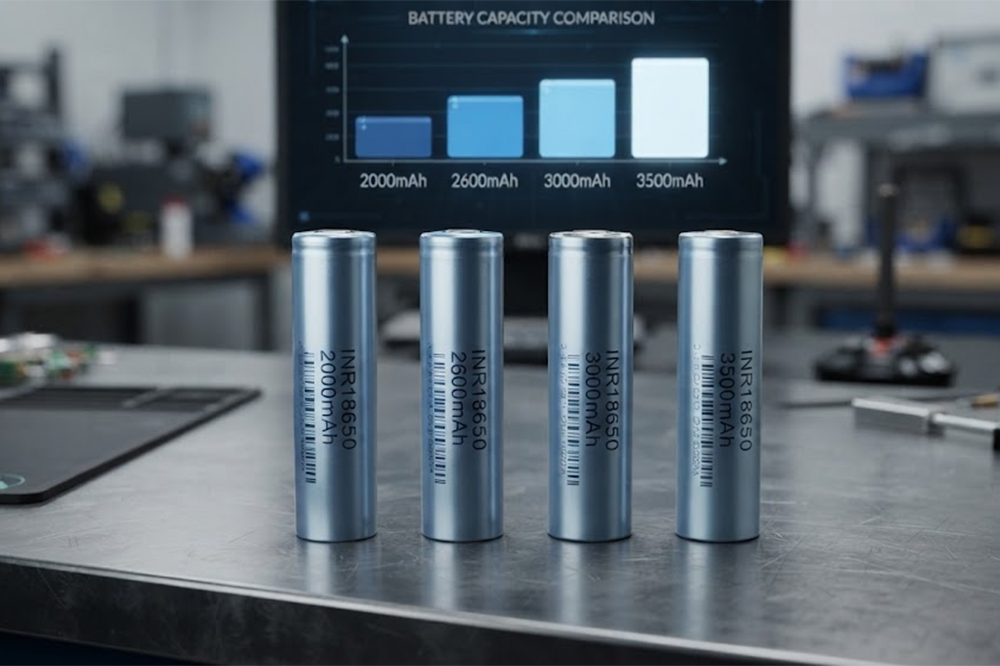
Capacity is one of the most important specifications when selecting standard 18650 lithium-ion batteries. It affects how long a device can operate, how much energy a battery pack stores, and how many cells are needed for a particular project.
Many 18650 battery listings use capacity values such as 2000mAh, 2600mAh, 3000mAh, and 3500mAh. A higher number may suggest longer runtime, but it does not automatically mean the cell is the best choice for every application.
The right capacity depends on the equipment’s power consumption, discharge requirements, available space, operating time, charging conditions, and target cost.
Capacity is only one part of the selection process. For a broader overview of voltage, discharge current, dimensions, terminal types, and application requirements, read our standard 18650 batteries buying guide.
What Does 18650 Battery Capacity Mean?
Battery capacity describes how much electrical charge a cell can store. It is usually measured in milliamp-hours, written as mAh.
For example:
- A 2000mAh cell stores approximately 2.0Ah of charge.
- A 2600mAh cell stores approximately 2.6Ah.
- A 3000mAh cell stores approximately 3.0Ah.
- A 3500mAh cell stores approximately 3.5Ah.
In simple terms, a 2600mAh battery could theoretically provide 2600mA for one hour under specified test conditions. Real operating time depends on the load, discharge rate, temperature, battery age, and cutoff voltage.
Capacity is not the same as power. A cell with higher capacity may not be able to deliver the high current required by a power tool or motor.
Common Standard 18650 Capacity Options
The following capacities are commonly seen in standard 18650 lithium-ion battery applications:
| Capacity | Equivalent Capacity | Typical Consideration |
|---|---|---|
| 1500mAh | 1.5Ah | Compact or higher-discharge applications |
| 2000mAh | 2.0Ah | Cost-sensitive and moderate-runtime designs |
| 2200mAh | 2.2Ah | General-purpose battery packs |
| 2600mAh | 2.6Ah | Balanced capacity and cost |
| 3000mAh | 3.0Ah | Longer runtime for many applications |
| 3300mAh | 3.3Ah | Higher energy storage |
| 3500mAh | 3.5Ah | High-capacity applications with moderate current demand |
The actual available capacity depends on the cell model and supplier. Buyers should always check the datasheet instead of selecting a cell only by the capacity printed on a product page.
2000mAh 18650 Batteries
A 2000mAh 18650 battery is often selected when the project needs a practical balance between cost, size, and performance.
These cells may be suitable for:
- Portable electronic equipment
- Basic lighting products
- Small backup power systems
- General-purpose battery packs
- Cost-sensitive OEM products
- Applications with moderate runtime requirements
A 2000mAh cell may also be useful when the application requires a relatively higher discharge rate than some high-capacity cells can provide. However, this depends on the exact cell model. Capacity alone cannot determine discharge performance.
For a battery pack with two cells connected in parallel, two 2000mAh cells provide approximately:
2000mAh × 2 = 4000mAh
The nominal voltage remains the same as one cell when the cells are connected in parallel.

2600mAh 18650 Batteries
The 2600mAh capacity class is widely used because it offers a reasonable balance between energy storage, availability, and cost.
A 2600mAh 18650 cell may be considered for:
- Portable power equipment
- Consumer electronics
- Battery-powered instruments
- Small industrial devices
- E-bike battery packs
- General OEM battery assemblies
For many projects, 2600mAh is a practical starting point. It provides more energy than a 2000mAh cell while remaining suitable for a wide range of battery pack designs.
For example, a 4S2P pack using 2600mAh cells has:
- Nominal voltage: approximately 14.8V
- Full-charge voltage: 16.8V
- Pack capacity: approximately 5200mAh
- Total cell count: 8
The actual usable energy will be lower than the theoretical value because of conversion losses, load conditions, cutoff settings, and other system factors.
3000mAh 18650 Batteries
A 3000mAh 18650 battery is often selected when longer runtime is more important than achieving the lowest initial cost.
Compared with a 2600mAh cell, a 3000mAh cell provides approximately 15% more nominal capacity when the comparison is made under similar test conditions.
Potential applications include:
- Portable medical and testing equipment
- Industrial handheld devices
- Backup power systems
- Portable lighting
- Battery-powered instruments
- Custom battery packs requiring additional runtime
However, a 3000mAh cell should still be checked for discharge capability. Some high-capacity cells are designed for moderate current rather than demanding high-power loads.
If the equipment requires a high starting current, a lower-capacity high-drain cell may perform better than a higher-capacity cell with a lower current rating.
3500mAh 18650 Batteries
A 3500mAh 18650 cell is generally selected for applications where energy storage and operating time are important.
Typical applications may include:
- Long-runtime portable equipment
- Energy storage modules
- Industrial monitoring devices
- Backup power systems
- Low-to-moderate current battery packs
- OEM products with strict runtime targets
A 3500mAh cell can provide more energy in the same general 18650 form factor. However, it may have a lower continuous discharge rating than some 2000mAh or 2600mAh high-drain cells.
This makes it important to separate two different requirements:
- Energy requirement: How long the device needs to operate
- Power requirement: How much current the device needs at a given moment
A battery pack must satisfy both.
Does Higher Capacity Always Mean Longer Runtime?
Higher capacity usually provides longer runtime when the following conditions are similar:
- The cell chemistry is comparable
- The battery pack voltage is the same
- The load is unchanged
- The discharge cutoff is similar
- The cell is tested under comparable conditions
For example, replacing a 2600mAh cell with a 3500mAh cell may increase runtime. However, the improvement may not be exactly proportional in real use.
Runtime can also be affected by:
- Equipment efficiency
- Battery pack wiring
- BMS power consumption
- Temperature
- Cell aging
- Voltage sag
- Discharge current
- DC-DC converter efficiency
A higher-capacity cell is useful only when the equipment and battery design can take advantage of the additional energy.

How to Calculate 18650 Battery Energy
Capacity is measured in Ah, while energy is usually measured in watt-hours, or Wh.
The basic calculation is:
Energy in Wh = Nominal Voltage × Capacity in Ah
For a single 3.7V cell:
| Cell Capacity | Approximate Nominal Energy |
|---|---|
| 2000mAh | 7.4Wh |
| 2600mAh | 9.62Wh |
| 3000mAh | 11.1Wh |
| 3500mAh | 12.95Wh |
These figures are theoretical nominal energy values.
For a 4S2P battery pack using 2600mAh cells:
- Nominal voltage: 14.8V
- Pack capacity: 5.2Ah
- Nominal energy: 14.8V × 5.2Ah = 76.96Wh
The same result can also be estimated by multiplying the energy of one cell by the total number of cells:
9.62Wh × 8 = 76.96Wh
Actual usable energy depends on the discharge conditions and system efficiency.
Capacity in Series and Parallel Battery Packs
When cells are connected in series, the voltage increases while the capacity in Ah remains approximately the same.
For example, four 2600mAh cells connected in series create a 4S pack with approximately:
- Nominal voltage: 14.8V
- Capacity: 2600mAh
When cells are connected in parallel, the voltage remains approximately the same while capacity increases.
Two 2600mAh cells connected in parallel provide:
- Nominal voltage: approximately 3.7V
- Capacity: approximately 5200mAh
A 4S2P configuration combines both:
- Four series groups increase voltage
- Two parallel cells in each group increase capacity
- Eight cells are used in total
Understanding this difference helps buyers calculate the required number of cells for a custom battery pack.
Capacity must be evaluated together with voltage when estimating battery energy. Our guide to 18650 battery voltage explains nominal voltage, 4.2V full-charge voltage, discharge limits, and series battery pack calculations.
Capacity and Discharge Current Must Be Considered Together
A common mistake is to choose the highest capacity without checking the discharge current.
For example, a device may require:
- 12V nominal voltage
- 10A continuous current
- 20A short peak current
- Two hours of operating time
A high-capacity cell may provide the required energy but fail to deliver the required current. A high-drain cell may provide the current but offer less runtime.
The supplier should evaluate:
- Nominal capacity
- Rated continuous discharge current
- Maximum pulse discharge current
- Internal resistance
- Operating temperature
- Voltage sag
- Cell cycle life
For motor-driven products, power tools, and other high-load equipment, discharge performance can be just as important as capacity.

How Capacity Affects Battery Pack Size and Cost
A higher-capacity cell does not always reduce the total number of cells required.
The final design also depends on:
- Required voltage
- Maximum current
- Pack dimensions
- Cell availability
- Thermal management
- BMS size
- Mechanical structure
- Safety spacing
- Certification requirements
In some projects, using a higher-capacity cell allows the manufacturer to reduce the number of parallel cells. In other projects, the higher-capacity cell may not meet the current requirement, so more cells are still needed.
The best choice is the one that meets the complete electrical and mechanical specification, not simply the cell with the largest mAh value.
What Wholesale Buyers Should Check
Before ordering standard 18650 batteries in bulk, buyers should confirm the following points.
Capacity Test Conditions
Ask how the capacity was measured, including discharge current, cutoff voltage, and temperature. Capacity values from different test conditions may not be directly comparable.
Rated Capacity and Minimum Capacity
Some suppliers list a typical capacity, while others provide a minimum guaranteed capacity. These values should not be treated as identical.
Discharge Current
Confirm the continuous and peak discharge ratings. A 3500mAh cell and a 2000mAh cell may have very different current capabilities.
Internal Resistance
Internal resistance affects voltage sag, heat generation, and high-load performance. It is especially important for battery packs with several cells connected in parallel.
Cell Consistency
For multi-cell packs, cells should be matched by capacity, internal resistance, voltage, and production batch whenever possible.
Dimensions and Terminal Type
Although 18650 cells share a general size class, small dimensional differences may affect pack assembly. Flat-top and button-top versions may also require different mechanical designs.
Storage and Shipment Requirements
Bulk buyers should confirm packaging, storage conditions, shipment documents, and applicable battery transport requirements before placing an order.
Choosing the Right Capacity for Different Applications
A general selection approach may look like this:
| Application Requirement | Possible Capacity Direction |
|---|---|
| Low cost and moderate runtime | 2000mAh–2600mAh |
| Balanced runtime and cost | 2600mAh–3000mAh |
| Longer runtime with moderate current | 3000mAh–3500mAh |
| High current or motor startup | Check high-drain models first |
| Compact custom battery pack | Compare capacity, current, and dimensions together |
| Long-runtime industrial equipment | Evaluate energy, temperature, and cycle life |
These are starting points rather than fixed rules. The final cell model should be selected after reviewing the equipment’s voltage, current, runtime, space, and operating environment.

Standard 18650 Battery Cells for Wholesale and OEM Projects
For B2B and OEM battery pack projects, capacity selection should be based on the complete product specification.
Apsenx provides standard 18650 lithium battery cells and custom battery pack solutions for different voltage, capacity, discharge, size, and connector requirements. Buyers can discuss cell selection, series-parallel configuration, BMS, casing, wiring, labels, packaging, and production requirements with the supplier.
For available standard 18650 battery options, visit the standard 18650 lithium battery product category.
Final Thoughts
The difference between 2000mAh, 2600mAh, 3000mAh, and 3500mAh 18650 batteries is mainly related to stored charge and potential runtime. However, capacity should never be evaluated separately from discharge current, voltage, dimensions, temperature, and application requirements.
- 2000mAh cells may suit cost-sensitive or moderate-runtime products.
- 2600mAh cells offer a practical balance for many applications.
- 3000mAh cells provide additional energy for longer operating time.
- 3500mAh cells are useful when runtime is important and current demand is moderate.
- High-capacity does not always mean high-discharge.
- Series connections increase voltage, while parallel connections increase capacity.
- The best cell is the one that meets the complete battery pack specification.
For wholesale purchasing and OEM manufacturing, a detailed datasheet and application review are more useful than choosing a battery based only on its mAh label.
Before comparing capacity options, it is useful to understand the basic specifications of the cell. Our guide explains what is a standard 18650 battery, including its dimensions, nominal voltage, capacity, and terminal types.
Voltage explains how a battery operates, while watt-hours help estimate how much energy it can store. Read our guide to 18650 battery watt-hours for practical energy calculations.
Voltage may drop under load, and understanding 18650 battery discharge current helps explain why different cells behave differently when supplying power.
Leave a Reply