
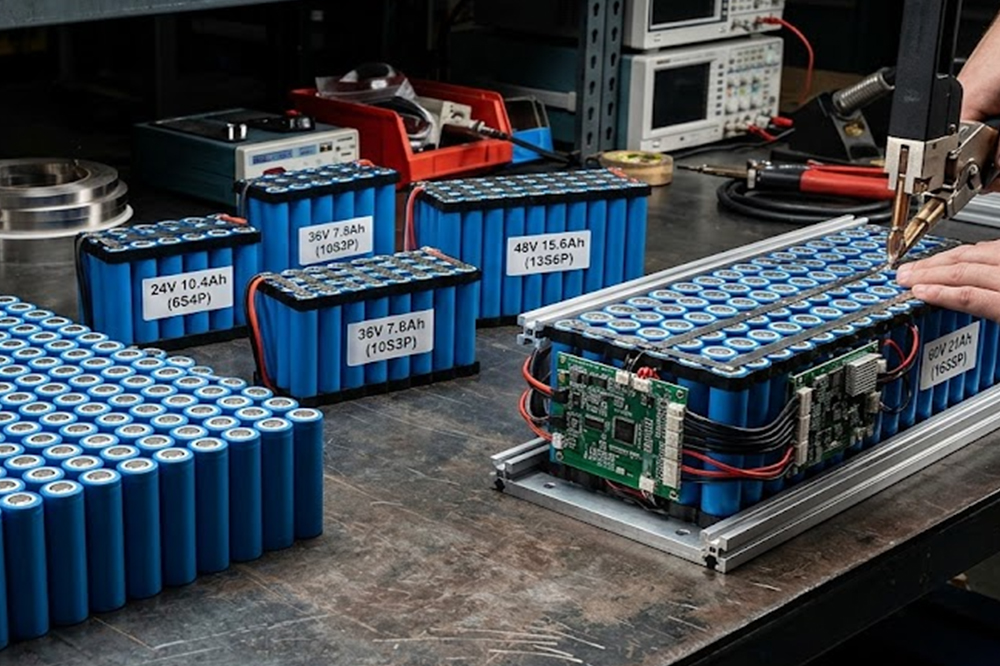
Standard 18650 batteries are widely used cylindrical lithium-ion cells for portable electronics, battery packs, power tools, lighting equipment, and other applications that need a compact rechargeable power source.
For a buyer, choosing 18650 battery is not simply a matter of finding the highest mAh rating. The cell’s voltage, capacity, discharge capability, physical dimensions, terminal design, and intended application all matter. A cell that works well in a flashlight may not be the right choice for a high-power battery pack.
This guide explains what to look for when buying standard 18650 batteries, especially when comparing cells for wholesale supply, OEM battery pack production, or industrial applications.
What Is Standard 18650 Battery?
An 18650 is a cylindrical rechargeable battery cell. The name refers approximately to its physical dimensions:
- 18 — approximately 18 mm in diameter
- 65 — approximately 65 mm in length
- 0 — cylindrical cell format
The actual dimensions can vary slightly depending on the cell design, terminal structure, protection components, and manufacturing tolerances.
Most standard 18650 lithium-ion cells use a nominal voltage around 3.6V or 3.7V, with a full-charge voltage commonly reaching 4.2V. However, buyers should always check the manufacturer’s datasheet rather than relying only on the general 18650 label.
The term “standard” usually describes the common cylindrical cell format. It does not mean that every 18650 cell has the same capacity, chemistry, discharge current, or quality.
That distinction becomes important when selecting cells for a battery pack.

Why Are Standard 18650 Batteries Still Widely Used?
The 18650 format has been used in rechargeable battery products for many years. It is available in a wide range of capacities and performance levels, and many battery pack designs already accommodate this size.
For manufacturers, the format offers several practical advantages:
- A well-established cylindrical cell design
- Many available capacity and discharge options
- Flexible series and parallel configurations
- Relatively straightforward pack assembly
- Compatibility with existing battery holders and pack structures
- Availability from multiple cell manufacturers and suppliers
The 18650 format is not automatically the best option for every new product. Some applications may need a larger cell, a different form factor, or a custom battery design. But when a product already uses 18650 cells, continuing with this format can simplify development and production.
Standard 18650 Battery Specifications to Compare
When comparing standard 18650 batteries, start with the specifications that affect how the cell will perform inside the finished product.
1. Nominal Voltage
Nominal voltage is the typical operating voltage used when describing a lithium-ion cell.
A common 18650 lithium-ion cell is listed as 3.6V or 3.7V nominal. These values are often used interchangeably in product descriptions, but the exact voltage range depends on the cell chemistry and manufacturer.
For battery pack design, the number of cells connected in series determines the pack voltage.
For example:
- 1 cell in series: approximately 3.6V or 3.7V nominal
- 2 cells in series: approximately 7.2V or 7.4V nominal
- 3 cells in series: approximately 10.8V or 11.1V nominal
- 4 cells in series: approximately 14.4V or 14.8V nominal
The actual full-charge voltage is higher than the nominal voltage. The charger and battery management system must be designed for the correct cell chemistry and series configuration.
2. Capacity
Capacity is usually expressed in mAh, or milliamp-hours.
It indicates how much electrical charge a cell can deliver under specified test conditions. A higher capacity can provide longer runtime, but it does not automatically mean the cell is better for every application.
For example, a buyer comparing 2000mAh, 2600mAh, 3000mAh, and 3500mAh cells should also check:
- Required operating current
- Expected runtime
- Available installation space
- Cell discharge performance
- Operating temperature
- Battery pack configuration
- Manufacturer test conditions
A 3500mAh cell may be attractive for a low-current application. A lower-capacity cell may be more suitable when the equipment requires higher continuous or pulse current.
Capacity should always be evaluated together with the actual load.
3. Discharge Current
Discharge current describes how much current a cell can safely deliver under specified conditions.
This is one of the most important specifications for applications such as:
- Power tools
- Motorized equipment
- High-power lighting
- Portable power systems
- Industrial battery packs
- Equipment with short periods of high current demand
A cell with a high mAh rating is not necessarily a high-discharge cell.
When reviewing a datasheet, check whether the stated current is:
- Continuous discharge current
- Maximum discharge current
- Pulse discharge current
- Tested at a specific temperature
- Dependent on a particular cutoff voltage
For OEM battery packs, the cell selection should be based on the equipment’s actual current requirements rather than capacity alone.
4. Physical Dimensions
The 18650 format is approximately 18 mm in diameter and 65 mm long, but the finished cell may differ slightly.
Small dimensional differences can matter when the battery must fit inside:
- A molded plastic housing
- A battery holder
- A metal enclosure
- A power tool battery case
- A compact electronic device
- A custom battery pack
Protected cells may be longer than unprotected cells because of the additional protection circuit and outer sleeve.
Before ordering in bulk, compare the supplier’s actual cell dimensions with the available battery compartment. Do not assume that every product labeled “18650” will fit the same space.
5. Terminal Design
18650 cells are commonly available with different terminal designs, including:
- Flat-top terminals
- Button-top terminals
The correct choice depends on the battery holder, contact structure, and pack assembly method.
A flat-top cell may be suitable for a custom battery pack with welded nickel strips. A button-top cell may be required by a particular battery holder or device.
This is a small detail, but it can create problems if it is overlooked during sampling.
Common Standard 18650 Capacity Options
Standard 18650 batteries are available in different capacity ranges for different applications.
A supplier may offer models such as:
| Capacity | Typical selection consideration |
|---|---|
| 2000mAh | Applications where cost, availability, or current capability is more important than maximum capacity |
| 2200mAh | General-purpose battery pack designs |
| 2600mAh | A common balance between capacity and practical pack requirements |
| 3000mAh | Applications requiring more energy within the same cell format |
| 3300mAh | Higher-capacity designs with suitable current requirements |
| 3500mAh | Applications prioritizing capacity and runtime |
These are general selection examples, not a guarantee that every cell in a capacity category has the same performance.
The actual capacity, discharge current, cycle life, and test conditions must be confirmed from the supplier’s datasheet.
For wholesale buyers, it is useful to compare several capacity options before deciding which model should become the standard cell for a product line.

How Much Energy Does 18650 Battery Store?
Battery capacity is often expressed in mAh, but energy is usually expressed in Wh.
A simple calculation is:
Energy (Wh) = Nominal Voltage (V) × Capacity (Ah)
For example, a 3.7V, 3000mAh cell has:
3.7V × 3Ah = 11.1Wh
This is a nominal energy calculation. Actual usable energy depends on the equipment’s cutoff voltage, discharge current, temperature, and other operating conditions.
For battery pack design, energy can be estimated by multiplying the nominal voltage and capacity of the complete pack. However, series and parallel configurations affect voltage, capacity, and the number of cells required.
Standard 18650 Batteries in Series and Parallel
18650 cells are often connected in series, parallel, or a combination of both.
Series Connection
Connecting cells in series increases the voltage.
For example, a 4S configuration uses four cells or cell groups in series. With cells rated at 3.7V nominal, the pack has an approximate nominal voltage of:
4 × 3.7V = 14.8V
Parallel Connection
Connecting cells in parallel increases the capacity and current capability of the cell group.
For example, a 2P configuration using 3000mAh cells provides an approximate capacity of:
2 × 3000mAh = 6000mAh
Series-Parallel Configuration
A battery pack may be described as 4S2P, meaning four series groups with two cells in parallel in each group.
Using 3.7V, 3000mAh cells:
- Nominal voltage: approximately 14.8V
- Capacity: approximately 6000mAh
- Total cells: 8
The final pack design also needs an appropriate BMS, suitable interconnections, insulation, mechanical support, and a charging system designed for the pack.
Protected vs Unprotected 18650 Batteries
One of the first questions buyers should ask is whether the cell is protected or unprotected.
Protected 18650 Batteries
A protected cell includes a protection circuit, usually beneath the outer sleeve or near the terminal.
Depending on the design, the protection circuit may help protect against conditions such as:
- Overcharge
- Over-discharge
- Overcurrent
- Short circuit
Protected cells are often used in products where the protection function is built into the individual cell.
Unprotected 18650 Batteries
Unprotected cells do not include the same individual protection circuit.
They are commonly used in custom battery packs where protection and monitoring are handled by a separate BMS.
For OEM battery pack manufacturing, unprotected cells are often selected because the pack designer needs to control the protection system, cell arrangement, and electrical connections.
The correct choice depends on the product design. Buyers should not assume that protected cells are always safer or that unprotected cells are unsuitable. The entire battery system must be designed correctly.
Flat-Top vs Button-Top 18650 Cells
The terminal design can affect compatibility.
Flat-top cells have a relatively flat positive terminal. They are commonly used in battery packs assembled with spot welding and nickel strips.
Button-top cells have a raised positive terminal. They may be required by certain battery holders or electronic devices.
Before placing an order, confirm:
- Terminal type
- Cell length
- Contact design
- Welding requirements
- Battery holder compatibility
- Whether a protection circuit is included
A sample check is usually worthwhile, especially when the cell will be installed into an existing product.
High-Capacity vs High-Discharge 18650 Batteries
This is one of the most common selection questions.
A high-capacity cell is designed to store more energy within the same general format. A high-discharge cell is designed to deliver more current under specified conditions.
The two characteristics can overlap, but they are not identical.
For example:
- A portable sensor may prioritize capacity and runtime.
- A flashlight may require a balance of capacity and discharge capability.
- A power tool may prioritize current delivery and thermal performance.
- An industrial battery pack may require a specific combination of capacity, current, size, and cycle life.
The best cell is the one that matches the equipment’s electrical requirements.
Choosing a cell only because it has the highest mAh rating can lead to an unsuitable battery pack.
Where Are Standard 18650 Batteries Used?
Standard 18650 batteries are used in many rechargeable products and battery pack designs.
Common applications include:
Portable Electronics
18650 cells can be used in rechargeable electronic equipment where a cylindrical battery format is suitable.
Flashlights and Lighting Equipment
Some flashlights and lighting products use 18650 cells because the format provides a practical balance between size and energy.
Power Tools
Power tool battery packs may use multiple 18650 cells connected in series and parallel. These applications require careful attention to discharge current, cell matching, thermal management, and BMS design.
E-Bike and Small Mobility Battery Packs
Some e-bike and small mobility battery packs use cylindrical lithium-ion cells. The correct cell selection depends on the motor power, pack voltage, current demand, available space, and safety requirements.
Industrial Equipment
Industrial equipment may use custom 18650 battery packs for portable instruments, backup systems, monitoring devices, and other applications.
OEM Battery Packs
For OEM manufacturers, the 18650 format can be a practical starting point when the product requires a cylindrical lithium-ion battery pack.
How to Choose Standard 18650 Batteries for OEM Battery Pack
For OEM projects, the selection process should begin with the finished product rather than the cell catalog.

A practical evaluation usually includes the following questions:
What Voltage Does the Equipment Need?
Determine the nominal voltage and maximum charging voltage required by the equipment.
How Much Runtime Is Required?
Estimate the energy demand and expected operating time. This helps narrow down the required capacity.
What Is the Maximum Current?
Check both continuous and peak current requirements. The cell must be suitable for the actual load.
What Space Is Available?
Measure the battery compartment, including length, diameter, wiring space, insulation, and mechanical support.
What BMS Is Required?
The BMS should match the cell chemistry, series configuration, current requirements, and protection needs.
How Will the Cells Be Connected?
For many OEM battery packs, spot welding with nickel strips is used. The pack structure must be designed around the cell arrangement and electrical requirements.
Are the Cells Matched?
Cells used in the same battery pack should be properly matched according to the manufacturer’s testing and pack assembly requirements.
Are Samples Available?
A sample order allows the buyer to check dimensions, electrical performance, assembly compatibility, and actual product quality before moving to bulk production.
What Should Wholesale Buyers Check Before Ordering?
When buying standard 18650 batteries in bulk, the lowest unit price is not the only consideration.
A reliable purchasing process should include:
Cell specifications: Confirm nominal voltage, capacity, discharge current, dimensions, and terminal design.
Testing conditions: Ask how capacity and discharge performance were measured.
Batch consistency: Check whether the supplier can provide cells with consistent specifications across production batches.
Sample approval: Test samples before confirming a larger order.
Packaging: Confirm how the cells will be packed and protected during transportation.
Documentation: Request relevant datasheets and available compliance documents.
Production capability: Ask whether the supplier can support repeat orders and the required quantity.
OEM support: If the cells will be used in a custom battery pack, confirm whether the supplier can support pack design, BMS selection, welding, casing, and other customization requirements.
For a distributor, battery pack manufacturer, or industrial buyer, a stable supply is often more valuable than a small difference in the initial unit price.
Standard 18650 Batteries for Wholesale and OEM Supply
Apsenx supplies standard 18650 lithium battery cells in different capacity options for battery pack manufacturers, distributors, and project buyers.
Available capacity options include 2000mAh, 2200mAh, 2600mAh, 3000mAh, 3300mAh, and 3500mAh, depending on the selected model and current supply.
For buyers who need more than loose cells, the same 18650 format can also be considered for custom battery pack projects. Depending on the application, customization may include:
- Series and parallel configuration
- Voltage and capacity
- BMS or PCM
- Cell arrangement
- Nickel strip welding
- Connector selection
- PVC or custom casing
- Labels and packaging
- OEM drawings and samples
The final cell selection should be based on the project’s voltage, capacity, current, size, and operating requirements.
View Standard 18650 Lithium Battery Cells
Final Thoughts
Standard 18650 batteries remain a practical option for many rechargeable battery products because the format is widely used, flexible, and available in different capacity and performance ranges.
But “18650” is only the starting point. The right battery depends on the complete specification: voltage, capacity, discharge current, dimensions, terminal design, protection system, and application.
For wholesale buyers, it is worth comparing several cell options, testing samples, and confirming batch consistency before placing a large order. For OEM battery pack manufacturers, the best result usually comes from selecting the cell together with the pack design rather than treating the cell as an isolated component.
If you are comparing standard 18650 batteries for a new product or an existing battery pack, start with the equipment requirements and then work backward to the cell specification.
If you are still unfamiliar with the basic specifications, our guide explains what is standard 18650 battery, including its size, nominal voltage, capacity, and common terminal types.
Voltage becomes especially important when several cells are combined into a battery pack. Our detailed guide to 18650 battery voltage explains nominal voltage, 4.2V full charging voltage, discharge limits, and series pack calculations.
Standard 18650 cells are available in several capacity classes. For a more detailed comparison of standard 18650 battery capacity options, including 2000mAh, 2600mAh, 3000mAh, and 3500mAh models, read our dedicated guide.
Capacity and voltage together determine how much energy a battery stores. Learn how to calculate 18650 battery energy in Wh for individual cells and battery packs.
-

12V 4400 mah Lithium ion 3S2P 18650 Battery Pack
-

18650 2000mAh 3.7 volt Lithium-ion Battery
-

18650 20V 3.0Ah Cordless Drill battery
-

18650 22.2V 7.8Ah 2600Mah 6S3P Rechargeable Battery Pack
-

18650 2600mAh Rechargeable Lithium-Ion Battery 3.7V
-

18650 3.7V 10Ah Li-Ion Power Battery Pack
-

18650 3.7V 3300mah Rechargeable Lithium ion Battery
-

18650 7S7P 24V 14Ah Lithium ion Electric Scooter Battery Pack
-

18650 battery 3.7V 1500mAh Lithium-Ion Battery
-

18650 Battery 3500 mah Rechargeable Battery Cells
-

18650 Electric Scooter 48V 13000mAh Lithium Battery
-

2600mAh 3S1P 11.1V 18650 Battery Packs
-

3.7V Li ion Rechargeable 3000mah 18650 Battery Cell
-

36V 5200mAh 10S2P 18650 Battery Pack
-

48v 4400mah 13S2P 18650 Rechargeable Battery Pack
-

7S2P 24V 18650 Lithium Battery Pack
-

Electric Scooter 36V 4400mAH 10S2P 18650 Battery Pack
-

ICR 18650 Battery 2200mah 3.7V
Leave a Reply