
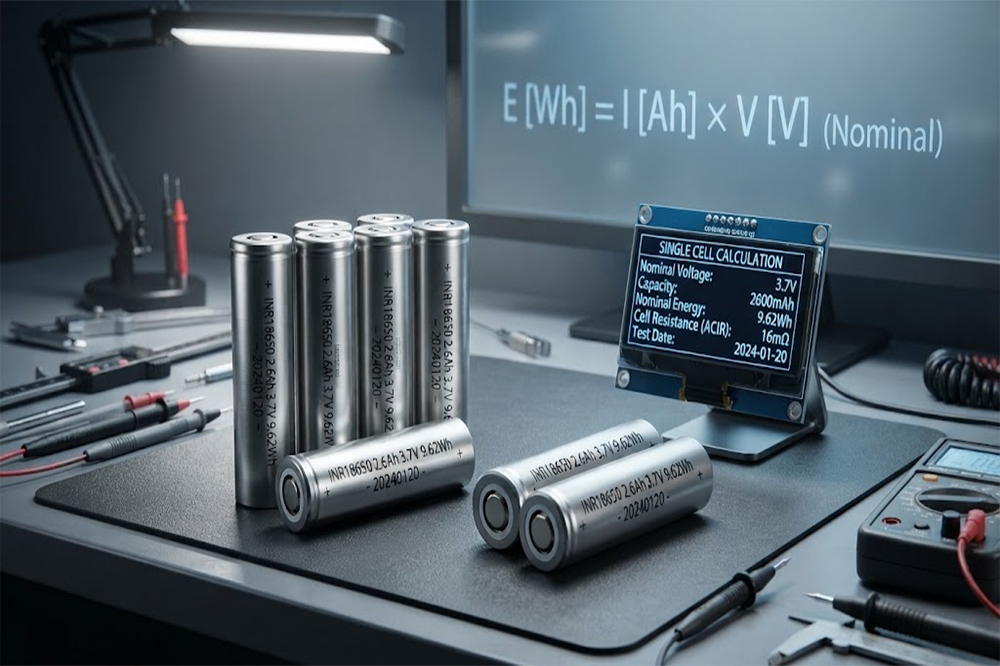
When comparing 18650 lithium-ion batteries, buyers often focus on capacity. A cell may be listed as 2000mAh, 2600mAh, 3000mAh, or 3500mAh, but capacity alone does not show how much energy the battery can store.
To estimate stored energy, voltage and capacity must be considered together. The result is usually expressed in watt-hours, or Wh.
This calculation is useful when designing battery packs, comparing different cell models, estimating runtime, selecting a charger, or preparing an OEM battery specification.
What Does Wh Mean for 18650 Battery?
Wh stands for watt-hour. It is a unit used to describe energy.
A battery rated at 1Wh can theoretically deliver one watt of power for one hour under specified conditions. In real applications, the available energy depends on discharge efficiency, load, temperature, battery age, and cutoff voltage.
For a standard 18650 lithium-ion cell, the basic energy formula is:
Energy in Wh = Nominal Voltage × Capacity in Ah
Because battery capacity is often listed in mAh, it must first be converted into Ah.
1000mAh = 1Ah
For example:
- 2000mAh = 2.0Ah
- 2600mAh = 2.6Ah
- 3000mAh = 3.0Ah
- 3500mAh = 3.5Ah
If a cell has a nominal voltage of 3.7V and a capacity of 2600mAh:
3.7V × 2.6Ah = 9.62Wh
The cell therefore has approximately 9.62Wh of nominal energy.
Nominal Voltage Must Be Used in the Calculation
A standard 18650 lithium-ion cell is commonly specified with a nominal voltage of 3.6V or 3.7V.
The fully charged voltage is usually approximately 4.2V. However, 4.2V should not normally be used to calculate the cell’s rated nominal energy.
For example, a 3.7V, 2600mAh cell has:
3.7V × 2.6Ah = 9.62Wh
Using the full-charge voltage would produce:
4.2V × 2.6Ah = 10.92Wh
This second number does not represent the standard nominal energy rating. It uses the maximum charging voltage rather than the nominal voltage.
For a consistent comparison between different cells, use the nominal voltage shown in the manufacturer’s datasheet.

Energy Comparison of Common 18650 Capacities
The following table uses 3.7V as the nominal voltage:
| Cell Capacity | Capacity in Ah | Approximate Nominal Energy |
|---|---|---|
| 1500mAh | 1.5Ah | 5.55Wh |
| 2000mAh | 2.0Ah | 7.40Wh |
| 2200mAh | 2.2Ah | 8.14Wh |
| 2600mAh | 2.6Ah | 9.62Wh |
| 3000mAh | 3.0Ah | 11.10Wh |
| 3300mAh | 3.3Ah | 12.21Wh |
| 3500mAh | 3.5Ah | 12.95Wh |
These are approximate theoretical values. Actual energy may vary depending on the discharge test conditions and the cell’s voltage curve.
A 3500mAh cell stores more nominal energy than a 2000mAh cell when both have the same nominal voltage. However, this does not automatically mean that the 3500mAh cell can deliver more current.
How Much Energy Does a 2600mAh 18650 Battery Hold?
A common 3.7V, 2600mAh 18650 cell has an approximate nominal energy of:
3.7V × 2.6Ah = 9.62Wh
This is the theoretical energy based on the nominal voltage and rated capacity.
The usable energy may be lower because of:
- Battery management system cutoff
- Equipment power conversion losses
- Internal resistance
- Discharge current
- Operating temperature
- Cell aging
- Voltage limitations of the device
For basic comparisons, 9.62Wh is a useful reference value. For engineering calculations, the actual discharge curve should be reviewed.
How Much Energy Does a 3500mAh 18650 Battery Hold?
For a 3.7V, 3500mAh cell:
3.7V × 3.5Ah = 12.95Wh
Compared with a 2600mAh cell:
12.95Wh − 9.62Wh = 3.33Wh
The 3500mAh cell provides approximately 34.6% more nominal energy than the 2600mAh cell when both are compared at the same nominal voltage.
However, the higher-capacity cell may have different discharge limits, internal resistance, dimensions, and cycle-life characteristics. It should be selected according to the complete application requirements.

Calculating Energy for an 18650 Battery Pack
For a battery pack, the calculation depends on the series and parallel configuration.
A useful general formula is:
Pack Energy in Wh = Nominal Cell Voltage × Cell Capacity in Ah × Total Number of Cells
This formula works when all cells have the same capacity and nominal voltage.
For example, an 8-cell pack using 3.7V, 2600mAh cells:
3.7V × 2.6Ah × 8 = 76.96Wh
The pack has approximately 76.96Wh of nominal energy.
Another method is to calculate the pack voltage and capacity separately.
For a 4S2P pack:
- Series count: 4
- Parallel count: 2
- Cell nominal voltage: 3.7V
- Cell capacity: 2.6Ah
Pack nominal voltage:
3.7V × 4 = 14.8V
Pack capacity:
2.6Ah × 2 = 5.2Ah
Pack energy:
14.8V × 5.2Ah = 76.96Wh
Both methods produce the same theoretical result.
Series Connections Increase Voltage
When 18650 cells are connected in series, the voltage increases while the Ah capacity remains approximately the same.
For example, four 3.7V, 2600mAh cells connected in series create a 4S pack with:
- Nominal voltage: 14.8V
- Capacity: 2600mAh
- Nominal energy: approximately 38.48Wh
Calculation:
14.8V × 2.6Ah = 38.48Wh
The full-charge voltage of this pack is approximately 16.8V, but the nominal energy calculation uses 14.8V.
The charger and BMS must be selected for a 4S standard lithium-ion pack.
Parallel Connections Increase Capacity
When cells are connected in parallel, the nominal voltage remains approximately the same while capacity increases.
Two 3.7V, 2600mAh cells connected in parallel create a 1S2P group with:
- Nominal voltage: 3.7V
- Capacity: 5200mAh
- Nominal energy: approximately 19.24Wh
Calculation:
3.7V × 5.2Ah = 19.24Wh
Parallel connections can also increase the available current capability, depending on the cell model, connection design, and thermal conditions.
However, parallel cells should be properly matched. Differences in voltage, capacity, and internal resistance can affect current sharing and long-term pack performance.
Estimating Battery Runtime from Wh
Wh can be used to estimate runtime when the equipment’s power consumption is known.
The basic formula is:
Runtime in Hours = Battery Energy in Wh ÷ Equipment Power in W
For example, a battery pack with 76.96Wh of nominal energy powers a device that consumes 10W:
76.96Wh ÷ 10W = 7.696 hours
This is an ideal estimate. If the system efficiency is 85%, the estimated usable energy becomes:
76.96Wh × 0.85 = 65.42Wh
Estimated runtime:
65.42Wh ÷ 10W = 6.54 hours
Actual runtime may be shorter or longer depending on the real load profile, battery cutoff, temperature, and equipment efficiency.

Why Rated Energy and Usable Energy Are Different
The rated nominal energy is calculated from the cell’s nominal voltage and capacity. It does not mean that every application can use all of that energy.
Usable energy may be reduced by:
Voltage Cutoff
The equipment or BMS may stop discharging before the cell reaches the manufacturer’s lowest rated voltage.
Conversion Efficiency
A DC-DC converter, inverter, or other power electronics may consume part of the stored energy.
Discharge Current
High current can increase voltage sag and heat generation, reducing the amount of energy available before cutoff.
Temperature
Low temperatures can reduce temporary capacity and increase internal resistance.
Cell Aging
As a cell ages, its capacity and power performance may decrease.
Pack Imbalance
In a multi-cell pack, one weak cell may reach the cutoff voltage earlier than the others, limiting the usable energy of the entire pack.
For accurate product development, energy should be evaluated under the actual operating conditions rather than only through a simple formula.
Wh, mAh, and Ah: What Is the Difference?
These three units describe different battery characteristics.
| Unit | Meaning | Common Use |
|---|---|---|
| mAh | Milliamp-hours | Cell capacity labels |
| Ah | Amp-hours | Battery pack capacity |
| Wh | Watt-hours | Stored energy and runtime estimation |
mAh and Ah describe charge capacity. Wh combines voltage and capacity to describe energy.
For example:
- 3.7V, 2600mAh
- 3.7V, 2.6Ah
- Approximately 9.62Wh
These three descriptions refer to the same theoretical cell capacity and energy.
Two batteries can have the same mAh rating but different Wh values if their nominal voltages are different. This is why Wh is often more useful when comparing battery systems with different voltage levels.
Comparing Battery Packs with Different Voltages
Consider two battery packs:
Pack A
- Nominal voltage: 14.8V
- Capacity: 5.2Ah
- Energy: 14.8V × 5.2Ah = 76.96Wh
Pack B
- Nominal voltage: 7.4V
- Capacity: 10.4Ah
- Energy: 7.4V × 10.4Ah = 76.96Wh
Although Pack A and Pack B have different voltage and Ah ratings, their theoretical nominal energy is approximately the same.
This is why comparing battery packs only by mAh can be misleading. For many applications, Wh provides a more useful energy comparison.
What Wholesale Buyers Should Confirm
When purchasing 18650 battery cells in bulk, buyers should ask for more than the capacity label.
Nominal Voltage
Confirm whether the cell is specified as 3.6V or 3.7V and check the full datasheet.
Rated Capacity
Ask whether the listed capacity is typical or minimum guaranteed capacity.
Test Conditions
Review the discharge current, cutoff voltage, temperature, and testing method used to measure capacity.
Discharge Performance
Confirm the continuous discharge current and any peak current rating. A high-capacity cell may not be suitable for a high-load device.
Internal Resistance
Internal resistance affects voltage sag, heat generation, and usable energy under load.
Cell Matching
For battery packs, cells should be matched by capacity, voltage, internal resistance, and production batch when possible.
Pack Configuration
Confirm the number of series and parallel cells, nominal voltage, full-charge voltage, capacity, and total energy.
BMS and Charger
The BMS and charger must match the battery chemistry and series configuration.
Standard 18650 Battery Cells for OEM Battery Packs
For OEM battery pack development, Wh is useful for comparing different cell options and estimating the energy available to the finished product.
Apsenx supplies standard 18650 lithium-ion battery cells and custom battery pack solutions for B2B applications. Depending on the project, buyers can discuss capacity, nominal voltage, series-parallel configuration, discharge current, BMS, connectors, casing, dimensions, and packaging.
The final battery design should be based on the equipment’s actual power consumption, runtime target, charging method, operating temperature, and available installation space.
For available standard 18650 battery options, visit the standard 18650 lithium battery product category.
Final Thoughts
The energy stored in an 18650 battery depends on both voltage and capacity.
The basic formula is:
Wh = V × Ah
For a standard 3.7V cell:
- 2000mAh provides approximately 7.4Wh
- 2600mAh provides approximately 9.62Wh
- 3000mAh provides approximately 11.1Wh
- 3500mAh provides approximately 12.95Wh
For battery packs, series connections increase voltage, while parallel connections increase capacity. The total nominal energy can then be estimated using the same voltage-and-capacity formula.
For accurate OEM and wholesale battery selection, use Wh as a starting point, then review discharge current, voltage cutoff, temperature, cell consistency, BMS design, and system efficiency before confirming the final cell model.
Energy is an important part of battery selection, but voltage, capacity, discharge current, dimensions, and application requirements must also be considered. For a broader overview, read our standard 18650 batteries buying guide.
Before calculating battery energy, it is helpful to understand the basic specifications of the cell. Our guide explains what is a standard 18650 battery, including its dimensions, nominal voltage, capacity, and terminal types.
The voltage used in a Wh calculation should normally be the nominal voltage, not the full-charge voltage. For more details, see our guide to 18650 battery voltage, including 3.6V, 3.7V, 4.2V, and series pack voltage.
The energy difference between cells is closely related to their capacity ratings. For a more detailed comparison of 2000mAh, 2600mAh, 3000mAh, and 3500mAh cells, read our 18650 battery capacity comparison.
A higher mAh rating does not always mean better performance, especially when comparing high-discharge 18650 battery cells with high-capacity alternatives.
-

12V 4400 mah Lithium ion 3S2P 18650 Battery Pack
-

18650 2000mAh 3.7 volt Lithium-ion Battery
-

18650 20V 3.0Ah Cordless Drill battery
-

18650 22.2V 7.8Ah 2600Mah 6S3P Rechargeable Battery Pack
-

18650 2600mAh Rechargeable Lithium-Ion Battery 3.7V
-

18650 3.7V 10Ah Li-Ion Power Battery Pack
-

18650 3.7V 3300mah Rechargeable Lithium ion Battery
-

18650 7S7P 24V 14Ah Lithium ion Electric Scooter Battery Pack
-

18650 battery 3.7V 1500mAh Lithium-Ion Battery
-

18650 Battery 3500 mah Rechargeable Battery Cells
-

18650 Electric Scooter 48V 13000mAh Lithium Battery
-

2600mAh 3S1P 11.1V 18650 Battery Packs
-

3.7V Li ion Rechargeable 3000mah 18650 Battery Cell
-

36V 5200mAh 10S2P 18650 Battery Pack
-

48v 4400mah 13S2P 18650 Rechargeable Battery Pack
-

7S2P 24V 18650 Lithium Battery Pack
-

Electric Scooter 36V 4400mAH 10S2P 18650 Battery Pack
-

ICR 18650 Battery 2200mah 3.7V
Leave a Reply