
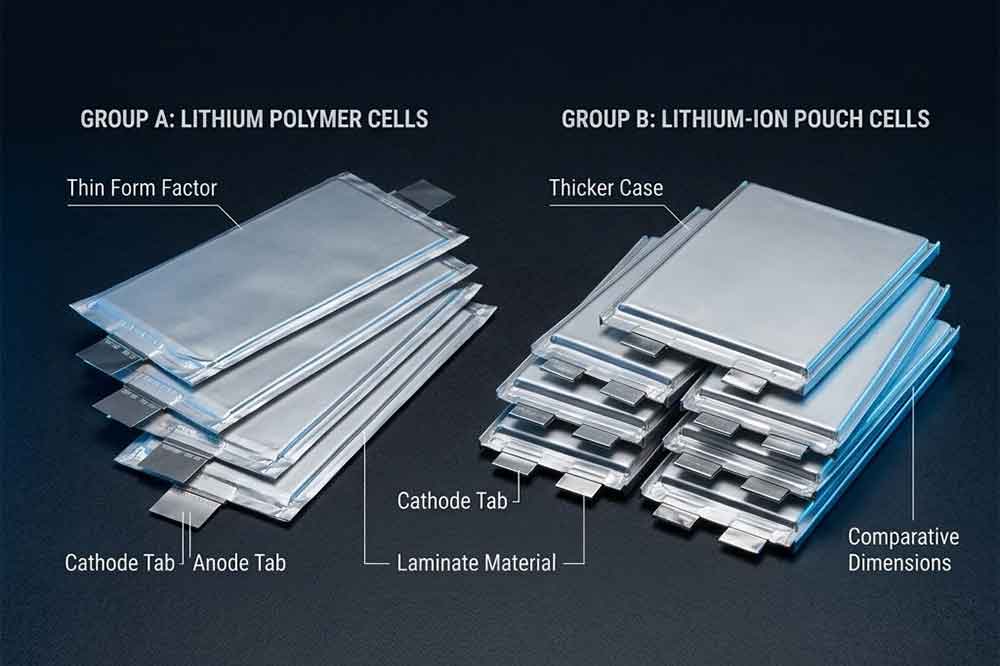
When sourcing rechargeable batteries for a new electronic product, buyers often encounter two terms: lithium polymer batteries and lithium ion pouch cells. They are frequently used interchangeably in product catalogs, technical discussions, and battery specifications. However, the terminology can create confusion during product development and supplier selection.
Are lithium polymer batteries different from lithium ion pouch cells? Does a polymer battery use a completely different chemistry? And which type is more suitable for an OEM device requiring a thin, lightweight, or custom-shaped power source?
The distinction is not as straightforward as the names suggest. In commercial battery manufacturing, many products marketed as lithium polymer batteries are actually lithium-ion cells manufactured in a flexible pouch format.
Understanding the relationship between these terms helps engineers and purchasing teams evaluate battery specifications more accurately instead of making decisions based on product names alone.
1. What Is Lithium Polymer Battery?
A lithium polymer battery, commonly called a LiPo battery, is a rechargeable lithium-based battery technology associated with polymer-containing electrolyte systems and flexible cell construction.
The term originally referred to batteries using polymer-based electrolytes. Early solid polymer electrolyte designs had limitations in ionic conductivity at room temperature. Modern commercial lithium polymer batteries commonly use gelled or polymer-modified electrolyte systems to support practical operation.
In the commercial market, however, lithium polymer is frequently used as a general name for rechargeable lithium batteries with soft pouch packaging.
Typical characteristics include:
- Lightweight laminated pouch packaging.
- Thin and flat cell construction.
- Flexible dimensional design.
- Multiple capacity and voltage options.
- Compatibility with different lithium-ion electrode chemistries.
Lithium polymer batteries are widely used in portable electronics, medical devices, wireless equipment, smart products, and other applications where battery dimensions and weight are important.
One important point: the term LiPo alone does not tell buyers the complete chemical composition, operating voltage, discharge capability, or cycle life of a battery. These parameters must be confirmed through the actual cell datasheet.
2. What Is a Lithium Ion Pouch Cell?
A lithium ion pouch cell is a rechargeable lithium-ion battery enclosed in a flexible multilayer aluminum-plastic laminate film rather than a rigid metal can.

Its internal construction generally includes four major components:
- Cathode: The positive electrode, which determines important electrochemical characteristics together with the anode.
- Anode: The negative electrode, commonly using graphite-based materials.
- Separator: A porous insulating layer that prevents direct contact between the electrodes while allowing lithium-ion movement.
- Electrolyte: The medium that enables lithium ions to move between the electrodes during charging and discharging.
The outer laminate packaging protects the internal cell structure and provides a lightweight alternative to conventional metal enclosures.
Unlike cylindrical cells, pouch cells do not require a rigid cylindrical housing. Their flat construction makes them suitable for products with limited installation space or specific dimensional requirements.
Lithium ion pouch cells can be manufactured in different lengths, widths, and thicknesses depending on the application and production capabilities.
They are available with different cathode chemistries, including:
- LCO (Lithium Cobalt Oxide)
- NCM (Lithium Nickel Cobalt Manganese Oxide)
- NCA (Lithium Nickel Cobalt Aluminum Oxide)
- LFP (Lithium Iron Phosphate)
Each chemistry has different characteristics in terms of energy density, voltage, cycle life, thermal behavior, and cost.
Therefore, a pouch cell’s performance cannot be determined simply by whether it is marketed as lithium polymer or lithium ion.
3. Lithium Polymer vs Lithium Ion Pouch Cell: Key Differences
The most important distinction is between electrolyte technology and physical packaging.
Lithium polymer describes a battery technology associated with polymer-based or gelled electrolyte systems. Lithium ion pouch cell describes a lithium-ion cell using flexible pouch packaging.
In everyday commercial applications, these descriptions often refer to overlapping products.
Here is a practical comparison:
| Comparison | Lithium Polymer Battery | Lithium Ion Pouch Cell |
|---|---|---|
| Main terminology | Battery technology / commercial product name | Physical cell format |
| Electrolyte | Often polymer-modified or gelled in LiPo terminology | Commonly liquid electrolyte; designs vary |
| Packaging | Commonly flexible pouch | Flexible aluminum-plastic laminate |
| Cell shape | Often thin and flat | Thin, flat, or customized |
| Electrode chemistry | Depends on the cell design | LCO, NCM, NCA, LFP, etc. |
| Energy density | Depends on chemistry and design | Depends on chemistry and design |
| Cycle life | Depends on cell construction and operating conditions | Depends on cell construction and operating conditions |
| Applications | Portable electronics and compact devices | Industrial equipment, medical devices, smart products, and portable electronics |
The table should not be interpreted as two completely separate battery categories. A lithium polymer pouch battery may also be classified as a lithium-ion pouch cell.
For OEM purchasing, the actual cell specification is more important than the commercial name.

4. Are Lithium Polymer Batteries and Lithium Ion Pouch Cells the Same?
In many commercial applications, they refer to essentially the same type of rechargeable battery product.
A battery advertised as a lithium polymer battery may use lithium-ion electrochemistry and a flexible aluminum-plastic pouch enclosure. The same product may appear in a technical specification as a lithium ion pouch cell.
However, the terms are not technically identical in every situation.
A genuine distinction can exist when discussing polymer electrolyte technology. A lithium-ion cell using a specific gel polymer or solid polymer electrolyte system has different electrolyte characteristics from a conventional liquid-electrolyte pouch cell.
This is why engineers should avoid assuming that every product labeled LiPo uses a fully solid polymer electrolyte.
When evaluating a supplier, request the following information:
- Cathode chemistry and anode material.
- Electrolyte type, where relevant and disclosed.
- Nominal voltage and maximum charging voltage.
- Rated capacity and discharge current.
- Operating temperature range.
- Dimensions and thickness tolerance.
- Cycle life under specified testing conditions.
These details provide a much more reliable technical basis for comparison.
5. Performance Comparison: Capacity, Energy Density and Cycle Life
One common purchasing question is whether lithium polymer batteries offer better performance than lithium ion pouch cells.
There is no universal answer because the two descriptions overlap and do not independently define cell performance.
Energy Density
Energy density depends mainly on electrode chemistry, active material loading, cell design, and manufacturing quality.
A thin pouch design can reduce the weight associated with rigid external packaging. This may improve the overall packaging efficiency of a battery assembly.
However, a pouch cell is not automatically more energy-dense than every cylindrical or prismatic lithium-ion cell.
Capacity
Capacity is determined by the cell’s electrochemical design and physical dimensions.
For example, two pouch cells with the same nominal voltage may have different capacities because of differences in electrode area, thickness, material composition, and internal construction.
OEM buyers should compare rated capacity in Ah or mAh rather than relying on the LiPo or Li-ion label.
Cycle Life
Cycle life depends on several factors, including:
- Electrode chemistry.
- Charge and discharge rates.
- Charging voltage.
- Operating temperature.
- Depth of discharge.
- Cell manufacturing quality.
An LFP pouch cell and an LCO pouch cell may have substantially different cycle-life characteristics, even though both use pouch packaging.
For equipment requiring frequent cycling, chemistry selection and operating conditions should be evaluated before choosing the cell format.
6. Safety and Swelling: What Should OEM Buyers Know?
Both lithium polymer batteries and conventional lithium-ion pouch cells require appropriate electrical and mechanical protection.
Pouch cells use flexible laminate packaging rather than rigid metal enclosures. This construction makes mechanical support an important part of battery integration.
Gas generation during abnormal operation, aging, or certain degradation processes can cause pouch cells to swell.
For product designers, this creates several practical considerations:
- Allow sufficient space for dimensional tolerances and possible cell expansion.
- Avoid sharp edges and excessive mechanical pressure.
- Design suitable insulation and electrical connections.
- Select an appropriate protection circuit or BMS.
- Follow the manufacturer’s charging and discharging limits.
- Validate the battery under the intended operating conditions.
A battery protection circuit can provide functions such as overcharge protection, over-discharge protection, and overcurrent protection, depending on its design.
However, protection electronics cannot replace proper cell selection, mechanical design, or thermal management.
For OEM products, battery safety must be considered at both the individual cell level and the complete battery pack level.
7. Which Battery Is Better for OEM Applications?
For most OEM projects, the more useful question is not whether lithium polymer is better than lithium ion pouch technology.
Instead, engineers should identify the required cell chemistry, physical dimensions, electrical performance, and mechanical integration conditions.
Portable and Slim Electronic Devices
Thin pouch cells are suitable for products where available installation space is limited.
Examples include handheld terminals, smart devices, wireless accessories, and compact electronic equipment.
A customized cell thickness can help product designers use internal space more efficiently.
Medical and Healthcare Equipment
Medical equipment may require compact battery dimensions, stable voltage output, and predictable operating performance.
The selection should be based on the equipment’s power requirements, operating environment, charging method, and applicable battery safety requirements.
Industrial and Smart Devices
Industrial controllers, monitoring equipment, communication devices, and smart instruments may use customized pouch cells when their internal structure cannot accommodate standard cylindrical batteries.
For these projects, the battery supplier should evaluate continuous discharge current, peak current, operating temperature, and expected service life.
Custom Battery Packs
When a device requires more than one cell, the battery pack design becomes another important consideration.
Cells may be connected in series or parallel to achieve the required voltage and capacity. The pack may also include a PCM or BMS, custom wiring, connectors, insulation, and protective housing.
The final design must account for the electrical and mechanical requirements of the complete product.
8. What Information Should You Provide When Sourcing Pouch Cells?
A common problem in battery sourcing is that the initial inquiry only includes a voltage and capacity requirement.
For example, requesting a 3.7V 2000mAh lithium polymer battery does not provide enough information to confirm whether an existing cell can fit the application.

For a more accurate quotation and technical evaluation, prepare the following information:
| Specification | Information Required |
|---|---|
| Battery chemistry | LCO, NCM, LFP, or other |
| Nominal voltage | Required operating voltage |
| Capacity | Required mAh or Ah |
| Dimensions | Length × width × thickness |
| Continuous current | Normal operating discharge current |
| Peak current | Maximum current and pulse duration |
| Charging parameters | Charging voltage and current |
| Protection | PCM or BMS requirements |
| Connector | Type, wire length, and polarity |
| Application | Device type and operating environment |
If the battery will be installed in a custom enclosure, a drawing or physical sample is also useful.
A battery manufacturer can then evaluate whether a standard pouch cell is suitable or whether a customized design is necessary.
Conclusion
Lithium polymer and lithium ion pouch cell are closely related terms in the commercial battery industry, but they describe different aspects of battery technology.
Lithium polymer is associated with electrolyte and material terminology, while pouch cell refers to the physical packaging format. Many commercial lithium polymer batteries are, in practice, lithium-ion pouch cells.
For OEM applications, selecting the right battery requires more than comparing product names. Chemistry, capacity, voltage, discharge performance, dimensions, cycle life, and safety requirements should all be evaluated together.
At Apsenx, we supply lithium-ion pouch cells and support OEM battery sourcing for different equipment and product applications. Whether your project requires a standard pouch cell or a customized battery solution, providing the electrical specifications and available installation space is a practical starting point.
Explore our Lithium Ion Pouch Cell Battery Products or contact our team to discuss your battery requirements.
FAQ
Q1: Is a lithium polymer battery the same as a lithium ion pouch cell?
In many commercial applications, yes. Lithium polymer batteries are commonly manufactured using lithium-ion technology and flexible pouch packaging. However, the terms are not technically identical because polymer can also refer to the electrolyte system.
Q2: Which is better, lithium polymer or lithium ion pouch cells?
Neither is universally better. Performance depends on electrode chemistry, cell design, capacity, discharge requirements, and operating conditions. OEM buyers should compare actual technical specifications rather than battery labels.
Q3: Do lithium polymer pouch cells have a longer lifespan?
Not necessarily. Cycle life depends on electrode chemistry, charging conditions, temperature, discharge rate, and manufacturing quality. The manufacturer’s cycle-life test conditions should be reviewed before selection.
Q4: Can lithium ion pouch cells be customized for OEM products?
Yes. Depending on manufacturing capabilities, pouch cells can be supplied in different dimensions, thicknesses, capacities, and electrical specifications. Battery packs can also be customized with protection circuits, connectors, wiring, and enclosures.
Related Lithium Ion Pouch Cell Article
For a broader introduction to pouch battery technology, including its working principles, cell formats and common applications, read our guide to lithium ion pouch cell working principles and applications.
The quality of these internal layers depends heavily on electrode preparation and assembly processes. Learn more about how lithium ion pouch cells are manufactured step by step.
To understand the internal construction of pouch batteries, see our guide to lithium ion pouch cell structure.
The internal structure of a pouch cell depends on several carefully selected materials. For a closer look at the cathode, anode, electrolyte, separator, and packaging layers, read our guide to What Materials Are Used in Lithium Ion Pouch Cells?
Lithium Ion Pouch Cell Voltage: Nominal Voltage, Charging and Discharging — Learn how voltage specifications affect charging systems, battery pack configurations and equipment compatibility.
Cell chemistry is only one factor in battery selection. You should also evaluate the required capacity, operating time, and physical dimensions. Read our guide to lithium ion pouch cell capacity selection for more details.
For a better understanding of how battery weight and physical dimensions affect overall performance, read our guide to lithium ion pouch cell energy density, where we explain Wh/kg, Wh/L, and the key factors engineers should consider when selecting pouch cells for OEM battery applications.
Lithium ion Pouch Cells Products
-

11.1V 3S 850mAh li-ion Polymer Pouch Cell Battery Pack
-

134365 4500mAh 3.7V Rechargeable Lithium Polymer Battery
-

3.7V 1200mAh Li-Polymer Pouch Cell Battery
-

3.7V 15Ah 148198 Pouch Lithium Ion Battery
-

3.7V 1S2P 3000mah lithium Polymer Battery
-

3.7V 2000mAh Pouch Cell Battery
-

3.7V 502248 500mAh Lithium Ion Polymer Battery
-

3.7V 700mAh Li-Polymer Pouch Cell Battery
-

3.7V 800mAh Rechargeable Pouch Li-Polymer Battery
Leave a Reply