
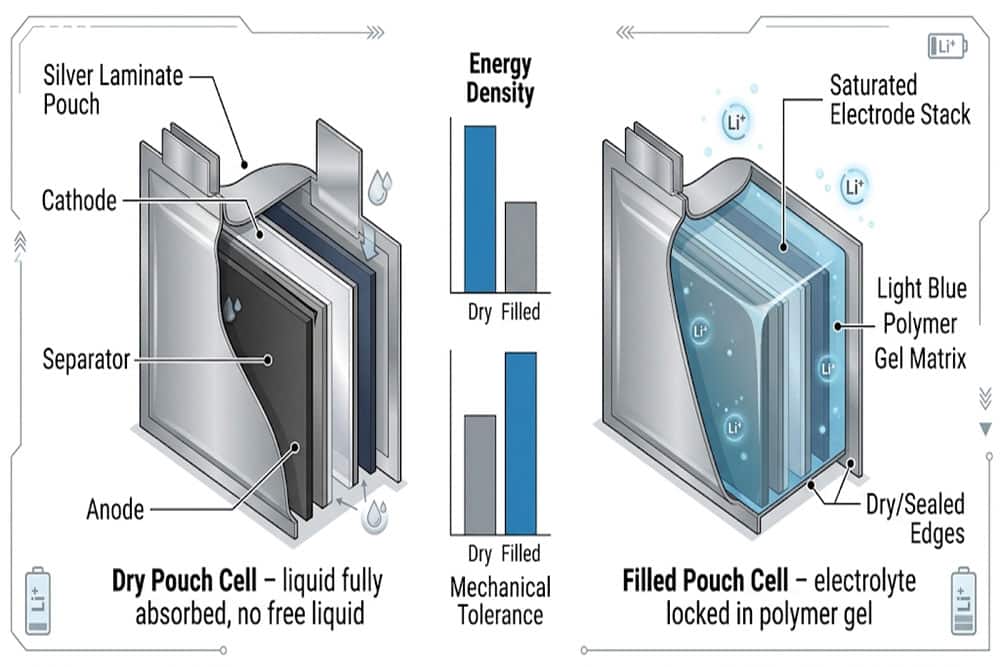
At first glance, you cannot tell them apart. A dry pouch cell and a filled pouch cell both come wrapped in the same silver laminated aluminum film, both weigh about the same, and both carry the same voltage rating printed on the label. Yet the two formats behave differently once they are inside your product — sometimes in ways that decide whether your device passes certification or comes back for warranty repair.
The difference is not the packaging. It is the electrolyte, the medium that carries lithium ions between the electrodes. How that electrolyte is formulated and immobilized shapes the cell’s energy density, swelling behavior, temperature tolerance and cost. If you are sourcing cells for a new product, this distinction matters more than the “dry” or “filled” label suggests. Below, we go through it piece by piece.
What Is Dry Pouch Cell?
A dry pouch cell is built like a sandwich: cathode sheet, separator, anode sheet, stacked or wound and then sealed inside the aluminum laminate. After assembly, the cell receives a metered injection of liquid electrolyte — enough to wet the separator pores and the electrode surfaces, but little enough that no free liquid pools inside the bag. The cell then goes through formation and degassing, and the residual gas is vacuum-extracted before final sealing.
“Dry” does not mean the cell contains no liquid. It means the electrolyte is fully absorbed into the porous materials, leaving no excess. This is why the term trips up so many buyers. A “dry” pouch cell is, chemically speaking, still a liquid-electrolyte lithium-ion cell — just a disciplined one.
Because nothing inside is wasted on a gel matrix, the electrode stack occupies more of the internal volume. That translates directly into higher energy density per liter, which is one reason high-discharge formats such as UAV packs and power tool cells favor the dry approach. Our 3.7V 15Ah 148198 pouch lithium ion battery follows this construction for exactly that reason.

What Is Filled Pouch Cell?
A filled pouch cell — often marketed as a gel polymer or “gel-filled” cell — starts from the same stack but adds a polymer matrix that gels the electrolyte. In practice, manufacturers add monomers or a pre-made gel during the filling step; heat or UV triggers polymerization, and the liquid electrolyte becomes trapped in a cross-linked network. The result is a cell whose interior behaves like a soft solid rather than a liquid-filled pouch.
The gel does two jobs at once. It holds the electrolyte against the electrodes over the cell’s lifetime, and it acts as a cushion that resists deformation. If the cell is squeezed, punctured or bent past its design limits, the gel limits electrolyte migration and slows the spread of internal shorts. That tolerance for mechanical stress is why filled formats appear so often in wearables, medical adhesive devices and ultra-thin consumer electronics, where the cell lives close to the user’s body and rarely gets an ideal mounting environment.
The trade-off is volume. The gel matrix occupies space that a dry cell would give to active material, so filled cells typically carry 3–8% less energy in the same footprint. Our 134365 4500mAh 3.7V rechargeable lithium polymer battery is a typical mid-range filled design — balanced, safe and forgiving in compact enclosures.

Dry Pouch Cell vs Filled Pouch Cell: Side-by-Side Comparison
| Attribute | Dry Pouch Cell | Filled (Gel) Pouch Cell |
| Electrolyte state | Liquid, fully absorbed into separator/electrodes | Liquid trapped in a polymer gel network |
| Energy density | Higher (more active material per volume) | 3–8% lower due to gel volume |
| Swelling behavior | More sensitive to gas generation; needs proper stack pressure | Gel suppresses electrolyte pooling; more uniform swelling |
| Low-temperature performance | Better ion mobility in cold conditions | Gel network slows ion transport below 0°C |
| Leak resistance | Good when properly sealed; less forgiving if the pouch is damaged | Strong — gel stays in place even after deformation |
| Mechanical tolerance | Requires firm fixture and stack pressure | Handles bending, pressure and vibration better |
| Typical cycle life | 500–1000 cycles depending on chemistry and load | Comparable, often slightly longer under mechanical stress |
| Cost | Lower — simpler filling and formation process | Slightly higher — polymerization step adds process and material cost |
| Common applications | Drones, power tools, RC, energy storage modules | Wearables, medical patches, thin consumer devices |
No row in that table makes one format the automatic winner. Each attribute only matters if your application cares about it.
Where Each Format Wins
Choose a dry pouch cell when energy density and discharge rate lead your spec sheet. Flight time is a function of watt-hours per gram, so drone and UAV batteries almost always run dry construction. The same logic applies to power tools, RC vehicles and portable jump starters, where high current draw punishes any restriction on ion mobility — including a gel network at low temperatures.
Choose a filled pouch cell when safety margin and shape flexibility matter more than a few percent of capacity. A medical patch that flexes against skin, a hearable squeezed into a curved housing, or a tracker that must survive drops: these designs benefit from the gel’s mechanical forgiveness and its resistance to electrolyte leakage. If your enclosure cannot guarantee uniform stack pressure on the cell, the filled format removes a failure mode you would otherwise have to engineer around.
Many consumer projects actually blend the two: a dry cell in the main power pack, a filled cell in a compact secondary module. That split is easier to plan if you involve your supplier during the design phase rather than after the mechanical drawings are frozen. Apsenx builds both formats under one roof, and the pouch cell battery category shows the range from 500mAh wearables cells to 15Ah high-discharge packs.

Swelling, Safety and Lifecycle Considerations
Swelling is where the two formats differ most visibly over time. Every lithium-ion cell generates gas during formation and, to a lesser degree, during aging. In a dry pouch cell, that gas gathers in pockets and pushes against the laminate; without adequate fixture pressure, the cell visibly bulges and loses contact with thermal interfaces. In a gel-filled cell, the polymer network distributes the stress and slows local deformation, so the profile stays flatter for longer.
Neither format eliminates swelling — it is inherent to the chemistry. We covered the full mechanism, its causes and prevention methods in a separate article on lithium ion pouch cell swelling, which pairs well with this one if you are designing the cell’s mounting environment.
On safety: a damaged dry cell can release liquid electrolyte quickly once the laminate is breached. A gel-filled cell leaks far less because the electrolyte is immobilized, buying time in over-abuse scenarios. That said, both formats rely on correct charging limits, temperature windows and protection circuitry — the electrolyte format changes failure behavior, not the fundamentals of safe integration.
Cost and Supply Considerations
Dry pouch cells are cheaper to produce. The filling step is a straightforward injection, and formation is a standard bake-and-cycle process. Filled cells add a polymerization stage with its own yield losses, which lands as a modest but real premium — usually visible in quotes above roughly 10k units.
Lead time differs less than buyers expect, since both formats share the same stacking, pouch-forming and testing infrastructure. What drives availability is capacity size and order volume, not electrolyte format. For a project that needs something between the catalog options, custom thickness, tab position and capacity are all negotiable — see the custom lithium battery pack solutions page for how that process works at Apsenx.
Frequently Asked Questions
No. A dry pouch cell still uses liquid electrolyte absorbed into the separator and electrodes. A true solid-state cell replaces the liquid with a solid ion conductor. The naming overlap causes confusion, but the internal chemistry is fundamentally different.
Under comparable conditions, both reach 500–1000 cycles. The gel-filled cell often holds capacity slightly better in applications with vibration or mechanical stress, while the dry cell can age faster if it is mounted without proper stack pressure.
Sometimes, but not as a drop-in decision. Check three things first: whether your enclosure provides stack pressure, whether the thickness budget tolerates the different swelling profile, and whether your discharge profile favors the dry cell’s higher rate capability. Ask the supplier to validate the swap in your actual load profile.
The premium is usually modest — a few percent at volume — because the two formats share most of the production line. The polymerization step adds process cost, but it does not change the economics of the cell the way exotic cathode chemistry would.
Filled (gel) construction is the usual pick. Wearables subject the cell to bending, body heat and tight enclosures, and the gel’s mechanical tolerance and leak resistance handle those conditions better than a liquid-electrolyte dry cell.
Choose the Right Pouch Cell Format for Your Project
The dry-versus-filled decision comes down to one question: does your product need maximum energy density or maximum mechanical forgiveness? Dry pouch cells deliver more watt-hours per liter and better cold-weather discharge, which is why drones, tools and storage modules use them. Filled pouch cells trade a few percent of capacity for leak resistance and tolerance of pressure and bending — exactly what wearables and medical devices need.
If you are weighing the two formats for a specific project, the team at Apsenx can review your size, load and environment requirements and recommend the matching construction. Browse the full pouch cell battery lineup, or compare formats further with our guide to pouch vs prismatic vs cylindrical cells and the OEM-focused breakdown of pouch cell vs prismatic cell differences. For a quote on either format, reach out through the contact page and include your target capacity and dimensions.
Pouch Cell Series
-

11.1V 3S 850mAh li-ion Polymer Pouch Cell Battery Pack
-

134365 4500mAh 3.7V Rechargeable Lithium Polymer Battery
-

3.7V 1200mAh Li-Polymer Pouch Cell Battery
-

3.7V 15Ah 148198 Pouch Lithium Ion Battery
-

3.7V 1S2P 3000mah lithium Polymer Battery
-

3.7V 2000mAh Pouch Cell Battery
-

3.7V 502248 500mAh Lithium Ion Polymer Battery
-

3.7V 700mAh Li-Polymer Pouch Cell Battery
-

3.7V 800mAh Rechargeable Pouch Li-Polymer Battery
Leave a Reply