
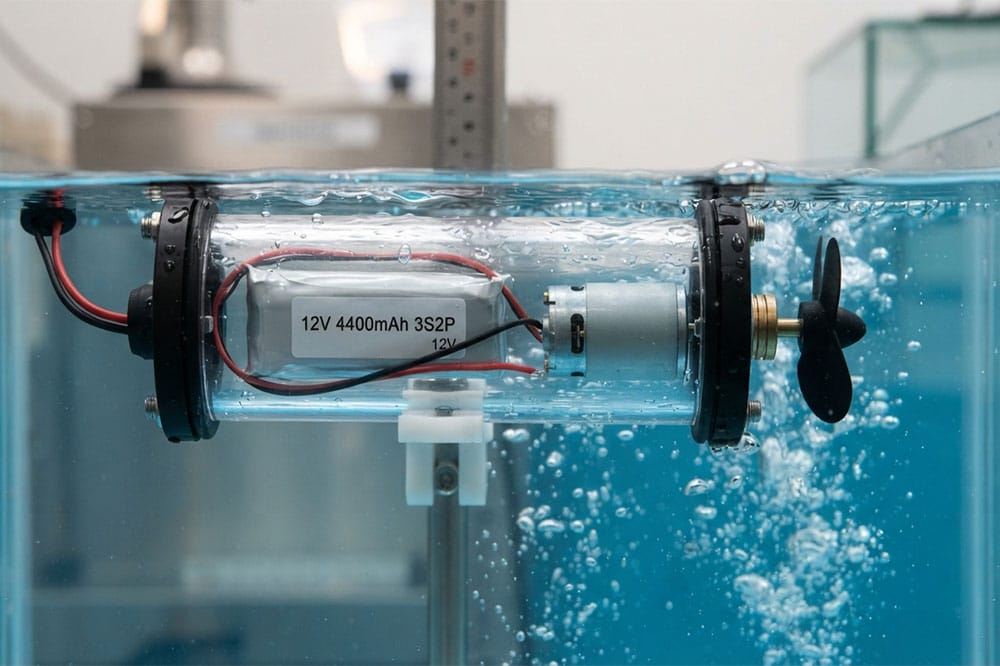
Running a 775 DC motor under water sounds simple until you actually do it. The motor is cheap, torquey, and everywhere — ROV thrusters, bait boats, aquarium stirrers, small dredges all use it. The hard part is the battery. Water kills electronics, motors stall unpredictably, and a pack that works fine on a bench can fail on its third dive. This guide breaks down what a 775 motor really needs on a 12V rail, which pack from the Apsenx catalog fits the job, and how to keep the whole thing dry.
Why the 775 Motor Is Everywhere in Underwater Builds
The 775 is a 42mm can motor with a beefier armature than the smaller 550 and 540 families. More copper means more torque at the same voltage, which is exactly what you want when a propeller has to push against water instead of air. It runs happily from 6V to 24V, but most builders settle on 12V because that voltage sits right in the sweet spot of the 18650 lithium world — three cells in series, done.
There’s another quiet reason: 12V packs are cheap to source and easy to replace. If your build uses a standard pack instead of something exotic, a damaged pack after a leak costs you days, not weeks.
What the Motor Actually Draws
Spec sheets for 775 motors usually quote a no-load figure around 0.3–0.6A, which is misleading. Under water the numbers change:
- No load (in air): 0.4–0.6A
- Normal load (propeller in water, cruising): 1–3A
- Heavy load (clogged intake, thick weed, jammed impeller): 4–6A
- Stall: 8A or more for a few seconds
Size the pack for the stall, not the cruise. If your BMS trips every time the propeller catches a fishing line, the pack was undersized. This is the single most common mistake in these builds, and it’s why the discharge capability of the pack matters more than the sticker capacity.
Choosing 12V Battery Pack for Underwater Work
Voltage and Capacity
A 3S lithium-ion configuration gives 11.1V nominal and about 12.6V fully charged — well within what a 775 motor tolerates, and it matches controllers and speed drivers sold for “12V” motors. Capacity decides runtime. As a rough rule, divide pack capacity in mAh by the average current draw in mA:
- 2A average draw ÷ 4400mAh pack ≈ 2 hours
- 3A draw ≈ 80 minutes
- Bursts at 5A+ cut those numbers hard
Discharge Rate
The pack has to deliver stall current without the BMS cutting output. A pack built from standard 2C-class 18650 cells in a 2P layout handles roughly 5–6A continuous — enough headroom for a loaded 775 motor at 12V. If your build pulls harder than that, either go wider on the parallel count or step up to a power-class pack.
The Sealing Problem
Here’s the blunt truth: no 18650 pack is waterproof, and you shouldn’t pretend otherwise. Water plus lithium cells plus a live BMS is a short circuit waiting to happen. There are three workable approaches:
- Sealed compartment. The pack stays dry inside an O-ring-sealed tube or box, with the motor shaft passing through a lip seal. This is how most serious ROV and bait boat builds do it — the pack never touches water.
- Resin potting. The whole pack is buried in epoxy or polyurethane. It works, but it’s permanent: heat gets trapped, and you can’t inspect or replace the BMS.
- Gel-filled pouch inside a bag. A middle ground used in disposable or low-cost builds. Less reliable, fine for shallow, short-run prototypes.
Option 1 wins in almost every case, and it pairs naturally with a standard rectangular pack — which brings us to the concrete recommendation.
The Recommended Pack: Apsenx 12V 4400mAh 3S2P 18650
The closest match in the current catalog is the 12V 4400mAh Lithium Ion 3S2P 18650 Battery Pack. If you’re searching for a battery for 775 dc motor 12v under water projects, this is the pack to start with, and here’s why the spec sheet backs that up:
| Item | Details |
| Configuration | 3S2P (6 × 18650 cells) |
| Nominal Voltage | 12V |
| Nominal Capacity | 4400mAh |
| Cycle Life | ~1000 cycles |
| Protection | Built-in smart BMS (overcharge, over-discharge, short circuit) |
| Operating Temperature | 0–60°C |
| Weight | ~1 kg |
| Dimensions | 6 × 7.5 × 19 cm |
| Connector | Customized |
| Warranty | 1 year, OEM/ODM supported |
The 6 × 7.5 × 19 cm footprint slides into a standard 75mm PVC or acrylic tube with room for an O-ring bulkhead and a fuse — exactly the enclosure style described above. The semi-solid-state cell chemistry and LiCoO₂ cathode give it stable output across the 0–60°C band, which covers warm pond water and most summer surface conditions. Note the lower limit, though: this is not an ice-fishing pack. If your project runs near freezing, ask about low-temperature cell options before ordering.
3S2P Wiring Explained
Three cells in series set the voltage near 12V; two strings in parallel double the capacity to 4400mAh and split the current load between them. That parallel step matters underwater. When the motor stalls and current spikes, two parallel strings share the surge, so cell voltage sag stays lower and the BMS is less likely to trip mid-dive. A lighter alternative for low-draw builds is the 2600mAh 3S1P 11.1V 18650 Battery Pack, which runs a gently loaded motor for over an hour in a smaller, lighter package.
Runtime With a Real 775 Motor
Practical numbers from typical builds: a 775 thruster pulling 2A on a cruising setting gets close to two hours from the 4400mAh pack. Full-throttle operation at 4–5A drops that to under an hour. Most builders program a throttle cap around 70%, which flattens the current curve and keeps the BMS comfortable — you lose a bit of top speed and gain a lot of runtime.
When to Go Custom
The catalog pack covers a wide range of builds, but some projects push past it:
- Higher thrust: two 775 motors on one hull double the current. You’ll want a 3S3P or wider pack rated above 10A continuous.
- Longer missions: monitoring buoys and dredges run for many hours. A pack built on 10Ah 18650-class power cells triples the runtime in the same voltage.
- Odd shapes: cramped hulls sometimes need a flat or L-shaped pack. That’s a special-shaped build, not a catalog item.
All three cases end at the same place: the custom 18650 battery pack OEM service, where you hand over your voltage, capacity, discharge current, and housing dimensions and get a pack built to fit — including wet-environment packaging choices like reinforced wrap and potting-ready layouts. For bulk pricing, the full 18650 Battery Pack category lists every stocked configuration, and if you’re sourcing individual cells for your own assembly line, the 18650 lithium battery cell category covers that side.
Not sure whether cylindrical 18650 cells or pouch cells suit your housing better? The comparison in Lithium Ion Pouch Cell vs Cylindrical Battery: Which Is Better? walks through the trade-offs, and it’s worth ten minutes before you commit a housing design.
Build Checklist Before You Order
- Measure your stall current with a clamp meter — not a guess, a measurement.
- Add 30% headroom above stall current when picking the pack.
- Design the dry compartment first, then pick the pack that fits it.
- Confirm connector and wire length with the supplier — both are customizable on the 4400mAh pack.
- Test in a bathtub or barrel before the real deployment. Every leak shows up there first.
FAQ
No. The pack must stay dry. 18650 cells and their BMS boards short out on contact with water, and a wet lithium pack is a genuine hazard. Keep the pack in a sealed, O-ring compartment or pot it fully — the motor can get wet, the pack can’t.
At a 2A cruising load, expect about two hours. At 4–5A full throttle, under an hour. Stalled runs can flatten the usable capacity in minutes, so throttle control protects both runtime and the BMS.
It should — that’s the point of the protection board. The smart BMS in the 12V 4400mAh pack cuts output on overcurrent and short circuit. If it trips on every startup surge rather than only on real jams, your pack is undersized for the motor.
Yes. Pack voltage, capacity, discharge rate, dimensions, connector, and wire length are all configurable through the OEM/ODM service. For wet builds, discuss potting-ready layouts or reinforced outer wrap when you request a quotation.
Yes. A 3S pack reads 12.6V full and 11.1V nominal, and 775 motors run the full range without issue. Speed varies a few percent with voltage sag — barely noticeable in water, where loads dominate behavior.
18650 Battery Pack
-

12V 4400 mah Lithium ion 3S2P 18650 Battery Pack
-

18650 20V 3.0Ah Cordless Drill battery
-

18650 22.2V 7.8Ah 2600Mah 6S3P Rechargeable Battery Pack
-

18650 3.7V 10Ah Li-Ion Power Battery Pack
-

18650 7S7P 24V 14Ah Lithium ion Electric Scooter Battery Pack
-

18650 Electric Scooter 48V 13000mAh Lithium Battery
-

2600mAh 3S1P 11.1V 18650 Battery Packs
-

36V 5200mAh 10S2P 18650 Battery Pack
-

48v 4400mah 13S2P 18650 Rechargeable Battery Pack
-

7S2P 24V 18650 Lithium Battery Pack
-

Electric Scooter 36V 4400mAH 10S2P 18650 Battery Pack
Leave a Reply