
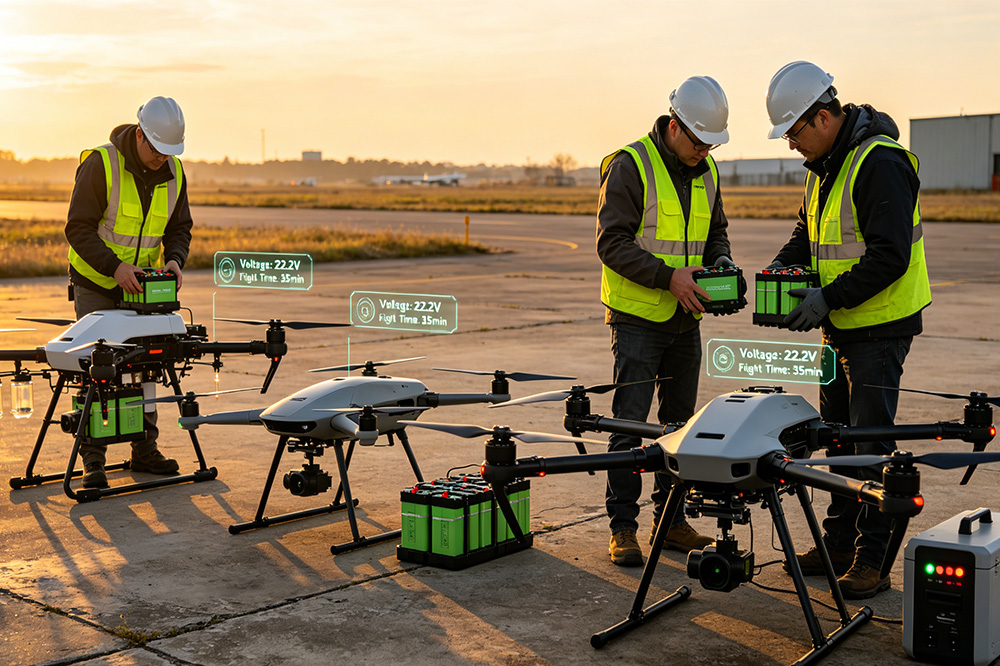
Battery choice has a bigger impact on industrial drones than many people expect.
It doesn’t just affect flight time. It changes payload capacity, operational efficiency, maintenance cost, and even flight safety.
A battery setup that works perfectly for a lightweight survey drone may completely fail on a heavy agricultural spraying platform. The same applies to inspection UAVs, logistics drones, and VTOL aircraft.
That’s why industrial UAV manufacturers spend so much time optimizing power systems around specific mission profiles rather than simply choosing the biggest battery available.
Modern commercial UAV battery systems are now designed around application requirements instead of generic flight performance alone.UAV Battery
Start With the Mission, Not the Battery
One of the most common mistakes in UAV design is choosing a battery before fully understanding the aircraft’s actual workload.
Different drone applications place completely different demands on the power system.
For example:
- Mapping UAVs prioritize endurance
- Agricultural drones prioritize lifting power
- Inspection drones prioritize stable cruising efficiency
- Emergency response UAVs may require rapid acceleration and reliability
The battery should support the mission instead of forcing the aircraft to adapt around it.
That sounds obvious, but in practice it’s often overlooked.
Flight Time Is Important, But It’s Not Everything
Most buyers immediately ask one question:
“How long can the drone fly?”
Flight endurance matters, but it should never be the only factor.
Longer flight time usually means:
- Larger battery packs
- More weight
- Increased motor load
- Slower maneuverability
At some point, adding more battery capacity creates diminishing returns.
A well-balanced UAV power system is usually more effective than simply maximizing battery size.
Industrial operators often care more about:
- Stable performance
- Predictable power delivery
- Battery lifespan
- Operational efficiency in the field
Not just the longest possible flight number on paper.
Payload Weight Changes Battery Requirements Completely
Payload has a massive effect on battery selection.
A drone carrying:
- Thermal cameras
- LiDAR systems
- Spraying tanks
- Delivery cargo
will behave very differently from an empty aircraft during testing.
Heavier payloads increase:
- Current draw
- Heat generation
- Power demand during takeoff
- Battery stress during climbing
This is one reason heavy-lift industrial drones often still rely on high-discharge LiPo battery systems.
They provide stronger burst current and more responsive throttle behavior under load.
Meanwhile, lighter inspection or mapping UAVs often perform better with Li-ion batteries focused on endurance efficiency.

LiPo vs Li-ion for Industrial UAVs
Both battery types are common in commercial UAV applications, but they solve different problems.
LiPo Batteries Usually Work Better For:
- Agricultural spraying drones
- Heavy-lift multirotors
- Emergency response UAVs
- High-thrust industrial platforms
They deliver fast current output and strong lift performance.
Li-ion Batteries Usually Work Better For:
- Mapping drones
- Long-range inspection UAVs
- VTOL survey aircraft
- Autonomous monitoring systems
They provide better energy density and longer flight duration.
There is no universal winner between the two.
The mission profile decides which battery technology makes more sense.
Temperature Resistance Matters More Than Many Operators Realize
Industrial UAVs often work in environments that consumer drones rarely encounter.
That includes:
- High summer temperatures
- Cold morning launches
- Desert conditions
- Coastal humidity
- Mountain environments
Battery performance changes significantly under temperature stress.
Cold weather can reduce voltage performance and shorten flight time. High temperatures accelerate battery degradation and increase thermal risk.
Professional UAV operators usually monitor battery temperature carefully before every mission, especially when flying expensive payloads.
This is one reason advanced industrial UAV battery systems now integrate temperature monitoring and smart battery management features directly into the pack.
Battery Safety Is a Business Issue
In commercial UAV operations, battery failure isn’t just inconvenient.
It can shut down an entire project.
A damaged battery can lead to:
- Mission delays
- Equipment loss
- Fire risk
- Expensive downtime
That’s why industrial operators increasingly focus on:
- Cell quality consistency
- Smart BMS integration
- Proper charging systems
- Battery cycle tracking
- Storage management
Reliable battery management is now considered part of overall fleet management rather than simple maintenance.
Fast Charging Isn’t Always the Best Option
Fast charging sounds attractive, especially for field operations.
But aggressive charging can create additional heat and shorten long-term battery lifespan if not properly managed.
For industrial UAV fleets running daily operations, battery longevity often matters more than reducing charging time by a few minutes.
Many professional operators now balance:
- Moderate charging speeds
- Controlled battery temperature
- Storage voltage discipline
- Scheduled battery rotation
These habits help reduce replacement costs over time.

Smart Battery Systems Are Becoming Standard
The UAV industry is moving toward smarter power systems.
Modern commercial battery packs increasingly include:
- Real-time voltage monitoring
- Temperature protection
- CAN communication
- Remaining capacity estimation
- Automatic balancing functions
For large drone fleets, these features improve operational reliability significantly.
Battery data has become part of flight planning, maintenance scheduling, and safety management.
Final Thoughts
Choosing the right UAV battery is really about understanding how the aircraft will be used in the real world.
The best battery for one industrial drone may be the wrong choice for another.
Before selecting a battery system, operators should look carefully at:
- Mission duration
- Payload weight
- Environmental conditions
- Charging workflow
- Safety requirements
- Long-term operating cost
Battery technology continues evolving quickly, but one thing remains consistent:
A well-matched power system usually performs better than simply choosing the highest capacity battery available.


Leave a Reply