
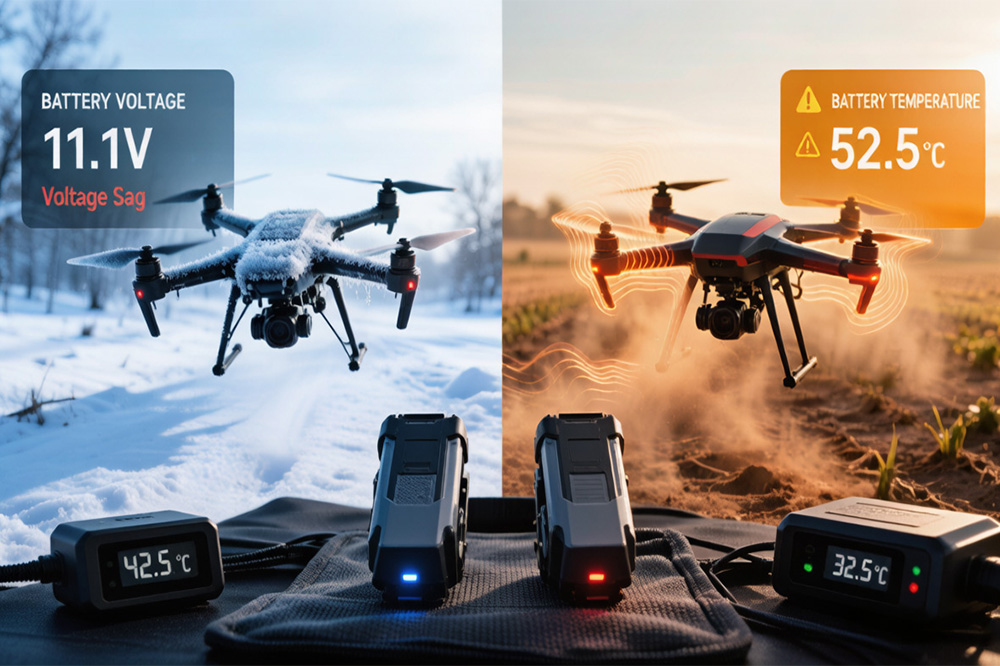
Most drone pilots pay attention to battery capacity, voltage, and flight time.
Temperature usually gets ignored until something starts going wrong.
Maybe the drone suddenly feels weak during winter flights. Maybe the battery comes down unusually hot after carrying a heavy payload. Sometimes flight time drops for no obvious reason.
A lot of those problems are connected to temperature.
Lithium batteries are sensitive to both heat and cold, and UAV performance can change more than people expect when environmental conditions shift.
That’s especially true in commercial drone operations where aircraft fly for long periods outdoors in changing weather.
Manufacturers building industrial UAV battery systems now place much more focus on thermal stability and battery protection than they did a few years ago.UAV Battery
Cold Weather Changes Battery Behavior Quickly
Most drone pilots notice cold-weather battery issues almost immediately.
The aircraft may:
- Feel less responsive
- Lose voltage faster
- Show shorter flight times
- Trigger low-voltage warnings earlier than normal
That happens because lithium batteries rely on chemical reactions inside the cells, and colder temperatures slow those reactions down.
As internal resistance increases, the battery struggles to deliver current as efficiently as it does in warmer conditions.
This becomes especially noticeable during:
- Fast acceleration
- Climbing
- Heavy payload takeoff
- Aggressive FPV flying
The drone may still fly normally at first, but voltage tends to sag more heavily under load.

Winter Flights Often Feel Different
FPV pilots usually notice cold-weather performance loss very quickly.
A battery that feels strong during summer can suddenly feel softer and less responsive on a cold morning.
Punch-outs feel weaker. Recovery after dives becomes less aggressive. Voltage drops faster near the end of the flight.
In some cases, batteries that normally stay stable can sag heavily only seconds after takeoff.
That’s why many experienced pilots warm batteries before winter flights instead of launching with packs sitting at outdoor temperatures.
Even simple temperature differences can noticeably affect performance.
High Heat Creates a Different Set of Problems
Cold weather reduces battery efficiency.
Heat damages batteries over time.
High temperatures accelerate chemical wear inside lithium cells and increase stress during charging and discharge cycles.
Drone batteries naturally generate heat during flight, especially when the aircraft is:
- Carrying heavy payloads
- Flying aggressively
- Operating in hot climates
- Charging at high current
A warm battery after landing is normal.
A battery that becomes excessively hot usually means the system is under too much stress.
Overheating Shortens Battery Lifespan
Excessive heat is one of the fastest ways to reduce battery lifespan.
High temperatures increase:
- Internal resistance growth
- Cell degradation
- Capacity loss over time
This doesn’t always happen immediately.
Sometimes the damage appears slowly through:
- Reduced flight time
- Increased voltage sag
- Battery swelling
- Poor charging behavior
Commercial UAV operators pay close attention to temperature because replacing large industrial battery packs frequently becomes expensive very quickly.

Heavy-Lift UAVs Generate More Battery Heat
Industrial drones carrying payloads naturally create more stress on the battery system.
Agricultural spraying drones are a good example.
Lifting liquid payloads requires significant current during:
- Takeoff
- Climbing
- Direction changes
- Hovering under load
That current generates heat inside the cells.
The heavier the workload, the more important battery cooling and discharge efficiency become.
This is one reason many heavy-lift UAVs still rely on high-discharge LiPo systems designed for strong current handling.
Fast Charging Adds Additional Heat Stress
Fast charging is convenient, especially during field operations.
But faster charging also increases battery temperature.
Repeated high-speed charging cycles can accelerate long-term battery wear if thermal management is poor.
That’s why many professional UAV operators avoid charging batteries immediately after flight.
Instead, they usually:
- Let packs cool first
- Monitor cell temperatures
- Use balanced charging settings
- Avoid charging inside hot vehicles or direct sunlight
These habits help reduce thermal stress over time.
Temperature Affects Voltage Stability
Voltage behavior changes noticeably with temperature.
Cold batteries usually show:
- More voltage sag under load
- Reduced throttle response
- Faster apparent voltage drop
Hot batteries may temporarily feel powerful, but prolonged heat increases long-term wear and instability.
This matters a lot in:
- FPV racing
- Long-range UAV flights
- Heavy-lift industrial operations
- Autonomous drone missions
Stable voltage is important not only for flight performance, but also for safe power management during critical operations.
Storage Conditions Matter Too
Temperature affects batteries even when they are not flying.
Leaving lithium batteries:
- Inside hot vehicles
- In direct sunlight
- In freezing conditions for long periods
can slowly damage the cells over time.
Most experienced operators store UAV batteries:
- In cool dry environments
- At storage voltage
- Away from direct heat sources
Good storage habits usually extend battery lifespan more than people expect.
Industrial UAV Systems Now Use Thermal Monitoring
Modern commercial UAV platforms increasingly include battery temperature monitoring as part of the aircraft’s management system.
Some industrial drones can track:
- Cell temperature
- Current draw
- Voltage stability
- Charging conditions
- Remaining battery health
This helps operators identify problems before they become safety risks.
As UAV systems become larger and more expensive, battery thermal management is becoming part of overall flight reliability rather than simple maintenance.

Final Thoughts
Temperature affects nearly every part of UAV battery performance:
- Flight time
- Voltage stability
- Power delivery
- Charging behavior
- Long-term battery lifespan
Cold weather usually reduces immediate performance. Heat slowly damages batteries over time.
Neither problem should be ignored.
For casual drone pilots, temperature awareness helps improve flight consistency. For industrial UAV operators, it helps protect expensive equipment and maintain reliable operations.
Most battery problems don’t happen because of a single flight.
They build gradually through heat, stress, and poor handling over time.


Leave a Reply