
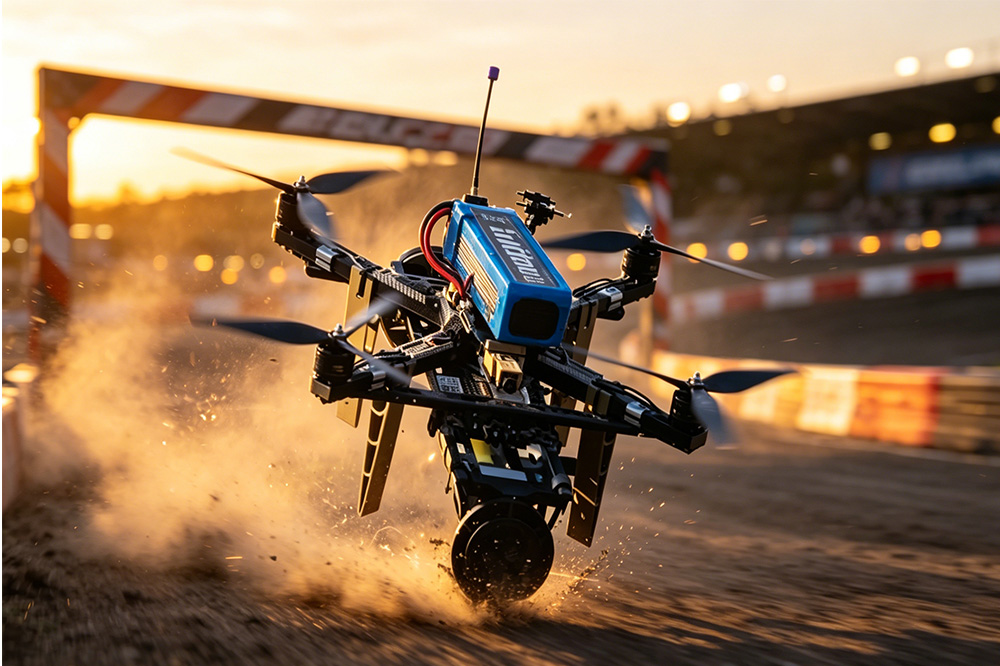
Battery technology in the drone industry has changed a lot over the past few years. Longer flight times, smarter battery management systems, and higher energy density have pushed UAV performance further than ever before.
But if you walk into an FPV racing event or look at most freestyle drone builds, one thing hasn’t changed.
Almost everyone is still flying LiPo batteries.
That’s not because newer battery technologies don’t exist. Li-ion packs, high-voltage batteries, and hybrid systems are becoming more common in industrial UAV projects. But FPV flying places very different demands on a drone compared to mapping or inspection missions.
For FPV pilots, responsiveness matters more than endurance.
That’s exactly where LiPo batteries still have the advantage.
Manufacturers developing high discharge drone batteries for demanding UAV applications continue to rely heavily on LiPo technology because of its unmatched power delivery characteristics.UAV Battery
FPV Drones Need Instant Power
An FPV drone changes speed constantly.
One second it’s hovering. The next second it’s diving, recovering, and accelerating hard through a tight turn. Those rapid throttle changes demand a battery that can react immediately without major voltage drop.
LiPo batteries handle this extremely well.
Their high discharge capability allows motors to pull large amounts of current very quickly. That instant power delivery is one of the biggest reasons FPV drones feel sharp and responsive in the air.
Pilots notice it immediately when switching to weaker battery setups.
The drone feels softer. Less aggressive. Less connected to throttle input.
For freestyle and racing pilots, that difference matters.
Voltage Sag Is a Big Deal in FPV Flying
FPV pilots talk about voltage sag all the time, and for good reason.
When a battery struggles to keep up with power demand, voltage drops under load. The harder the pilot pushes the drone, the more noticeable it becomes.
Excessive voltage sag can lead to:
- Reduced throttle response
- Slower motor reaction
- Unstable flight feel
- Early low-voltage warnings
LiPo batteries perform well under these conditions because they are built for high current output.
Li-ion batteries, while excellent for endurance flying, generally cannot maintain the same aggressive discharge performance during rapid throttle changes.
That’s why Li-ion setups are more common in long-range cruising builds rather than racing drones.
Flight Time Isn’t Everything in FPV
A lot of newer drone pilots focus heavily on flight time when comparing batteries.
Longer flights sound better on paper, but FPV flying is different from commercial UAV operations.
A racing drone only needs a few minutes of peak performance. During that short flight window, pilots care more about:
- Power consistency
- Fast recovery after punches
- Stable voltage
- Lightweight handling
LiPo batteries deliver exactly that.
Most FPV pilots would rather have four minutes of strong, predictable power than eight minutes of softer throttle response.
That’s one reason LiPo technology remains deeply connected to FPV culture.

Weight Changes the Way a Drone Flies
Battery weight affects more than endurance.
It changes how the drone behaves in the air.
Heavier batteries can make a quad feel less agile, especially during quick directional changes. FPV pilots often tune their builds carefully around weight balance and responsiveness.
LiPo batteries still offer one of the best combinations of:
- High discharge capability
- Lightweight construction
- Compact size
That balance is difficult to replace.
Even small differences in battery weight can change how a drone tracks through corners or recovers after a maneuver.
For competitive pilots, those details matter.
Why Long-Range FPV Pilots Sometimes Choose Li-ion
Li-ion batteries are not useless in FPV. They simply serve a different purpose.
Long-range FPV pilots often use Li-ion packs because endurance becomes more important than aggressive throttle response.
In cruising flights, drones spend more time maintaining steady speed rather than constantly accelerating.
That allows Li-ion batteries to take advantage of their higher energy density.
Still, most long-range pilots understand the compromise:
- Better flight time
- Reduced punch power
- Softer throttle feel
- More noticeable voltage sag under heavy load
For cinematic cruising, that tradeoff can make sense.
For racing, it usually doesn’t.
Heat and Battery Stress
FPV drones are hard on batteries.
High motor output, aggressive throttle changes, and repeated bursts of current create significant heat inside the battery pack.
LiPo batteries are designed to handle this kind of stress better than most alternatives.
That said, battery care still matters.
Experienced FPV pilots usually pay close attention to:
- Storage voltage
- Battery temperature
- Charging balance
- Physical damage after crashes
A damaged LiPo battery is never something to ignore.
Proper charging habits and safe storage make a major difference in battery lifespan and overall safety.

Why LiPo Technology Isn’t Going Away Anytime Soon
Battery technology will continue evolving, but LiPo batteries remain difficult to replace in high-performance FPV applications.
They still offer:
- Fast power delivery
- Strong throttle response
- Reliable high-current output
- Lightweight performance characteristics
Until another battery technology can deliver the same combination of power, responsiveness, and weight efficiency, LiPo will likely remain the standard for FPV drones.
That’s why even as endurance-focused UAV systems move toward Li-ion solutions, the FPV world still revolves around LiPo packs.
For the kind of flying FPV pilots demand, they simply work.


Leave a Reply