
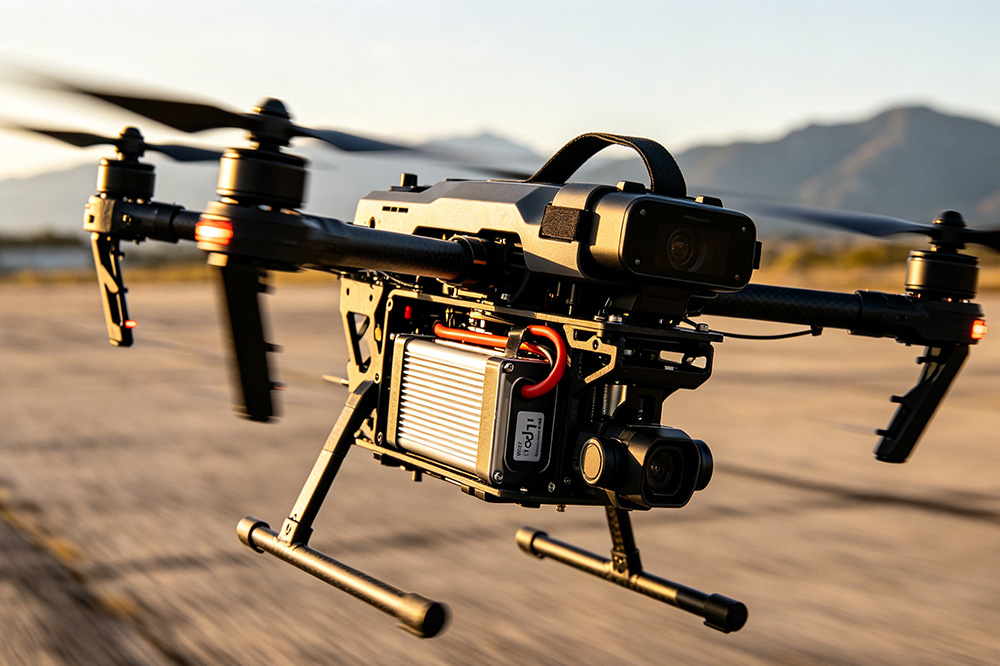
Ask ten drone pilots what battery they trust most and you’ll probably get two answers: LiPo or Li-ion.
Both power thousands of UAVs every day, but they behave very differently once the drone leaves the ground. One is built for raw power and aggressive throttle response. The other is designed to squeeze every possible minute out of a flight.
That’s why battery choice has become more important as drones move beyond hobby flying. A racing quad, a mapping UAV, and an agricultural spraying platform don’t need the same kind of power system.
The battery that works perfectly for one aircraft can be completely wrong for another.
Companies building professional drone systems now pay much closer attention to battery configuration, especially in industrial projects where endurance and reliability directly affect operating cost. Many manufacturers offer specialized industrial UAV battery solutions through product categories like UAV Battery
Why LiPo Batteries Are Still Everywhere
LiPo batteries have been the standard in drones for years, and there’s a good reason for that.
They deliver power fast.
The moment a pilot punches the throttle, a LiPo pack can dump a large amount of current into the motors almost instantly. That immediate response is exactly what FPV pilots and heavy-lift drone operators want.
You feel it most during:
- Fast climbs
- Sharp turns
- Sudden acceleration
- Heavy payload takeoff
That aggressive power delivery is difficult for other battery types to match.
LiPo packs are also relatively lightweight for the amount of power they can provide, which helps drones stay agile in the air.
This is why they continue to dominate:
- FPV racing drones
- Cinematic quads
- Agricultural spraying UAVs
- Large multirotor platforms
The tradeoff is maintenance.
LiPo batteries need to be treated carefully. Overcharging, over-discharging, or storing them fully charged for long periods can shorten lifespan quickly. Physical damage is another issue. A damaged LiPo pack is something most experienced drone pilots take seriously.
Where Li-ion Batteries Do Better
Li-ion batteries solve a different problem.
Instead of focusing on maximum burst power, they focus on efficiency and endurance.
A Li-ion UAV usually won’t feel as aggressive in the air as a LiPo-powered drone, but it can stay airborne much longer. That matters a lot in commercial operations where flight time is tied directly to productivity.
For example:
- Survey drones covering large areas
- Powerline inspection UAVs
- Mapping aircraft
- Long-range VTOL systems
These aircraft often spend more time cruising steadily than making rapid movements. In those situations, energy density matters more than explosive throttle response.
That’s where Li-ion performs well.
A properly optimized Li-ion setup can add significant flight time compared to a traditional LiPo configuration.
For industrial operators trying to reduce battery swaps in the field, that difference becomes valuable very quickly.

The Biggest Difference Comes Down to Mission Type
A lot of online discussions treat LiPo and Li-ion like competitors, but in practice they serve different kinds of UAV missions.
If a drone needs:
- Fast acceleration
- Strong thrust
- Heavy lift capability
- High discharge performance
LiPo usually makes more sense.
If the goal is:
- Long endurance
- Efficient cruising
- Reduced power consumption
- Longer route coverage
Li-ion is often the better option.
That’s why FPV pilots still rely heavily on LiPo packs, while long-range UAV builders increasingly move toward Li-ion systems.
Neither battery is universally “better.” The aircraft’s purpose matters more than the battery label itself.
Flight Time Isn’t the Whole Story
People often compare batteries using flight time alone, but that doesn’t tell the full story.
A drone might stay airborne longer with Li-ion batteries, but it may also feel less responsive under heavy load. Voltage sag becomes more noticeable during aggressive throttle changes.
LiPo batteries handle those sudden power demands much better.
That difference becomes obvious in windy environments or when carrying heavier equipment. Industrial drones flying with thermal cameras, spraying systems, or delivery payloads often need stable high-current output rather than maximum endurance.
This is one reason many operators still choose high discharge drone batteries even when shorter flight time is part of the compromise.
Weight Matters More Than Most People Think
Battery weight changes how a UAV behaves.
A heavier battery can increase endurance, but it can also affect maneuverability and efficiency if the aircraft isn’t designed for it.
Li-ion packs typically offer better energy density, which means more stored energy for the same weight. That’s one of the reasons they work well in long-range aircraft.
LiPo batteries, meanwhile, tend to feel more responsive during dynamic flight because they can release energy much faster.
In simple terms:
- Li-ion helps drones fly farther
- LiPo helps drones fly harder

Safety and Battery Lifespan
Both battery types need proper handling, but Li-ion batteries are generally considered a little more stable during normal use.
LiPo packs are more sensitive to:
- Physical punctures
- Overcharging
- Improper storage
- High heat exposure
That doesn’t mean Li-ion batteries are risk-free, though. Any lithium battery can become dangerous if abused or poorly managed.
For commercial UAV fleets, battery management systems are now standard. Monitoring temperature, voltage balance, and charging cycles helps extend lifespan and reduce failure risk.
As drones become more expensive and more autonomous, battery management is turning into a major part of overall flight reliability.
Final Thoughts
LiPo batteries still dominate applications where immediate power and aggressive flight performance matter most. They remain the first choice for FPV pilots, heavy-lift multirotors, and drones operating under demanding load conditions.
Li-ion batteries continue gaining ground in endurance-focused UAV projects where longer flight time is worth more than rapid acceleration.
The important thing is understanding what the aircraft actually needs before choosing a battery system.
In most cases, the “best” UAV battery is simply the one that matches the mission properly.
Choosing between LiPo and Li-ion batteries depends on more than battery capacity. Many UAV engineers first need to understand why LiPo batteries became the standard choice for drones and what makes them different in real flight conditions. Read our detailed explanation here: Why Are LiPo Batteries Used in Drones?


Leave a Reply