
Introduction: Why Solar Light Batteries Matter
In the hot summers of Ontario, California, almost every backyard is lit with solar garden lights. At first, they shine brightly and last through the night. But after several months to a year, brightness fades, and nighttime runtime shortens—a very common issue.
Battery degradation is usually the culprit, though many assume the solar panel is failing. In reality, if your light can’t stay on all night after several sunny days of charging, the battery is likely worn out.
Replacing the 18650 battery is the simplest fix. Done correctly, it can restore brightness and extend your light’s lifespan by another 1–2 years.
Overview of 18650 Batteries
18650 batteries are cylindrical lithium-ion cells with a standard size: 18mm diameter × 65mm length. Capacity typically ranges from 1500mAh to 5200mAh.
Common Types
ICR (Lithium Cobalt Oxide): High energy density, best for compact lights requiring long runtime. Moderate discharge rate, not ideal for high-power LEDs. Thermal stability is average, so caution is needed in hot climates.
Case Study: Small garden lights in Brooklyn, NY using ICR cells performed reliably but drained a bit faster during summer heat.
INR (Lithium Nickel Manganese Cobalt Oxide): Strong discharge capability, suitable for high-brightness LED lights. Thermal stability is average, requiring proper protection against overheating. Best for flagpole or flood-style garden lights.
LiFePO4 (Lithium Iron Phosphate): Excellent thermal stability and long cycle life, though slightly lower capacity. Performs well in hot outdoor environments and continuous-use setups like courtyard lights.
Important Notes
Most solar lights are designed for either 3.2V or 3.7V batteries. Using higher voltage can damage circuits.
ICR and INR cells usually output 3.6–3.7V, generally safe for direct replacement.
LiFePO4 batteries are 3.2V—compatibility must be checked before use.
Always choose PCM-protected batteries to avoid overcharge, over-discharge, and short-circuit risks.

Choosing the Right Replacement Battery
Capacity
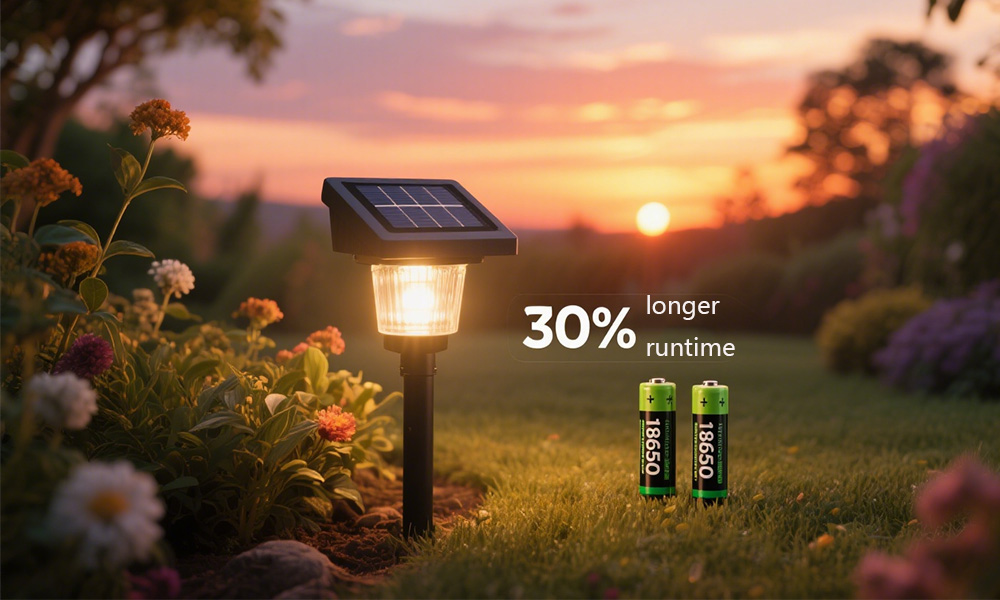
In Brooklyn, NY, one community tested old 1500mAh batteries that powered lights for about 4 hours. After upgrading to 2500mAh batteries, runtime extended to 6 hours, with brightness up about 30%.
Tip: Bigger is not always better. If the light’s circuitry only supports 1500–2500mAh, oversized cells may not fully charge—or worse, may overheat.
Battery Type
ICR: Best for small lights, long runtime, mild climates.
INR: Best for high-brightness LEDs requiring strong discharge, e.g. flagpole or spotlight use.
LiFePO4: Best for long-term outdoor use, high heat tolerance, and slow nightly discharge.
DIY Tip: Different brands have different discharge curves—mixing brands or chemistries can cause unstable performance.
Step-by-Step Installation (Hands-On Guide)
Tools Needed: Small Phillips screwdriver, insulated gloves, new 18650 battery.
Disassemble the light – Rotate the base counterclockwise or remove screws. Take care not to damage the waterproof seal.
Remove old battery – Note polarity before taking it out.
Insert new battery – Align positive and negative ends correctly.
Reassemble the housing – Ensure the waterproof ring is sealed to prevent rain damage.
Test brightness – Charge fully in sunlight, then check nighttime brightness and runtime.
Practical Note: Be careful with wiring near the solar panel. Older lights may have brittle plastic clips that snap easily during disassembly.
FAQ
How much brighter will the light be after replacement?
Field tests in Brooklyn showed a 30% brightness boost and 1.5–2 hours longer runtime when upgrading from 1500mAh to 2500mAh batteries.

How do I know it’s time to replace the battery?
Noticeable brightness drop.
Runtime under 80% of original spec.
Even after sunny days, the light fails to last overnight.
Are all 18650 batteries suitable for solar lights?
No. You must check:
Voltage (3.2V vs. 3.7V).
Chemistry type.
Protected vs. unprotected cell.
Manufacturer consistency—mixing can cause instability.
Conclusion
Replacing the 18650 battery is the most straightforward way to revive solar lights. By selecting the right capacity, chemistry, and brand—and following careful installation—you can extend your light’s lifespan and restore strong nighttime illumination.
Recommend Products
-

12V 4400 mah Lithium ion 3S2P 18650 Battery Pack
-

18650 20V 3.0Ah Cordless Drill battery
-

18650 22.2V 7.8Ah 2600Mah 6S3P Rechargeable Battery Pack
-

18650 3.7V 10Ah Li-Ion Power Battery Pack
-

18650 7S7P 24V 14Ah Lithium ion Electric Scooter Battery Pack
-

18650 Electric Scooter 48V 13000mAh Lithium Battery
-

2600mAh 3S1P 11.1V 18650 Battery Packs
-

36V 5200mAh 10S2P 18650 Battery Pack
-

48v 4400mah 13S2P 18650 Rechargeable Battery Pack
-

7S2P 24V 18650 Lithium Battery Pack
-

Electric Scooter 36V 4400mAH 10S2P 18650 Battery Pack
Leave a Reply