
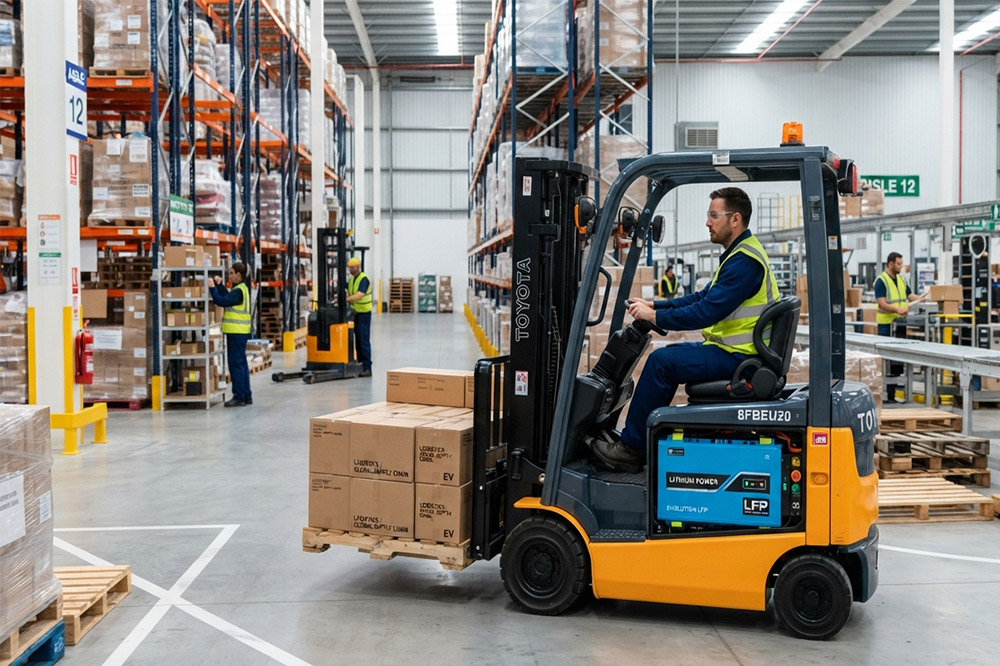
Forklifts are not complicated machines, but their performance depends heavily on one component that is often overlooked — the battery.
For many warehouses and factories, the battery determines how long equipment can work, how often operators need to stop for charging, and how much maintenance cost is added over the years.
Traditionally, lead acid batteries were the standard choice for electric forklifts. They are familiar and widely available, but companies running multiple shifts are facing more pressure from downtime, charging limitations, and maintenance work.
This is why more forklift operators and equipment manufacturers are moving toward lithium ion battery for forklift solutions, especially LiFePO4-based battery systems.
Compared with traditional batteries, lithium forklift batteries offer longer cycle life, faster charging capability, and easier daily operation. For OEM manufacturers and industrial buyers, choosing the right battery design is not only about replacing an old power source — it is about building a more reliable machine.
Why Lithium Ion Battery for Forklift Is Becoming Popular
A forklift in a busy warehouse may operate several hours every day. A battery that requires frequent maintenance or long charging periods can directly affect productivity.
From our experience working with industrial battery projects, customers usually focus on three questions:
- How long can the battery run?
- How many years can it last?
- Can it fit their equipment design?
Lithium battery technology answers these concerns in several ways.
1. Longer Working Time and Higher Energy Efficiency
Lithium batteries have better energy utilization compared with lead acid batteries.
During operation, the voltage remains more stable, which means forklifts can maintain better performance even when battery capacity decreases.
For applications such as:
- warehouse forklifts
- electric pallet trucks
- stackers
- AGV equipment
stable output is often more important than simply having a large battery capacity.
2. Less Maintenance Compared With Lead Acid Batteries
Lead acid forklift batteries usually require:
- water filling
- acid level inspection
- terminal cleaning
- regular maintenance
For companies managing dozens or hundreds of forklifts, these small tasks become a continuous labor cost.
A lithium ion battery for forklift normally uses a sealed battery structure with an intelligent BMS system, reducing daily maintenance requirements.
3. Faster Charging for Multi-Shift Operations
One major advantage of lithium forklift batteries is opportunity charging.
Instead of waiting for a full charging cycle, operators can charge during:
- lunch breaks
- shift changes
- short idle periods
This is especially valuable for warehouses where equipment availability directly affects delivery efficiency.
Why LiFePO4 Battery Is Suitable for Forklift Applications

Not all lithium batteries are the same.
For industrial vehicles, safety and cycle life are usually more important than maximum energy density.
This is why many forklift battery projects choose LiFePO4 chemistry.
LiFePO4 Forklift Battery Advantages
High Safety Performance
LiFePO4 chemistry has excellent thermal stability, making it suitable for demanding industrial environments.
Forklifts often operate in:
- warehouses
- manufacturing plants
- logistics centers
- outdoor working areas
A stable battery chemistry helps reduce operational risks.
Long Cycle Life
A quality LiFePO4 battery can typically provide thousands of charge cycles.
Compared with traditional lead acid batteries, the longer lifespan can reduce replacement frequency.
For fleet operators, this means:
- fewer battery replacements
- lower downtime
- better long-term cost control
Good High-Current Performance
Forklifts require strong power during:
- starting
- lifting loads
- acceleration
A properly designed lithium battery pack combines suitable cells and BMS protection to handle these power demands.
Lithium Ion Battery vs Lead Acid Forklift Battery
| Feature | Lithium Ion Forklift Battery | Lead Acid Battery |
|---|---|---|
| Charging Speed | Faster | Slower |
| Maintenance | Low | High |
| Cycle Life | 3000+ cycles possible | Around 1000-1500 cycles |
| Opportunity Charging | Supported | Limited |
| Energy Efficiency | Higher | Lower |
| Long-Term Cost | Lower operating cost | Higher maintenance cost |

The initial purchase price of lithium batteries is usually higher.
However, many companies find that the total ownership cost becomes more attractive because the battery lasts longer and requires less maintenance.
How to Choose the Right Lithium Ion Battery for Forklift
Buying a forklift lithium battery is not simply choosing the largest capacity.
The battery needs to match the actual equipment.
1. Confirm Forklift Voltage
Common forklift battery systems include:
24V Lithium Battery
Used for:
- electric pallet trucks
- small warehouse equipment
36V Lithium Battery
Used for:
- medium-duty forklifts
48V Lithium Battery
Common in:
- warehouse forklifts
- logistics equipment
72V / 80V Lithium Battery
Suitable for:
- heavy-duty forklifts
- high-load applications
2. Select Suitable Battery Capacity
Capacity affects working hours.
Important factors include:
- forklift motor power
- daily working hours
- load weight
- charging frequency
A warehouse operating 8 hours per day requires a different battery design compared with a 24-hour logistics operation.

3. Check Battery Dimensions
For forklift replacement projects, physical size matters.
Before production, buyers normally provide:
- battery compartment size
- connector type
- installation method
- weight requirements
OEM battery manufacturers can redesign the battery structure around the equipment.
Custom Lithium Ion Battery for Forklift OEM Projects
Many forklift manufacturers and distributors do not need an off-the-shelf battery.
They need a battery that fits their own equipment.
ANPS Global provides customized lithium battery solutions, including LiFePO4 battery cells and custom battery pack development for industrial applications.
Customization options include:
Voltage Design
Examples:
- 24V
- 36V
- 48V
- 72V
- 80V
Capacity Options
Battery capacity can be customized according to:
- operating time
- load requirements
- available installation space
Battery Structure
Customization includes:
- battery housing
- BMS configuration
- connectors
- wiring design
- communication requirements

What Should Buyers Check Before Ordering Lithium Forklift Batteries?
Many purchasing problems happen because buyers only compare battery prices.
A reliable industrial battery supplier should provide more than a quotation.
Important factors include:
Battery Cell Quality
The cell is the foundation of battery performance.
Check:
- cell consistency
- capacity testing
- internal resistance
BMS Protection System
A forklift battery should include protection for:
- overcharge
- over-discharge
- over-temperature
- short circuit
Manufacturing Capability
For OEM projects, buyers should evaluate:
- production capability
- quality control process
- customization experience
ANPS Global focuses on lithium battery manufacturing and custom battery solutions, covering battery cells, packs, and industrial applications.
Applications of Lithium Ion Battery for Forklift
Lithium forklift batteries are used in many industrial scenarios:
Warehouse Equipment
- electric forklifts
- pallet trucks
- reach trucks
Manufacturing Equipment
- material handling vehicles
- factory transport equipment
Automated Systems
- AGV robots
- smart warehouse systems
Industrial OEM Projects
Custom battery packs can be developed for special equipment requirements.
Frequently Asked Questions
How long does lithium forklift battery last?
A lithium forklift battery can often operate for several years depending on charging habits, working environment, and battery design.
Can lithium batteries replace lead acid forklift batteries?
Yes. Many forklifts can be converted, but voltage, size, charger compatibility, and BMS communication should be checked first.
Are LiFePO4 batteries good for forklifts?
Yes. LiFePO4 is widely considered suitable for industrial applications because of its safety characteristics and long cycle life.
Can forklift lithium batteries be customized?
Yes. OEM manufacturers can customize voltage, capacity, dimensions, connectors, and BMS design according to equipment requirements.
Final Thoughts
The decision to switch to a lithium ion battery for forklift is not only about adopting new battery technology.
For companies operating electric forklifts every day, the real value comes from:
- less downtime
- fewer maintenance tasks
- longer service life
- more predictable operation
A properly designed LiFePO4 forklift battery can become a long-term power solution rather than just a replacement component.
For forklift manufacturers, distributors, and industrial equipment companies looking for OEM lithium battery solutions, ANPS Global can provide customized LiFePO4 battery solutions based on your voltage, capacity, and mechanical requirements.


Leave a Reply