
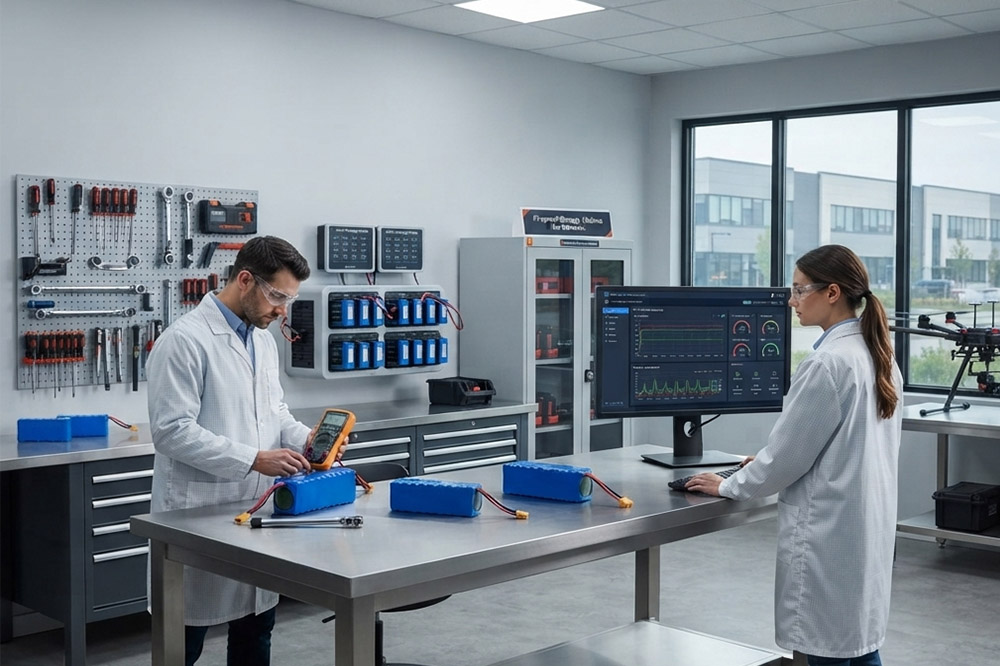
For many commercial drone companies, battery replacement is one of the hidden operating costs.
The first few months usually feel easy.
New batteries provide stable flight time.
Charging is fast.
The drone performs exactly as expected.
But after several months of daily operation, some problems start to appear.
A battery that originally supported 45 minutes of flight may only provide 35 minutes.
Charging time becomes longer.
Voltage drops faster during heavy loads.
Operators start wondering:
“Is this battery quality poor, or are we using it incorrectly?”
In many cases, the answer is not only about battery quality.
Lithium batteries are sensitive products. The way they are charged, stored, transported, and used has a direct impact on their service life.
For commercial UAV operators, good battery management can often save significant costs over the entire operation cycle.
Why UAV Battery Maintenance Matters More in Commercial Applications

A hobby drone user may fly once or twice a week.
A commercial drone company may use the same batteries every day.
The difference is huge.
For example:
An agricultural drone operator may complete multiple flights during a spraying season.
An inspection company may use drones continuously for infrastructure checks.
A mapping company may manage dozens of battery packs across different teams.
In these situations, battery condition directly affects:
- Flight planning
- Operation efficiency
- Maintenance cost
- Customer delivery schedule
A battery problem is not only a technical issue.
It can delay the entire project.
Start With Basic Battery Inspection
Before discussing advanced battery management, basic inspection is often the most overlooked step.
Many battery problems can be discovered early.
Before each flight, operators should check:
Physical Condition
Look for:
- Swelling
- Damage to the casing
- Loose connectors
- Unusual smell
A damaged battery should not continue operating.
Voltage Status
Check whether individual cells remain balanced.
Large voltage differences between cells may indicate aging or internal problems.
Temperature
A battery should not be extremely hot before charging or operation.
Temperature problems often appear before serious battery failures.
A simple inspection routine only takes a few minutes but can prevent bigger issues.
Charging Habits Directly Affect UAV Battery Life

Charging is one of the most important parts of battery maintenance.
Some common mistakes include:
Charging Immediately After Heavy Use
After a long flight, the battery temperature may still be high.
Charging a hot battery can increase stress on the cells.
Allowing the battery to cool first is usually a better practice.
Keeping Batteries Fully Charged for Long Periods
Many operators store batteries at 100% because they want them ready anytime.
However, long-term storage at full charge may accelerate aging.
For batteries that will not be used for some time, proper storage conditions are important.
Using Incorrect Chargers
Different battery packs may require different charging settings.
Using unsuitable charging equipment can affect:
- Battery balance
- Charging efficiency
- Safety
For commercial operations, standardized charging procedures are highly recommended.
Storage Conditions Can Change Battery Lifespan
Battery storage is often ignored when drones are not flying.
However, storage time can represent a large part of battery life.
Important storage factors include:
Temperature
Extreme heat can accelerate battery aging.
Very cold environments can reduce available capacity.
Charge Level
Long-term storage at suitable charge level is generally better than leaving batteries completely full or empty.
Environment
Avoid:
- Moisture
- Direct sunlight
- High-temperature areas
A simple storage cabinet in the right environment can make a noticeable difference.
Use Battery Monitoring Instead of Guessing
For small drone operations, manually checking batteries may be enough.
For larger fleets, it becomes difficult.
Imagine a company managing 100 battery packs.
Without tracking, operators may not know:
- Which battery has the most cycles?
- Which battery has reduced capacity?
- Which battery needs replacement?
A smart BMS can provide useful information such as:
- Remaining capacity
- Voltage balance
- Temperature history
- Charge cycles
- Battery health status
This helps companies make decisions based on actual data instead of guessing.
Avoid Deep Discharge During UAV Operation
Many lithium batteries do not perform well when repeatedly discharged too deeply.
During flight, operators should avoid pushing batteries to their absolute limit.
For example:
A drone returning with very low battery every flight creates additional stress.
A better approach is usually leaving enough reserve capacity for:
- Safe landing
- Unexpected conditions
- Temperature changes
This is especially important for commercial operations where safety matters more than squeezing out the last few minutes.
Battery Rotation Helps Commercial Drone Fleets
For companies operating multiple drones, battery rotation is a simple but effective method.
Instead of using the same few batteries every day:
- Rotate battery usage
- Track cycle numbers
- Record performance changes
This helps distribute aging more evenly.
A battery management system can become much easier when every battery has usage records.
When Should UAV Battery Be Replaced?
There is no single replacement time for every battery.
It depends on:
- Battery chemistry
- Usage frequency
- Charging habits
- Operating environment
Signs that a battery may need replacement include:
- Noticeably shorter flight time
- Increased heating
- Large voltage imbalance
- Physical swelling
- Unstable performance
Continuing to use an unhealthy battery may create bigger problems.
How Battery Manufacturers Help Improve Long-Term Reliability
For UAV manufacturers, maintenance starts before the battery reaches the customer.
Battery design choices affect future operation.
A professional UAV battery supplier can help with:
- Cell selection
- BMS configuration
- Thermal design
- Battery structure
- Testing standards
For example, a commercial inspection drone used in hot outdoor environments may require different battery design compared with a small indoor UAV.
The right battery design reduces maintenance problems later.
Custom UAV Battery Solutions for Long-Term Operation
Many commercial drone companies eventually move toward custom battery packs.
The reason is simple:
Their operation requirements are different.
A custom UAV battery can be designed around:
- Flight time target
- Payload
- Operating temperature
- Charging method
- Battery management requirements
This approach often provides better control over long-term performance.
What Should Drone Companies Include in Their Battery Management Plan?
A practical UAV battery management plan should include:
- Regular inspection
- Charging procedures
- Storage rules
- Battery tracking
- Replacement standards
- Operator training
Small habits repeated every day usually have a bigger impact than occasional maintenance.
Final Thoughts
UAV battery lifespan is not determined only by the battery itself.
Daily usage habits, charging methods, storage conditions, and monitoring systems all influence performance.
For commercial drone operators, proper battery maintenance can improve reliability and reduce unnecessary replacement costs.
A good battery management process helps keep drones working longer and makes large-scale UAV operations easier to manage.


Leave a Reply