
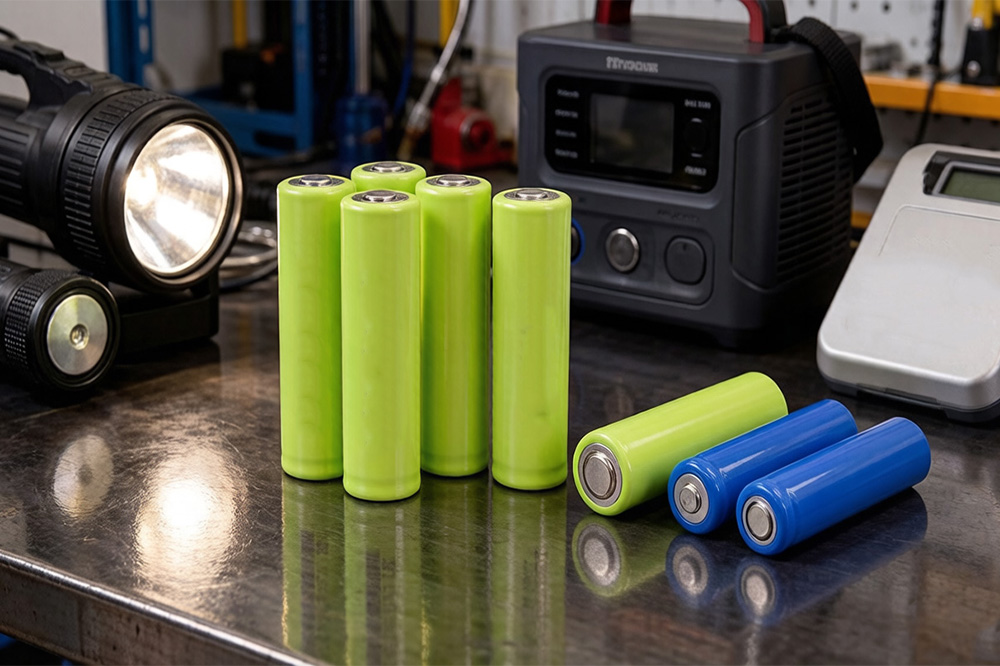
The first time many people encounter a 26650 rechargeable battery is usually through a high-powered flashlight.
You buy a flashlight expecting long runtime, open the battery tube, and suddenly realize the battery inside looks noticeably larger than a standard 18650.
At first glance, it seems outdated.
After all, 21700 batteries have become increasingly popular in recent years.
Yet something interesting keeps happening in enthusiast communities, industrial equipment projects, and OEM battery packs: 26650 cells refuse to disappear.
In fact, many experienced users still actively seek them out.
Not because they’re trendy.
Because in certain applications, they simply make sense.
A Bigger Cell Was Never Just About Size
The number “26650” refers to the battery dimensions:
- Approximately 26mm diameter
- Approximately 65mm length
Compared with 18650 battery, 26650 cell has significantly more internal volume.
That extra space changes everything.
More active material can be packed inside the cell, which usually means:
- Higher capacity
- Lower internal resistance
- Better heat management
- Longer runtime
In practical use, many quality 26650 cells fall between:
Of course, capacity alone doesn’t tell the full story.
A battery can advertise huge capacity while struggling under high current loads.
That’s where many buyers get misled.

What Experienced Flashlight Users Actually Care About
Reading through hundreds of discussions from flashlight enthusiasts reveals something interesting.
Most aren’t obsessing over the highest mAh number.
They’re asking different questions:
“How much voltage sag occurs?”
“Does the light stay bright after 30 minutes?”
“How hot does the cell get?”
“Does the runtime match real-world use?”
These questions matter because a battery’s performance under load often tells a different story than what’s printed on the wrapper.
For example:
A battery advertised at 6000mAh may deliver impressive runtime at low current.
But if a flashlight draws 10A or more, another cell with slightly lower capacity but stronger discharge characteristics may actually perform better.
That’s why experienced users often balance:
- Capacity
- Continuous discharge rating
- Internal resistance
- Cycle life
instead of chasing capacity numbers alone.
Where 26650 Batteries Are Still Widely Used
Some people assume 26650 batteries only belong in flashlights.
Not really.
Over the last decade, they have quietly found homes in a surprising range of equipment.
High-Power Flashlights
This remains the most common use case.
Long runtime combined with strong current delivery makes 26650 cells attractive for:
- Search lights
- Outdoor flashlights
- Tactical lighting
- Emergency lighting systems
A camper running a 3000-lumen light overnight will notice the difference immediately.
One battery swap instead of two or three.
That sounds small until you’re deep in the woods.

Portable Energy Storage
Many portable power products use larger cylindrical cells because they simplify pack design.
26650 cells can be found in:
- Portable power stations
- Backup energy devices
- Solar storage projects
- DIY battery packs
The larger cell size often means fewer cells are required to achieve the same pack capacity.
Industrial Equipment
This is a segment many online articles barely mention.
Industrial buyers often focus less on peak performance and more on stability.
Examples include:
- RFID systems
- Monitoring devices
- Inspection equipment
- Data collection terminals
- Portable communication systems
These applications frequently run for extended periods and require predictable discharge behavior.
Runtime matters more than flashy specifications.
Electric Mobility Products
Although 21700 cells dominate many modern EV applications, some smaller mobility products still use 26650 cells.
Examples include:
- Electric scooters
- Portable transport devices
- Recreational electric equipment
Particularly in older designs, replacing existing battery packs with compatible 26650 cells is often simpler than redesigning the entire system.
Capacity Claims: A Reality Check
This is where buyers should be cautious.
You’ll occasionally find listings claiming:
- 7000mAh
- 8000mAh
- 9000mAh
- Even 10000mAh
For a genuine 26650 lithium-ion cell, such figures should immediately raise questions.
Real-world testing repeatedly shows that many ultra-high-capacity claims fail verification.
A practical rule:
If the advertised capacity sounds dramatically higher than what established cell technology typically achieves, ask for test reports.
Request:
- Capacity testing data
- Internal resistance reports
- Cycle life results
- UN38.3 certification
- MSDS documentation
A serious supplier should provide them without hesitation.

Why Wholesale Buyers Often Evaluate Batteries Differently
Retail users and OEM buyers rarely prioritize the same things.
An individual flashlight owner may purchase two batteries.
A manufacturer might purchase 20,000.
The concerns become very different.
A procurement manager usually asks:
- Can capacity consistency stay within tolerance?
- Can every shipment match previous production runs?
- Is cell grading controlled?
- Are certifications complete?
- Is long-term supply stable?
One inconsistent production batch can create warranty claims months later.
That’s why professional buyers often spend more time evaluating manufacturing consistency than headline specifications.
Button Top or Flat Top?
This question appears constantly.
Neither is universally better.
The choice depends entirely on the device.
Button Top
Usually preferred when:
- Device design requires protruding positive terminals
- Direct replacement is needed
- Consumer electronics specify button-top cells
Flat Top
Often chosen for:
- Battery packs
- Custom assemblies
- Spot-welded configurations
- OEM manufacturing
For wholesale projects, flat-top versions are generally more flexible because they integrate more easily into pack production.
The Hidden Cost of Cheap Batteries
A surprisingly common scenario:
A buyer saves $0.50 per cell.
Everything seems fine.
Three months later:
- Runtime complaints increase
- Cells show uneven capacity
- Replacement costs rise
- Customer satisfaction drops
The original savings disappear quickly.
Battery procurement is one of those areas where the cheapest quote can become the most expensive decision.
Especially for equipment expected to operate daily.
What We Usually Recommend Before Placing a Bulk Order
Before committing to thousands of cells, request a pilot batch.
Not 10 units.
Enough to simulate actual deployment.
Typical evaluation includes:
✓ Capacity testing
✓ High-current testing
✓ Temperature performance
✓ Cycle life verification
✓ Compatibility checks
✓ Transportation certification review
This process often reveals issues that specification sheets never show.
Looking Beyond Capacity
Many product pages focus almost entirely on mAh.
In practice, runtime is only one part of the story.
The best-performing 26650 rechargeable battery for your application may not be the highest-capacity model available.
Sometimes the better choice is the battery that offers:
- More stable voltage output
- Better cycle life
- Lower heat generation
- Consistent manufacturing quality
Especially when hundreds or thousands of devices depend on it.
For OEM projects, industrial equipment, high-output flashlights, and custom battery pack applications, reliability usually wins over marketing numbers.
And that remains one reason the 26650 battery continues to maintain a loyal user base despite newer cell formats entering the market.
Need Bulk 26650 Rechargeable Batteries?
Whether you’re sourcing batteries for flashlights, industrial equipment, energy storage systems, or OEM battery packs, choosing the right supplier matters as much as choosing the right cell.
We support:
- OEM & Private Label Services
- Customized Battery Packs
- Industrial-Grade Cell Selection
- Low MOQ Trial Orders
- Bulk Wholesale Pricing
- Global Shipping Support
Contact our battery specialists today to discuss your project requirements and request samples for evaluation. High-volume buyers can receive customized specifications, testing reports, and long-term supply solutions.
Leave a Reply