
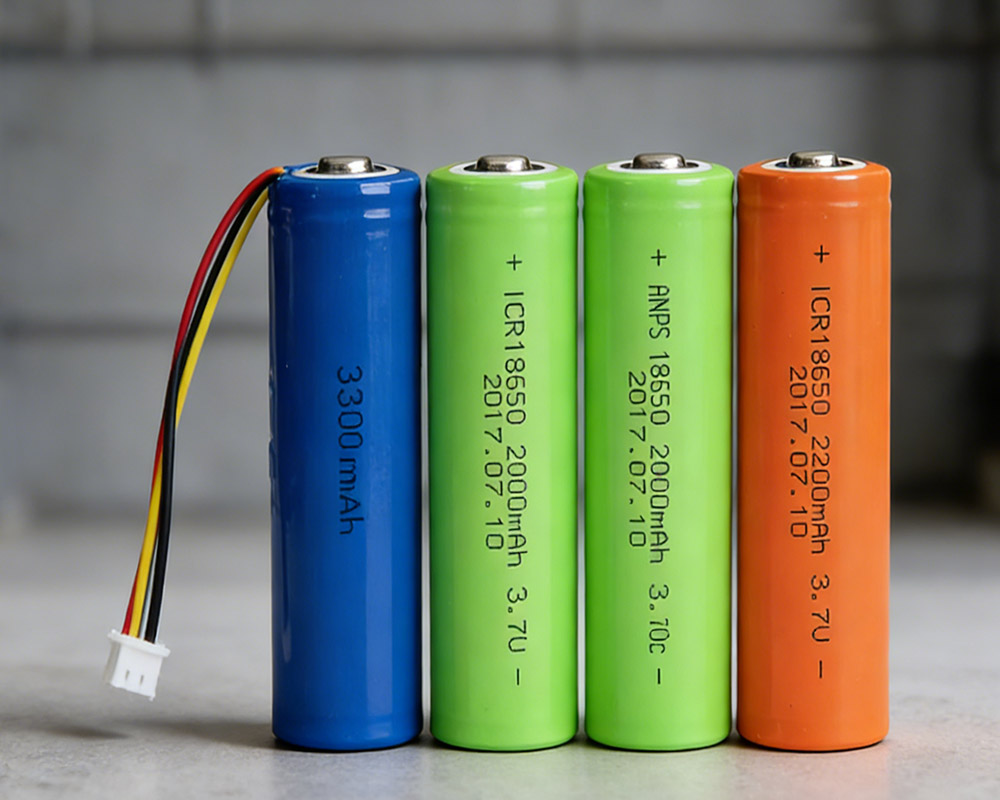
In wholesale sourcing, 18650 batteries look simple at first glance. Same size, same voltage, different numbers printed on the label.
In practice, choosing the right 18650 battery cell is rarely about picking the highest capacity available.
Most buyers who’ve worked with battery packs or end devices know this already: capacity, discharge behavior, and cell quality are always connected. You can’t look at one without thinking about the other two.
Before talking about specific capacities, one thing needs to be clear.
What 18650 really means
18650 is only a form factor.
Roughly 18 mm in diameter, 65 mm in length. That’s it.
It doesn’t tell you:
- how long the battery will last
- how much current it can safely deliver
- how stable it will be after 300 or 500 cycles
That’s why you can see 18650 cells at 2200 mAh, 3000 mAh, or 3300 mAh, all fitting into the same battery holder but behaving very differently in real devices.
From a wholesale buyer’s perspective, selection usually comes down to three practical questions:
- How much runtime does the device really need?
- How hard will the device pull current?
- How consistent does the cell quality need to be across batches?
Let’s break that down using three common capacity options.

2200mAh: Stable, Cost-Controlled, and Easy to Use
The ICR 18650 Battery 2200mAh 3.7V is still widely used for a reason.
It’s not flashy, but it’s predictable.
Typical use cases
This type of cell shows up in:
- basic LED flashlights
- desk lamps and portable lights
- Bluetooth speakers
- toys and consumer electronics
- simple DIY projects
These devices don’t demand high current, and they don’t need extreme runtime either.
Why buyers still choose 2200mAh
From a sourcing point of view:
- lower cost per cell
- fewer compatibility issues
- stable output for light-to-medium loads
If you’re supplying products where price control and reliability matter more than maximum runtime, 2200 mAh is often the cleanest choice. No surprises, no overengineering.
3000mAh: The Most Flexible Middle Ground
The 3.7V Li-ion Rechargeable 3000mAh 18650 Battery Cell sits right in the middle of the market — and that’s exactly why it’s popular.
For many buyers, 3000 mAh is where things start to feel “comfortable”.
Where it’s commonly used
You’ll see this capacity in:
- e-bike and scooter battery packs
- higher-output flashlights
- medical or monitoring devices
- industrial instruments
- small energy storage systems
Compared with 2200 mAh, the runtime gain is noticeable, especially in devices that stay on for long periods.
Why it works well for wholesale
- better energy density without jumping to premium pricing
- compatible with a wide range of loads
- stable cycle life for repeated use
If you’re building or sourcing battery packs for mixed applications, 3000 mAh is usually the safest all-round option.

3300mAh: When Runtime Becomes the Priority
The 18650 3.7V 3300mAh Rechargeable Lithium-ion Battery pushes close to the upper limit of standard 18650 capacity.
At this level, buyers are usually chasing one thing: longer operating time.
Typical applications
- outdoor and professional lighting
- backup power systems
- energy storage modules
- power banks
- devices expected to run continuously
In multi-cell battery packs, higher capacity directly reduces how often the system needs recharging.
Why buyers step up to 3300mAh
- longer single-cycle runtime
- stronger appeal for higher-end products
- better user experience in long-use scenarios
That said, higher capacity doesn’t automatically mean better for every device. Load profile still matters.
Capacity Alone Is Not Enough
This is where many sourcing mistakes happen.
Capacity vs. discharge behavior
A higher mAh number doesn’t guarantee:
- better performance under load
- stable voltage at higher current
- longer real-world lifespan
Some high-capacity cells are optimized for energy density, not current output.
If the device pulls more current than the cell is comfortable with, performance drops fast — regardless of the printed capacity.
In real projects, a slightly lower-capacity cell with better discharge stability often performs better.

Cell grade and consistency matter more in bulk orders
For wholesale buyers, especially OEMs:
- A-grade cells mean tighter consistency across batches
- Protected cells add safety, but increase size and cost
- Unprotected cells require proper system-level protection
In battery packs, consistency is everything. One weak cell can affect the whole pack.
Practical Capacity Matching
| Application | Common Choice | Why |
|---|---|---|
| Basic electronics | 2200 mAh | Cost control, stable output |
| Mid-power devices | 3000 mAh | Balanced runtime and reliability |
| Long-runtime systems | 3300 mAh | Endurance and user experience |
| OEM battery packs | 3000–3300 mAh | Consistency and cycle life |

Final Takeaway for Wholesale Buyers
Choosing an 18650 battery in bulk isn’t about chasing numbers.
It’s about matching the cell behavior to how the device actually works.
Start with:
- real current demand
- expected usage time
- acceptable cost and safety margin
Once those are clear, capacity becomes a decision — not a gamble.
You May Also Like
-

12V 4400 mah Lithium ion 3S2P 18650 Battery Pack
-

18650 2000mAh 3.7 volt Lithium-ion Battery
-

18650 20V 3.0Ah Cordless Drill battery
-

18650 22.2V 7.8Ah 2600Mah 6S3P Rechargeable Battery Pack
-

18650 2600mAh Rechargeable Lithium-Ion Battery 3.7V
-

18650 3.7V 10Ah Li-Ion Power Battery Pack
-

18650 3.7V 3300mah Rechargeable Lithium ion Battery
-

18650 7S7P 24V 14Ah Lithium ion Electric Scooter Battery Pack
-

18650 battery 3.7V 1500mAh Lithium-Ion Battery
Leave a Reply