
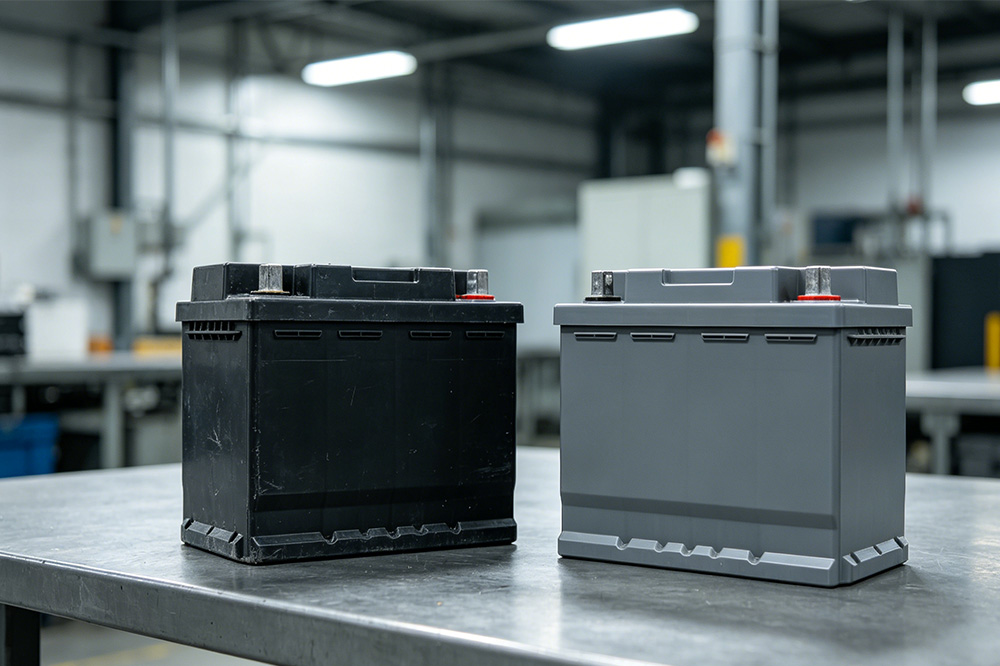
If you’ve sourced 12V 100Ah LiFePO4 batteries before, you’ve probably seen huge price gaps.
Sometimes one supplier quotes almost double another supplier for what appears to be the same product.
Same voltage.
Same capacity.
Similar-looking specs.
So where’s the difference actually coming from?
Usually, not from the label.
Cheap Doesn’t Always Mean Bad
To be fair, lower price alone isn’t necessarily a red flag.
Some suppliers reduce cost because they:
- produce at larger scale
- simplify packaging
- focus on standard configurations
- reduce marketing expenses
That’s normal.
The issue starts when cost reduction affects the parts users can’t easily see.

Where Lower-Cost Batteries Usually Cut Corners
In most cases, pricing differences come down to a few areas.
1. Cell Matching
Two batteries may both use LiFePO4 cells, but not with the same consistency.
Lower-cost packs sometimes use:
- mixed batches
- wider resistance tolerance
- less strict matching
At first, performance may look fine.
Over time, imbalance becomes more noticeable.
2. BMS Stability
This is one of the biggest differences.
On paper:
- both batteries may use a “100A BMS”
In real use:
- one handles surge loads smoothly
- the other shuts down unexpectedly
That difference usually doesn’t show up until the battery is installed in a real system.
3. Assembly Quality
This gets overlooked a lot.
Things like:
- cable thickness
- weld consistency
- internal layout
- thermal design
all affect long-term reliability.
You usually don’t notice these details during unboxing — only after repeated use.
Why Problems Show Up Later, Not Immediately
One reason cheap batteries continue selling is simple:
most problems don’t appear on day one
The battery works.
It powers the system.
Everything seems fine.
Then after months of cycling:
- capacity drift appears
- imbalance increases
- shutdowns become more frequent
That delayed effect makes sourcing tricky.
The Real Cost Isn’t Always the Purchase Price
For distributors and installers, battery cost is only one part of the equation.
The bigger costs are usually:
- warranty claims
- replacement shipping
- customer complaints
- project downtime
That’s why experienced buyers often focus more on consistency than saving a small amount upfront.

What Buyers Usually Learn After a Few Orders
A pattern shows up pretty often.
New buyers tend to compare:
- price
- Ah rating
- advertised cycle life
More experienced buyers start comparing:
- batch consistency
- communication reliability
- actual field performance
- repeat order stability
Because once systems are deployed, reliability matters more than spec sheets.
How to Compare Suppliers More Realistically
Instead of only asking:
“What’s your best price?”
Try asking:
- are the cells matched before assembly
- how is the BMS tested
- are batches kept consistent over time
- how are parallel systems validated
The answers usually tell you more than the quotation itself.

Why Stable Supply Matters More in Large Projects
For small personal use, minor differences may not matter much.
For larger installations or resale, they matter a lot.
Especially when batteries are used in:
- solar systems
- RV setups
- marine projects
- off-grid storage
In these situations, consistency becomes part of the product value.
A more stable solution like this
12V 100Ah LiFePO4 battery
is usually designed around repeatability and long-term supply stability, not just initial pricing.
A Practical Way to Reduce Risk
If you’re testing a new supplier:
- start with a smaller batch
- test under real load conditions
- compare unit consistency
- monitor a few full cycles before scaling up
That process catches a lot of problems early.
Final Thought
Cheap batteries aren’t automatically bad.
But in lithium battery sourcing, the cheapest option is rarely the cheapest in the long run.
The real question isn’t:
“Can this battery work?”
It’s:
“Will it still perform consistently after hundreds of cycles and multiple batches?”
That’s usually where the real difference appears.


Leave a Reply