
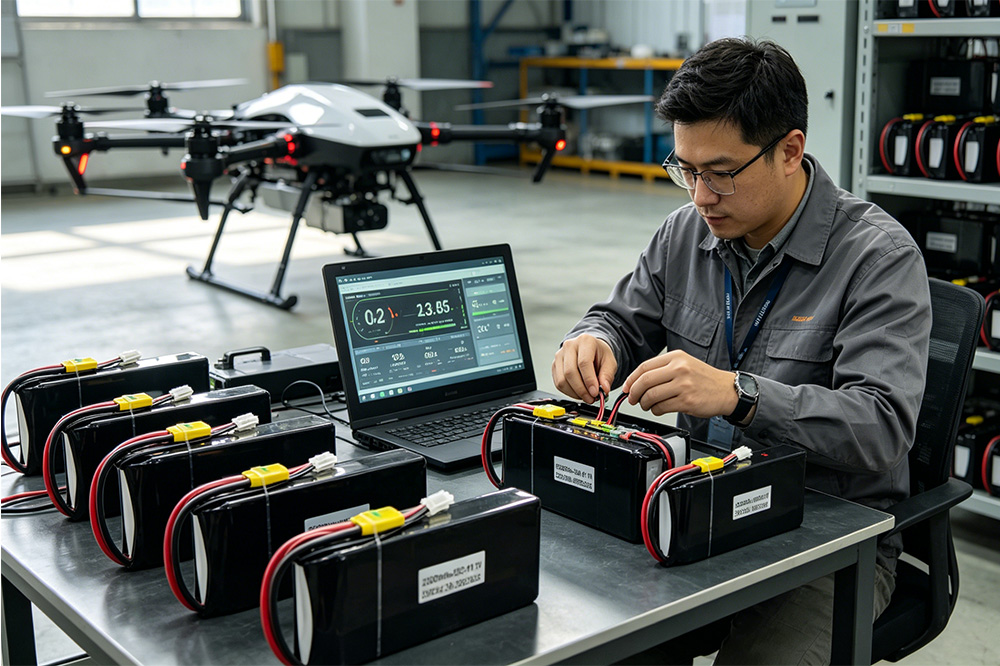
Most drone battery advertisements focus on the same things:
- Bigger capacity
- Higher C rating
- Longer flight time
But once drones start being used for real work, reliability becomes far more important than marketing numbers.
A battery that performs well for five flights and then starts overheating, swelling, or losing voltage stability becomes expensive very quickly.
For industrial UAV operators, battery reliability affects:
- Flight safety
- Maintenance costs
- Mission efficiency
- Equipment lifespan
- Operational downtime
That’s why professional drone operators usually care less about peak specifications and more about consistency over time.
Manufacturers building professional UAV battery systems now focus heavily on cell matching, thermal stability, and long-term cycle reliability rather than just chasing maximum performance numbers.UAV Battery
A Good Battery Should Behave Predictably
Reliable batteries feel consistent from flight to flight.
Voltage stays stable. Heat remains manageable. Cell balance doesn’t drift excessively after charging.
Unstable batteries usually reveal themselves slowly through:
- Increased voltage sag
- Uneven cell voltage
- Reduced punch during acceleration
- Unexpected low-voltage warnings
- Excessive temperature after landing
Experienced drone pilots notice these changes quickly because battery behavior directly affects how the aircraft feels in the air.
For commercial UAV operations, inconsistent batteries create operational risk.
Cell Quality Matters More Than the Label
Two batteries with identical specifications on paper can behave completely differently in real-world flights.
That usually comes down to cell quality.
Reliable UAV battery packs typically use:
- Consistent cell matching
- Stable internal resistance
- Better thermal tolerance
- Higher manufacturing consistency
Cheap battery packs often look similar externally, but performance differences become obvious after repeated charge cycles.
This is especially noticeable in:
- Heavy-lift drones
- FPV racing drones
- Agricultural UAVs
- Long-endurance inspection systems
High current and long flight times expose weak cells much faster.

Heat Is Often the First Warning Sign
Temperature tells you a lot about battery health.
A battery that consistently lands extremely hot is usually under too much stress.
Possible reasons include:
- Poor-quality cells
- Excessive discharge load
- Weak internal resistance performance
- Incorrect propeller setup
- Overloaded aircraft
Reliable batteries generally maintain more stable temperatures under normal operating conditions.
That becomes especially important for industrial UAV fleets running multiple flights daily.
Heat accelerates battery aging faster than many operators realize.
Why Voltage Stability Matters
Battery voltage affects how a drone performs throughout the flight.
Reliable batteries maintain smoother voltage behavior under load, especially during:
- Fast acceleration
- Climbing
- Payload lifting
- Wind correction
Poor voltage stability creates:
- Throttle inconsistency
- Reduced flight efficiency
- Earlier low-voltage warnings
- Unpredictable power delivery
FPV pilots notice voltage performance immediately because aggressive flying exposes battery weaknesses very quickly.
Industrial UAVs may hide the problem longer, but unstable voltage still reduces overall operational reliability.
Charging Habits Affect Reliability Too
Even high-quality batteries wear out quickly if charging habits are poor.
A lot of battery damage happens outside the aircraft.
Common problems include:
- Charging hot batteries immediately after flight
- Leaving packs fully charged for days
- Deep discharging regularly
- Using incorrect charging settings
- Poor storage conditions
Reliable performance depends partly on how the battery is treated over time.
Most experienced UAV operators follow simple routines:
- Let batteries cool before charging
- Store at proper voltage
- Monitor cell balance regularly
- Retire damaged packs early
These habits extend battery lifespan significantly.
Industrial UAVs Need Different Battery Priorities
A freestyle FPV drone and an inspection UAV have completely different battery requirements.
FPV pilots often prioritize:
- High discharge capability
- Aggressive throttle response
- Lightweight performance
Industrial UAV operators usually care more about:
- Stable endurance
- Long cycle life
- Predictable power behavior
- Safety under continuous use
That’s why battery selection should always match the aircraft’s actual workload.
A battery optimized for racing may not be the best choice for long-duration commercial flights.

Smart Battery Systems Are Becoming Standard
Modern industrial UAV batteries increasingly include built-in monitoring systems.
These systems can track:
- Cell voltage
- Temperature
- Charge cycles
- Remaining capacity
- Battery health condition
This helps operators identify problems before failures happen in the field.
For large drone fleets, battery management is now part of normal maintenance planning rather than simple accessory care.
Reliability Usually Beats Maximum Performance
Many drone operators eventually realize something important:
The most aggressive battery is not always the best battery.
A slightly lower-performance pack that stays stable for hundreds of cycles is often more valuable than a battery delivering extreme performance for only a short period.
That’s especially true in commercial UAV operations where:
- Downtime costs money
- Equipment reliability matters
- Flight consistency is important
- Safety risks must stay low
Reliable batteries reduce surprises.
And in drone operations, fewer surprises usually mean fewer problems.
Recommended Reading
- Best LiPo Battery for Drone: How to Pick One That Actually Works
- Explore Long Endurance Drones: Which Drone Has the Longest Battery Life?
- UAV Battery Product Category
- LiPo Battery for Drone: The Heart of UAV Power
- UAV Battery Types: Types and Applications for Drones
- Reliable Drone LiPo Battery: What Actually Makes It Reliable?
Final Thoughts
Reliable UAV batteries are usually defined by consistency rather than extreme specifications.
A good battery should:
- Deliver stable voltage
- Handle heat properly
- Maintain healthy cell balance
- Perform consistently over time
For FPV drones, reliability improves flight confidence. For industrial UAV operations, it protects equipment, schedules, and long-term operating costs.
In real-world drone work, stable performance over hundreds of flights is usually worth far more than impressive numbers printed on the label.


Leave a Reply