
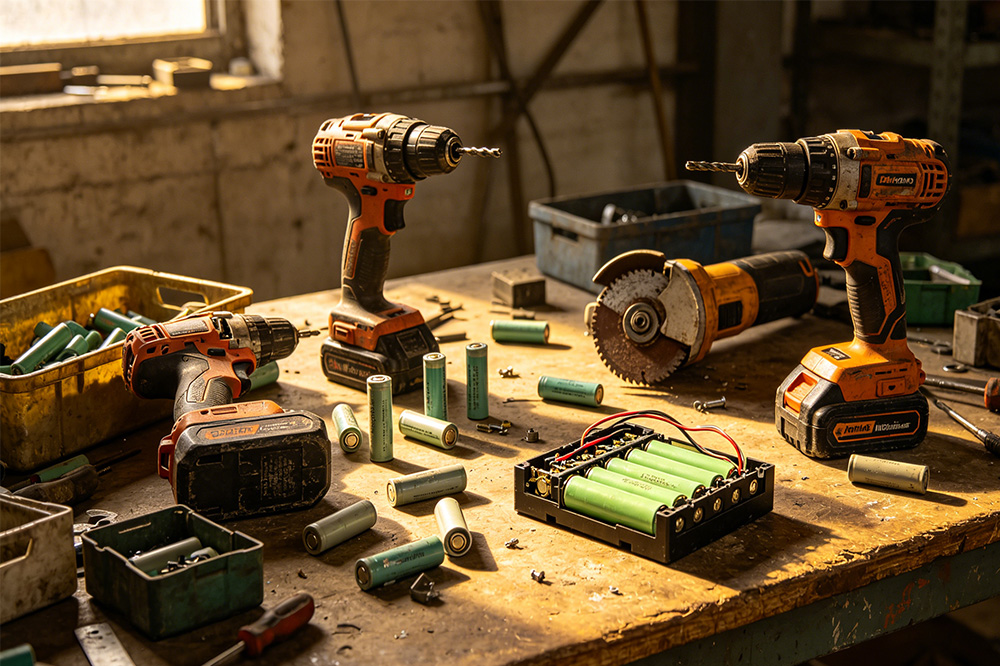
When people first search “18650 battery for power tools”, they usually think it’s just about finding a cell with the right capacity. That’s what most catalogs suggest anyway.
But in real sourcing work — especially bulk orders — things rarely stay that clean.
I still remember a client from Eastern Europe who came with a simple request: “We just need 18V battery packs for cordless drills, around 2000 pieces monthly.”
Sounds straightforward. Until you ask what kind of drills, what torque range, and how long each pack is expected to last under load.
That’s usually where the conversation starts to shift.
Power tools don’t really care about “nice specs”
On paper, a 3000mAh 18650 cell looks like a safe choice. Stable, widely used, not too expensive.
But in actual power tools — grinders, impact drivers, saws — what matters is not only capacity. It’s how the cell behaves when someone presses the trigger hard for 10 seconds straight.
Some factories prefer high-drain cells, even if cycle life drops slightly. Others go the opposite way, trying to extend warranty periods. There isn’t a universal answer, even if suppliers sometimes present it like there is.
That’s also why many OEM buyers end up working with a more flexible structure like this:18650 battery pack category
Not because it’s perfect, but because it allows adjustments later — which matters more than people expect at the beginning.

The “hidden decision” most buyers don’t talk about
When ordering 18650 battery for power tools in bulk, there is always a quiet decision happening behind the scenes:
- Do we prioritize price per pack?
- Or do we reduce failure risk in the field?
These two rarely align perfectly.
A factory in Southeast Asia once told me they lost a contract not because of battery capacity issues, but because the packs behaved differently after 3 months of warehouse storage. That detail wasn’t in the spec sheet. Nobody asked about it at first.
That’s the part that usually gets overlooked.
Why OEM buyers keep coming back to 18650 format
Even with newer cell formats like 21700 entering the market, 18650 still shows up everywhere in power tools.
Not always because it’s the best technically — sometimes it’s just easier:
- replacement ecosystem already exists
- tooling cost is lower
- compatibility with older tool lines
- easier sourcing in different regions
One engineer once said something like: “We don’t always upgrade because it’s better. We upgrade when the supply chain forces us to.”
That feels surprisingly accurate in this industry.
What wholesale buyers usually ask
After the first test batch, the real questions start:
- Why does pack A feel stronger than pack B, even with same spec?
- Can we adjust discharge curve slightly?
- What happens if we switch to 5S2P instead of 5S3P?
- Is the BMS limiting output, or the cells?
At this stage, buyers usually realize they are not just buying batteries — they are buying behavior under load.
And that’s where OEM discussion becomes more serious.
Not every supplier explains this clearly (but maybe they should)
A lot of listings will show:
- 2000mAh / 2600mAh / 3000mAh options
- standard voltage packs
- “high quality grade A cells”
But real production is less static.
Even inside one batch, performance variation can happen if sourcing or testing is not strict enough. Some buyers only notice this after field returns start appearing.
That’s why some OEM customers prefer discussing directly with factories that handle assembly and testing in-house, instead of purely trading channels.
If you are sourcing 18650 battery for power tools in bulk
You probably don’t need more theory.
You likely need clarity on:
- what load your tool actually draws
- how long the pack must survive daily cycles
- whether your market prioritizes price or stability
- and how strict your after-sales risk is
Once those are clear, the rest becomes easier.
If not, even the “best spec” battery can end up being a mismatch.

OEM / Wholesale Inquiry
If you are currently sourcing 18650 battery packs for power tools, you can check specifications or customization options here: 18650 battery pack category
OEM / ODM customization usually includes:
- voltage (12V / 18V / 24V)
- discharge rate tuning
- pack structure (series / parallel design)
- BMS configuration
- labeling and housing design
Some buyers come with full drawings. Others start with just a tool sample. Both work.
-

12V 4400 mah Lithium ion 3S2P 18650 Battery Pack
-

18650 2000mAh 3.7 volt Lithium-ion Battery
-

18650 20V 3.0Ah Cordless Drill battery
-

18650 22.2V 7.8Ah 2600Mah 6S3P Rechargeable Battery Pack
-

18650 2600mAh Rechargeable Lithium-Ion Battery 3.7V
-

18650 3.7V 10Ah Li-Ion Power Battery Pack
-

18650 3.7V 3300mah Rechargeable Lithium ion Battery
-

18650 7S7P 24V 14Ah Lithium ion Electric Scooter Battery Pack
-

18650 battery 3.7V 1500mAh Lithium-Ion Battery
-

18650 Battery 3500 mah Rechargeable Battery Cells
-

18650 Electric Scooter 48V 13000mAh Lithium Battery
-

2600mAh 3S1P 11.1V 18650 Battery Packs
-

3.7V Li ion Rechargeable 3000mah 18650 Battery Cell
-

36V 5200mAh 10S2P 18650 Battery Pack
-

48v 4400mah 13S2P 18650 Rechargeable Battery Pack
-

7S2P 24V 18650 Lithium Battery Pack
-

Electric Scooter 36V 4400mAH 10S2P 18650 Battery Pack
-

ICR 18650 Battery 2200mah 3.7V
Leave a Reply