
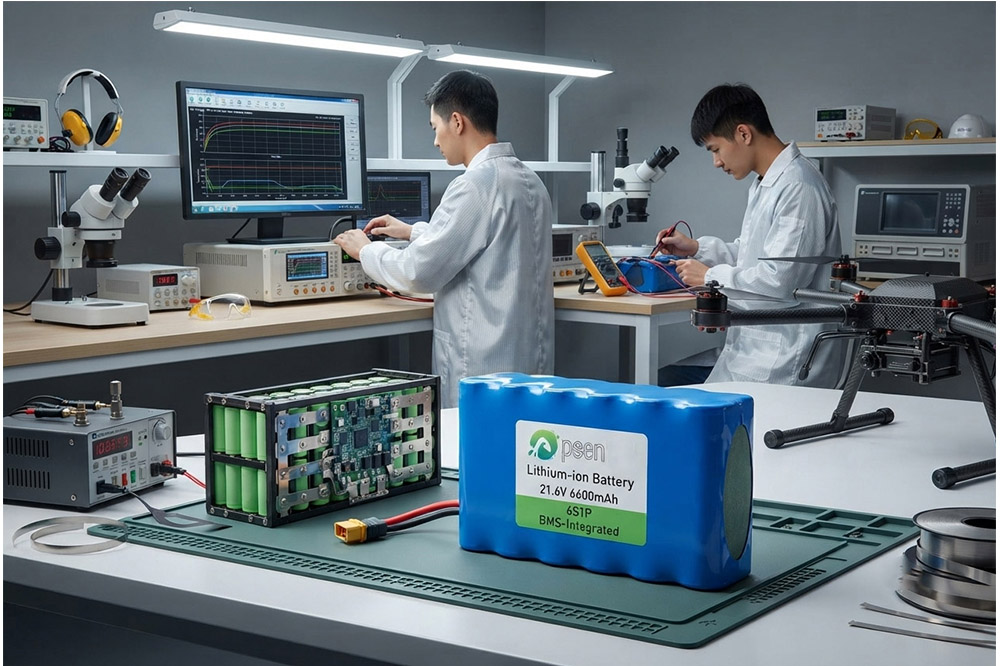
When people talk about drone batteries, many immediately think about LiPo batteries.
That makes sense. LiPo has been popular in the UAV industry for years, especially for racing drones and high-power applications.
But when we look at commercial drone projects, another battery format keeps appearing again and again:
18650 lithium-ion battery packs.
Some engineers are surprised by this.
They may ask:
“Isn’t 18650 an older battery technology?”
The answer is yes, 18650 cells have been around for a long time. But older does not always mean outdated.
In battery manufacturing, a mature technology often has advantages that newer solutions cannot immediately replace.
For UAV manufacturers, reliability, supply chain stability, and production consistency are often just as important as the newest battery specifications.
Why Drone Manufacturers Still Choose 18650 Cells

The first reason is simple:
18650 cells have a very mature manufacturing ecosystem.
For drone companies producing products at scale, this matters a lot.
A prototype battery may work perfectly in the laboratory. But when production increases from 50 units to 5,000 units, consistency becomes a different challenge.
18650 cells have been produced for many years, which means manufacturers have access to:
- Different capacity options
- Different discharge ratings
- Stable supply chains
- Proven production processes
This makes them attractive for UAV battery pack development.
Energy Density: Is 18650 Still Competitive?
One common misunderstanding is that 18650 cells are no longer suitable because newer batteries exist.
Actually, the situation is more complicated.
A modern high-quality 18650 cell can still provide excellent energy density, especially when combined into a well-designed battery pack.
For example, a UAV manufacturer may not simply need the highest capacity cell available.
They may need:
- A specific battery shape
- A certain voltage
- Stable discharge performance
- Reliable operation in different temperatures
In some cases, a carefully designed 18650 battery pack performs better than a larger battery that does not fit the drone structure properly.
The battery is part of the whole aircraft system.
18650 Battery Pack Design for UAV Applications
A drone battery pack is not just a group of cells connected together.
A professional UAV battery usually includes:
- Lithium-ion cells
- Battery management system (BMS)
- Protection circuit
- Connectors
- Mechanical structure
- Thermal management design
The way cells are arranged also affects performance.
For example:
A 4S configuration provides around 14.8V nominal voltage.
A higher series configuration can provide more voltage for larger UAV platforms.
Parallel connections increase capacity and current capability.
The final design depends on:
- Motor power
- Flight time requirement
- Payload
- Available battery space
This is why many UAV companies prefer working with battery manufacturers who can provide customization instead of only selling standard packs.
18650 vs LiPo Battery for UAVs: Which One Should You Choose?

There is no simple answer.
Both battery types have their own advantages.
LiPo batteries usually provide:
- Higher discharge capability
- Lower weight
- Fast power response
They are often preferred for:
- Racing drones
- FPV drones
- High-performance UAVs
18650 lithium-ion battery packs usually provide:
- Longer cycle life
- Stable performance
- Flexible pack design
- Better energy storage options
They are often selected for:
- Inspection drones
- Mapping UAVs
- Industrial drones
- Long endurance applications
A mistake some companies make is choosing batteries based only on capacity.
A larger capacity battery may increase flight time, but it also increases weight.
The entire UAV design needs to be considered.
Where Are 18650 Battery Packs Commonly Used in UAVs?
18650 battery packs are often found in commercial and industrial UAV projects.
Typical applications include:
Mapping Drones
Mapping missions require stable flight and longer operation time.
Battery reliability is usually more important than extreme acceleration.
Inspection UAVs
For power line, pipeline, and infrastructure inspection, drones often need predictable performance.
A stable lithium-ion battery pack can be a good choice.
Delivery Drones
Delivery UAVs need a balance between payload capacity and endurance.
Battery weight directly affects transportation efficiency.
Custom Industrial UAV Platforms
Many industrial drone projects have unique shapes and power requirements.
Custom 18650 packs can be designed around these limitations.
What Should Buyers Check Before Ordering 18650 UAV Batteries?
For bulk purchasing, the battery cell itself is only one part of the decision.
Drone manufacturers should also check:
Cell Quality
Different 18650 cells may have similar specifications but very different real-world performance.
Important factors include:
- Capacity consistency
- Internal resistance
- Cycle performance
BMS Design
A suitable BMS helps protect:
- Overcharge
- Over-discharge
- Over-current
- Temperature problems
Manufacturing Capability
A supplier should have experience with:
- Cell matching
- Spot welding
- Battery testing
- Quality inspection
A cheap battery pack may look attractive during quotation, but problems usually appear later during mass production.
Custom 18650 Battery Packs for UAV OEM Projects
Many drone companies do not buy ready-made batteries.
They need a battery designed around their aircraft.
A custom UAV battery pack may include:
- Custom voltage configuration
- Custom capacity
- Custom connector
- Custom dimensions
- Customized BMS settings
For example, an agricultural drone manufacturer may need a battery that fits a narrow compartment while supporting high current during takeoff.
A standard commercial battery may not solve this problem.
Choosing the Right 18650 Battery Supplier
For UAV projects, the supplier relationship is often more important than simply finding the lowest price.
A capable supplier should understand:
- Lithium-ion cell selection
- UAV power requirements
- Battery pack structure
- Safety testing
- Export requirements
During product development, small improvements in battery design can create noticeable changes in flight performance.
Final Thoughts
18650 battery packs continue to play an important role in UAV applications because they offer something manufacturers value: a balance between performance, reliability, and production flexibility.
They may not be the newest battery format, but for many commercial drone projects, they remain a practical choice.
The best UAV battery solution is usually not about choosing the newest technology. It is about choosing the battery that fits the drone’s actual working environment.
For companies developing commercial UAVs, a customized 18650 lithium battery pack can provide a reliable foundation for long-term production.
-

12000mAh High-Rate Low-Temperature Power UAV Lithium Battery for Drones
-

12V 4400 mah Lithium ion 3S2P 18650 Battery Pack
-

18650 20V 3.0Ah Cordless Drill battery
-

18650 22.2V 7.8Ah 2600Mah 6S3P Rechargeable Battery Pack
-

18650 3.7V 10Ah Li-Ion Power Battery Pack
-

18650 7S7P 24V 14Ah Lithium ion Electric Scooter Battery Pack
-

18650 Electric Scooter 48V 13000mAh Lithium Battery
-

22.2V 15000mAh 10C High-Rate 21700 Li-ion Drone Battery
-

2600mAh 3S1P 11.1V 18650 Battery Packs
-

36V 5200mAh 10S2P 18650 Battery Pack
-

48v 4400mah 13S2P 18650 Rechargeable Battery Pack
-

6S 22.2V 12000mAh LiPo Drone Battery
-

6S 22.8V 25C 22000mAh Drone Battery
-

7S2P 24V 18650 Lithium Battery Pack
-

8000mAh 21700 6S2P 22.2V 10C High-Rate LiPo Battery for RC Aircraft and Drones
-

Electric Scooter 36V 4400mAH 10S2P 18650 Battery Pack
Leave a Reply