
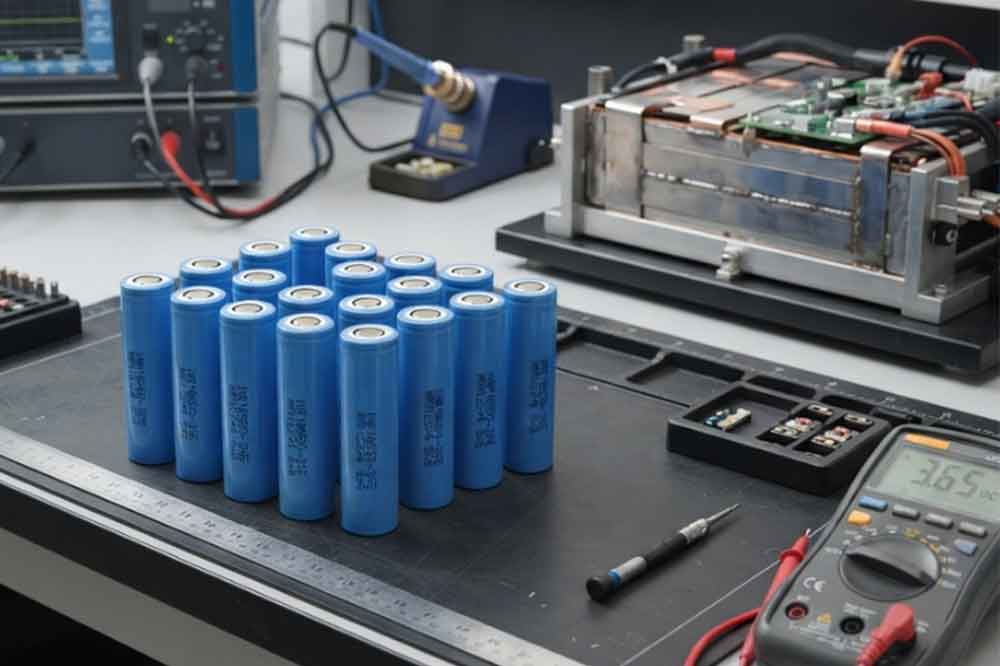
Choosing the best 18650 battery is not as simple as looking for the highest capacity or the most popular brand. A battery that performs well in a flashlight may not be suitable for a cordless power tool, a portable electronic device, or a custom battery pack.
The difference usually comes down to a few practical questions. How much energy does the device need? What current does it draw during normal operation? Is there enough room for the battery? Does the equipment require a protected cell, or does it already have a battery management system?
These details matter more than a single number printed on the battery label.
For individual users, the right 18650 battery should match the device’s electrical and physical requirements. For product developers and industrial buyers, the decision also involves consistency between cells, operating conditions, safety requirements, and long-term supply.
This guide explains how to compare 18650 batteries, which specifications deserve the most attention, and how to select a suitable cell for different applications.
What Is the Best 18650 Battery?
There is no single 18650 battery that is best for every application. A high-capacity cell may be a good choice for equipment that runs for long periods at a moderate current. A high-discharge cell may be more appropriate for equipment that draws substantial current. A protected 18650 battery may be necessary for a device designed to use that type of cell.
The starting point should always be the equipment manufacturer’s battery requirements.
When comparing potential options, look at the following specifications.
| Specification | Why It Matters |
|---|---|
| Capacity (mAh) | Helps estimate how long the device can operate |
| Nominal voltage (V) | Must match the equipment’s electrical requirements |
| Continuous discharge current (A) | Determines whether the cell can support the operating load |
| Internal resistance | Affects voltage drop and heat generation under load |
| Physical dimensions | Determines whether the battery fits the battery compartment |
| Protection circuit | Helps determine whether the cell matches the device’s protection design |
| Cycle life | Indicates expected service life under specified test conditions |
A useful comparison considers these specifications together rather than ranking cells by capacity alone.
For example, a cell rated at 3,000mAh is not automatically a better choice than a 2,800mAh cell. If the application requires a higher continuous discharge current than the first cell can safely provide, the additional capacity does not solve the problem.
The best battery is the one that meets the application’s requirements with an appropriate safety margin.
How to Choose the Best 18650 Battery for Different Applications
Different devices place different demands on a battery. Understanding those differences makes it easier to narrow down suitable cells before comparing individual models.
Best 18650 Battery for Flashlights
For a flashlight, runtime is often an important consideration. However, the battery must also support the current required by the LED driver.
A flashlight operating at a moderate output may benefit from a higher-capacity cell, while a high-output model may require a cell with stronger discharge capability. The manufacturer’s recommended battery specifications should take priority over general product rankings.
Battery dimensions are another common issue. Some flashlights accept standard flat-top cells, while others require button-top batteries. Protected cells may also be longer than unprotected versions, potentially preventing the battery compartment from closing properly.
Before choosing a replacement, check:
- The required battery type and voltage.
- The permitted battery length and terminal design.
- The current required at the intended brightness level.
- Whether the flashlight requires a protected battery.
A battery that fits physically but cannot support the required load is not a suitable replacement.
Best 18650 Battery for Power Tools
Power tools place different demands on lithium-ion cells. Motors can draw substantial current during acceleration or under heavy loads, so discharge capability and temperature behavior are especially important.
A high-capacity cell may offer longer runtime under suitable conditions, but capacity should not be the only selection criterion. The cell must also support the current profile specified for the tool’s battery pack.
For power tool applications, evaluate continuous discharge current, permitted pulse conditions, internal resistance, and thermal performance. Also consider how the cells will perform when assembled into a multi-cell pack.
The complete battery system matters. Series and parallel configurations, interconnections, cooling, and the battery management system can all affect performance.
For replacement packs, follow the original equipment specifications. Mixing cells with different capacities, ages, or performance characteristics can create an unbalanced pack and should not be treated as a simple substitution.
Best 18650 Battery for Portable Electronics
Portable electronics often operate at relatively modest power levels, making capacity, size, and reliable operation important considerations.
However, the required battery voltage and charging arrangement still need to match the device. A product designed around one specific cell chemistry or voltage range may not work correctly with another type of 18650 cell.
Check the device’s rated input requirements, battery compartment dimensions, and charging method before selecting a replacement.
For equipment intended to run for long periods, consider how the expected load, ambient temperature, and low-voltage cutoff affect usable runtime. The capacity printed on a battery label does not represent the exact amount of energy that every device can use.
Best 18650 Battery for Custom Battery Packs
For OEM projects, the best individual cell is only one part of the decision.
The required pack voltage, capacity, dimensions, output current, operating temperature, and expected service life must be established before selecting the cell. The design may also require a particular connector, enclosure, communication interface, or protection strategy.
For example, a portable instrument with limited internal space may require a different cell configuration from a high-power industrial device, even if both products use 18650 cells.
Engineering teams should evaluate cell datasheets, sample performance, discharge behavior, temperature rise, and consistency across production batches.
When the final product has strict dimensional or electrical requirements, it is often more effective to select the cell and design the battery pack together rather than choosing a cell first and attempting to solve compatibility problems later.
Battery Capacity vs. Discharge Current: Which Is More Important?
Capacity and discharge current describe different aspects of battery performance.
Capacity, expressed in milliamp-hours (mAh), indicates the amount of electric charge a battery can deliver under specified test conditions. Discharge current, measured in amperes (A), indicates how quickly current can be supplied.
Neither specification should be evaluated in isolation.
Consider two hypothetical 18650 cells:
| Parameter | Cell A | Cell B |
|---|---|---|
| Rated capacity | 3,000mAh | 2,800mAh |
| Required application current | Must be checked | Must be checked |
| Suitable application | Depends on verified specifications | Depends on verified specifications |
This comparison illustrates an important point: the capacity figures alone are insufficient to identify a winner. Without verified discharge ratings, voltage behavior, and operating limits, neither cell can be recommended for a particular load.
How Does Capacity Affect Runtime?
Under simplified conditions, estimated runtime can be calculated by dividing the rated capacity by the average discharge current.
For example, a nominal 3,000mAh battery supplying a constant 1,000mA load gives a theoretical estimate of three hours.
Actual runtime may be shorter because of load variation, temperature, battery aging, internal resistance, and the device’s cutoff voltage. Capacity ratings also depend on the manufacturer’s test conditions.
For devices with changing power consumption, an estimate based on average current may be more useful than one based on peak current.
Why Is Continuous Discharge Current Important?
A cell must be capable of supplying the current required by the application within its specified operating limits.
If the load exceeds the cell’s permitted discharge conditions, excessive heating, voltage drop, accelerated degradation, or safety hazards may result.
Pay attention to the continuous discharge rating rather than assuming that a large advertised pulse-current figure represents normal operating capability. Pulse ratings can depend on the duration of the pulse, starting temperature, recovery time, and the manufacturer’s test method.
For applications involving motors, high-output lighting, or other variable loads, the engineering team should evaluate the complete current profile rather than looking only at average consumption.
Protected vs. Unprotected 18650 Batteries
One of the most important decisions when selecting an 18650 battery is whether the application requires a protected cell.
A protected 18650 battery typically includes an additional protection circuit, often installed at the end of the cell assembly. Depending on its design, this circuit may help interrupt charging or discharging when specified electrical limits are exceeded.
An unprotected cell does not have this additional cell-level protection circuit. It is commonly used in battery packs or equipment where the required protection functions are implemented at the system level.

Neither type is automatically better for every application.
When Should You Choose a Protected 18650 Battery?
A protected cell may be appropriate when the device is designed to use an individual protected battery and the cell’s dimensions and current capability meet the manufacturer’s requirements.
Before purchasing one, verify:
- The overall length and diameter.
- The required terminal configuration.
- The protection circuit’s current rating.
- The actual protection functions provided.
- Compatibility with the device’s charging and operating requirements.
A protection circuit cannot compensate for an unsuitable battery specification or an incompatible charger.
When Is an Unprotected Cell Appropriate?
Unprotected cells are often used in professionally designed battery packs with a dedicated battery management system or other appropriate protection arrangements.
In these applications, protection must be evaluated at the system level. The design may need to address overvoltage, undervoltage, overcurrent, short circuits, temperature limits, and cell balancing where applicable.
The absence of a separate protection board on an individual cell does not mean the complete battery system is necessarily unprotected. However, the system must have the appropriate safeguards, and the design must be validated for its intended use.
Flat Top vs. Button Top 18650 Batteries
The terminal shape also affects compatibility.
Flat-top cells have a relatively flat positive terminal, while button-top versions have a raised positive terminal. Some devices are designed for one configuration and may not make reliable electrical contact with the other.
Protected cells can also have different overall dimensions because of the additional circuitry and construction.
Do not assume that all batteries labeled 18650 have identical physical dimensions. Check the actual product datasheet and the space available in the device.
How to Compare 18650 Battery Specifications
Once the application requirements are clear, use the following checks to compare candidate cells.
Nominal Voltage and Full-Charge Voltage
The term 18650 describes a cylindrical cell’s approximate size category, not its chemistry or voltage.
Many conventional lithium-ion 18650 cells have a nominal voltage around 3.6V or 3.7V, with a full-charge voltage commonly around 4.2V. LiFePO4 cells have different voltage characteristics, with a typical nominal voltage around 3.2V.
These values are representative rather than universal. Always use the specifications for the actual cell.
Do not substitute cells with different chemistries or charging requirements simply because they share the same physical format. The charger, protection system, and device must be compatible with the selected chemistry.
Internal Resistance and Heat Generation
Internal resistance affects the voltage available at the terminals under load and contributes to heat generation.
For a given current, higher internal resistance generally results in a greater voltage drop and more resistive heating. This can affect efficiency, usable capacity, and operating temperature.
However, internal resistance values are meaningful only when the measurement method and test conditions are understood. Values obtained using different measurement methods may not be directly comparable.
For demanding applications, review the manufacturer’s technical data and verify performance under representative operating conditions.
Cycle Life and Battery Aging
Cycle life describes how many charge-discharge cycles a cell can complete before reaching a specified end-of-life criterion.
It is not a fixed number that applies to every user. Discharge depth, temperature, charge rate, discharge rate, and storage conditions all influence battery aging.
For industrial products, the expected service life should be evaluated against the actual duty cycle. A battery that performs well during initial testing may behave differently after extended operation or exposure to elevated temperatures.
Where long service life is important, ask for the manufacturer’s cycle-life test conditions instead of relying on a cycle count without supporting information.

How OEM Buyers Should Select an 18650 Battery Supplier
For businesses purchasing 18650 cells in volume, the supplier decision involves more than finding the lowest price or the largest advertised capacity.
A suitable supplier should be able to provide clear technical documentation, consistent product specifications, and support during sample evaluation and production.
Check Datasheets and Test Reports
Start by obtaining the exact cell model number and its current datasheet.
Check the rated capacity, nominal voltage, charge limits, continuous discharge rating, dimensions, operating temperature, and cycle-life conditions. Confirm that the information applies to the exact model being quoted.
Where required, request relevant safety test reports, transport documentation, and certification records. The applicable documents depend on the product, destination market, and intended use.
For lithium batteries transported commercially, verify the applicable transport requirements and supporting documentation for the specific cell or battery configuration.
Evaluate Batch Consistency and Traceability
A successful sample does not automatically guarantee consistent performance across every production batch.
For recurring orders, buyers should establish incoming inspection criteria and confirm how the supplier identifies and traces batches. Depending on the project, this may include capacity checks, voltage measurements, internal resistance measurements, appearance inspection, and sample discharge testing.
Acceptance limits should be agreed upon in advance. Any testing procedure should use appropriate equipment and follow the relevant technical requirements.
Consider Custom Battery Pack Requirements
Some OEM projects need more than standard loose cells.
A custom battery pack may require a specific voltage and capacity, a compact enclosure, a dedicated connector, a BMS, temperature monitoring, or communication with the host device.
These requirements should be discussed during the engineering stage. They can affect the choice of cell, the pack configuration, and the time needed for sample validation.
For projects with strict space limitations or unusual load requirements, providing the supplier with a drawing, target dimensions, current profile, and expected operating conditions is usually more useful than requesting a quotation based only on capacity.
Find the Right 18650 Battery for Your Project
The best 18650 battery is the one that matches the device’s electrical requirements, physical dimensions, operating conditions, and protection design.
For individual applications, begin with the manufacturer’s recommended cell type, then compare capacity, continuous discharge current, terminal configuration, and charging requirements.
For OEM and industrial projects, evaluate the cell and the complete battery system together. Datasheet verification, sample testing, batch consistency, and appropriate protection design are all part of making a reliable selection.
Apsenx supplies lithium battery solutions for business and OEM applications. If your project requires specific voltage, capacity, dimensions, discharge performance, or battery pack integration, define these requirements before choosing a cell.
Explore our 18650 lithium battery products to review available options and identify a suitable starting point for your project.
For a customized requirement, prepare the target specifications and application details so the engineering team can assess compatibility and recommend an appropriate solution.
Frequently Asked Questions
1. What is the best 18650 battery for everyday use?
The best option depends on the device’s specifications. Compare capacity, discharge current, voltage, dimensions, and charging requirements instead of selecting a battery based on capacity or brand alone.
2. Is a 3,000mAh 18650 battery better than a 2,500mAh battery?
Not necessarily. The 3,000mAh cell may offer greater capacity under comparable test conditions, but the lower-capacity cell could be more suitable for an application that requires higher discharge current. Check both cells’ verified specifications.
3. Are protected 18650 batteries safer than unprotected batteries?
A protected cell includes an additional protection circuit with functions determined by its design. Unprotected cells can be suitable for properly engineered battery systems with appropriate system-level safeguards. The correct choice depends on the application and its protection architecture.
4. Can I use any 18650 battery in my flashlight or power tool?
No. The battery must meet the device’s voltage, current, dimensional, terminal, and charging requirements. Power tools and other high-current applications may have particularly demanding discharge and thermal requirements.
5. What should businesses check before buying 18650 batteries in bulk?
Verify the exact model, datasheet, capacity, discharge rating, dimensions, relevant safety documentation, batch traceability, and sample test results. OEM projects should also define pack configuration, BMS requirements, connectors, and operating conditions before production.
Related Products
-

12V 4400 mah Lithium ion 3S2P 18650 Battery Pack
-

18650 2000mAh 3.7 volt Lithium-ion Battery
-

18650 20V 3.0Ah Cordless Drill battery
-

18650 22.2V 7.8Ah 2600Mah 6S3P Rechargeable Battery Pack
-

18650 2600mAh Rechargeable Lithium-Ion Battery 3.7V
-

18650 3.7V 10Ah Li-Ion Power Battery Pack
-

18650 3.7V 3300mah Rechargeable Lithium ion Battery
-

18650 7S7P 24V 14Ah Lithium ion Electric Scooter Battery Pack
-

18650 battery 3.7V 1500mAh Lithium-Ion Battery
-

18650 Battery 3500 mah Rechargeable Battery Cells
-

18650 Electric Scooter 48V 13000mAh Lithium Battery
-

2600mAh 3S1P 11.1V 18650 Battery Packs
-

3.7V Li ion Rechargeable 3000mah 18650 Battery Cell
-

36V 5200mAh 10S2P 18650 Battery Pack
-

48v 4400mah 13S2P 18650 Rechargeable Battery Pack
-

7S2P 24V 18650 Lithium Battery Pack
-

Electric Scooter 36V 4400mAH 10S2P 18650 Battery Pack
-

ICR 18650 Battery 2200mah 3.7V
Leave a Reply