
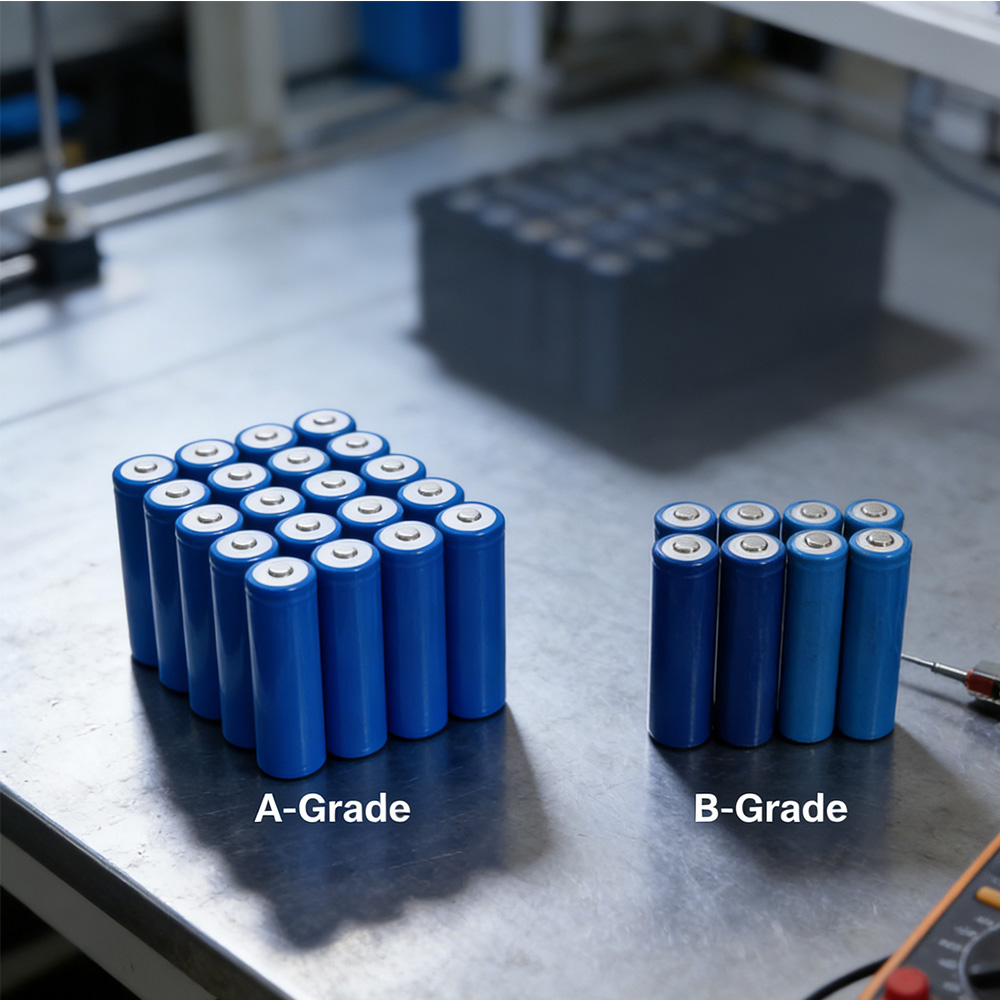
When you’re sourcing 18650 rechargeable batteries in bulk, one of the first decisions you’ll encounter is whether to buy A-grade or B-grade cells.
On the surface, they’re the same cylindrical 18650 lithium-ion format, but the difference in quality, consistency, and performance can be significant — and it has real implications for cost, warranty, and the final product your customer experiences.
Before we break down the differences, it’s useful to see the range of options in one place. Anpsenx lists a full selection under the 18650 lithium battery category — from economy offerings to higher-spec cell options — and many of the factors we discuss here play into how those products are priced and positioned.

What “Grade” Really Means
In battery sourcing, grade refers to how a cell performs relative to its rated specifications and how consistent it is compared with others in the same batch.
- A-Grade 18650 cells meet tight tolerances for capacity, internal resistance, cycle life, and discharge behavior. They tend to test very close to their stated spec and show less variation from unit to unit.
- B-Grade cells fall outside tighter tolerances, but not necessarily outside the realm of usable performance. They might have slightly lower capacity, higher variance in internal resistance, or minor cosmetic differences.
For wholesalers, the grade isn’t just a label — it’s a shorthand for how predictable the cell will be in your application.

The Real Differences That Matter
1) Performance Consistency
A-Grade:
- Narrow tolerance band on capacity and voltage
- Lower internal resistance variance
- More predictable behavior in series/parallel packs
- B-Grade:
- Wider variation between units
- Can lead to imbalanced packs, uneven performance
- Greater risk of early capacity fade
- If you’re assembling battery packs, especially for OEM products, the predictability of A-grade cells often outweighs the unit cost savings of B-grade.
2) Safety and Reliability
Safety in lithium-ion cells isn’t just about chemistry — it’s also about how consistently cells behave under stress.
A-grade cells are typically pulled from production runs that pass stricter sorting and testing. That means better uniformity in:
- discharge curves
- thermal behavior
- cycle durability
B-grade cells may still be safe, but with broader variance they require additional system-level protection, and that in turn can increase cost on the device side.
3) Cycle Life and Long-Term Value
A-grade batteries usually show better long-term retention of capacity over repeated charge/discharge cycles. That’s because manufacturing tolerances are tighter and materials are selected to meet spec reliably.
Wholesalers selling to:
- power tools
- energy storage modules
- medical devices
- premium flashlights
…will find that A-grade cells reduce defect rates and warranty support costs, even if the upfront cost is higher.
B-grade cells often exhibit shorter useful life simply because they started with looser performance windows.

Cost Implications for Wholesalers
It’s a common pattern in lithium-ion sourcing:
A-grade costs more per unit — but your risk and total cost of ownership usually go down.
B-grade costs less per unit — but your integration costs, testing overhead, and failure exposure can go up.
For example, in the broader 18650 category, you can see how a range of cells fits into different pricing structures based on spec and grade. Some are optimized for basic consumer electronics where variation matters less; others are built for higher-end or industrial use.
When B-Grade Makes Sense
It’s not that B-grade is “bad”. There are situations where it’s a rational choice:
- Low-impact consumer products where specs can vary without affecting function
- Non-critical applications, lab projects, or prototypes
- When you have a robust battery management system (BMS) that handles cell balancing
If the end application pulls only moderate current and the battery is easy to replace, the cost saving from B-grade can be real.
When You Should Always Choose A-Grade
For products where reliability matters and where failure could result in safety risk or brand damage, A-grade is usually the better choice:
- Devices with high current draw
- Multi-cell battery packs (series/parallel configurations)
- Medical, safety, industrial or outdoor equipment
- OEM products with warranty requirements
Here, the consistency, cycle life, and predictability of A-grade cells justifies the higher unit cost.

How to Evaluate Grade Before You Buy
When talking to suppliers, ask for:
- batch test reports
- capacity distribution charts
- internal resistance stats
- cycle life test results
- certificate of compliance (UN38.3, CE, etc.)
Many 18650 offerings in the 18650 lithium battery category come with different levels of testing and documentation. Knowing what you’re paying for lets you price bids and RFQs accurately.
Final Notes for Wholesalers
Grade affects more than price — it affects integration risk, product reputation, and total lifecycle cost.
Quick checklist:
- Know your application load profile — high current vs low current
- Decide if tight performance consistency matters
- Factor in testing, sorting and BMS costs
- Don’t judge quality by capacity rating alone
Choosing between A-grade and B-grade 18650 cells isn’t about cheap vs expensive — it’s about risk vs value. Evaluate based on how the cell will actually behave in your product, not just the price tag.
For a full view of what’s available and how these grades are represented in product lines, see the 18650 lithium battery category — it gives a practical sense of how different specs and grades are positioned in the market.
Recommend Products
-

12V 4400 mah Lithium ion 3S2P 18650 Battery Pack
-

18650 2000mAh 3.7 volt Lithium-ion Battery
-

18650 20V 3.0Ah Cordless Drill battery
-

18650 22.2V 7.8Ah 2600Mah 6S3P Rechargeable Battery Pack
-

18650 3.7V 10Ah Li-Ion Power Battery Pack
-

18650 3.7V 3300mah Rechargeable Lithium ion Battery
-

18650 7S7P 24V 14Ah Lithium ion Electric Scooter Battery Pack
-

18650 battery 3.7V 1500mAh Lithium-Ion Battery
-

18650 Electric Scooter 48V 13000mAh Lithium Battery
-

2600mAh 3S1P 11.1V 18650 Battery Packs
-

3.7V Li ion Rechargeable 3000mah 18650 Battery Cell
-

36V 5200mAh 10S2P 18650 Battery Pack
-

48v 4400mah 13S2P 18650 Rechargeable Battery Pack
-

7S2P 24V 18650 Lithium Battery Pack
-

Electric Scooter 36V 4400mAH 10S2P 18650 Battery Pack
-

ICR 18650 Battery 2200mah 3.7V
Leave a Reply