
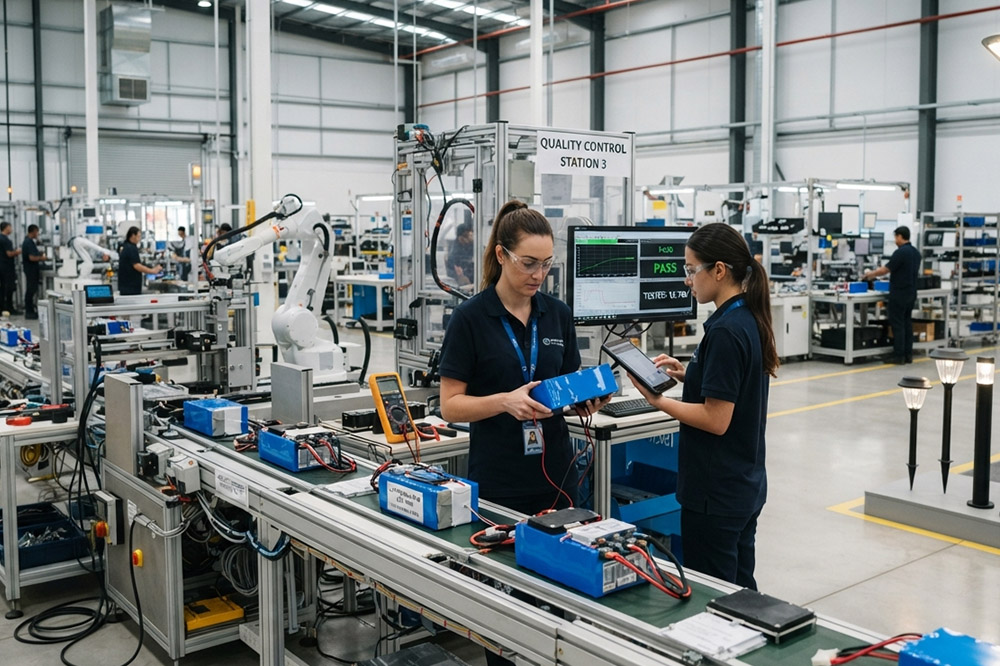
Walk through almost any lighting exhibition today and you’ll notice something interesting.
Solar lights look better than they did five years ago. They’re slimmer, brighter, and packed with smarter controls. Yet if you ask product managers what component causes the most headaches after products leave the factory, many of them still point to the battery.
It’s a little ironic.
The battery is usually hidden inside the housing where nobody can see it, but it often determines whether the entire product succeeds in the market.
That’s one reason more companies are now looking for factory direct rechargeable batteries for solar lighting manufacturers instead of purchasing through several layers of trading companies.
The goal isn’t simply finding a lower price. It’s about building a supply chain that stays reliable as production grows.
Buying Direct Usually Solves Problems You Don’t Notice at First
When people hear “factory direct,” they often think about saving money.
Yes, removing middlemen can reduce purchasing costs. But after talking with several OEM customers, I don’t think that’s the biggest advantage anymore.
The real benefit shows up months later.
Imagine you’re producing 30,000 solar garden lights for a retail chain. Everything is ready except one battery shipment that arrives with inconsistent cell performance. Suddenly production slows down because engineers need to inspect random samples one by one.
Nobody planned for that delay.
Factories that manufacture batteries themselves generally have better control over cell matching, welding quality, protection board installation, and final testing before shipment. Those details don’t appear in a quotation sheet, but they often determine whether production stays on schedule.
Every Solar Lighting Project Looks Similar—Until You Read the Specifications
From the outside, many solar lights appear almost identical.
Inside, the battery requirements can be completely different.
A decorative garden light installed in someone’s backyard has very different operating conditions compared with a highway warning light or a municipal pathway lamp.
For example, manufacturers may require:
- Different battery voltages
- Various capacities
- Customized battery dimensions
- Waterproof connectors
- High-temperature resistance
- Faster charging performance
- Longer cycle life
That’s why factory-direct suppliers rarely recommend exactly the same battery for every customer.
Usually the first discussion revolves around the application rather than the battery itself.

Custom Battery Packs Are Becoming More Common
This trend has become hard to ignore.
Several years ago, many solar lighting companies purchased standard cylindrical cells and built battery packs internally.
Now it’s almost the opposite.
OEM manufacturers increasingly ask battery factories to provide complete battery assemblies that arrive ready for installation.
That might include:
- Spot-welded battery packs
- Integrated PCM or BMS
- Custom cables
- Waterproof plugs
- Heat-shrink wrapping
- Laser labels
- Private packaging
One customer even redesigned the housing of a solar wall light simply because a custom battery pack allowed better use of internal space.
Small changes sometimes make surprisingly large differences.
Why LiFePO4 Keeps Replacing Older Battery Technologies
You still see NiMH batteries in entry-level solar lights, especially in products designed for the retail market.
Commercial projects, however, seem to be moving steadily toward LiFePO4.
The reasons are fairly practical.
LiFePO4 batteries generally deliver:
- Longer service life
- Better thermal stability
- Lower maintenance costs
- Improved safety
- More consistent charging efficiency
Of course, no battery chemistry is perfect.
LiFePO4 battery packs usually cost more upfront.
But many manufacturers calculate total ownership cost instead of purchase price alone. After replacing fewer batteries over several years, the higher initial investment often makes sense.

One Thing Purchasing Managers Ask More Frequently
I noticed something during conversations with overseas buyers.
Five years ago the first email was usually:
“What’s your best price?”
Now it’s often something like:
“Can you maintain this quality for every shipment?”
That feels like a small change, but it says a lot.
Consistency matters when production runs every week.
If the first container performs well but the second doesn’t, manufacturers end up dealing with warranty claims, production interruptions, and unhappy distributors.
Reliable factories understand this. They usually invest heavily in aging tests, capacity grading, voltage matching, and outgoing inspections before batteries ever reach the shipping container.
Communication Becomes Much Easier
This part doesn’t receive enough attention.
Working directly with a battery manufacturer often means engineers can communicate with engineers.
Instead of sending technical questions through several companies, product designers can discuss battery dimensions, connector locations, discharge requirements, or charging characteristics directly with the people building the packs.
Sometimes a quick discussion saves weeks of revisions.
We’ve seen projects where simply changing cable orientation made battery installation much easier on the production line.
That suggestion came from the battery factory, not the lighting manufacturer.
Certifications Matter More Than Many Buyers Expect
Battery performance is important, but documentation matters too.
For international shipments, customers frequently request certifications such as:
- UN38.3
- IEC62133
- CE
- RoHS
- MSDS
- Transportation reports
Without proper documentation, batteries may face customs delays or shipping restrictions.
Experienced battery manufacturers usually prepare these documents well before mass production begins, which makes logistics far less stressful.

Production Capacity Is About More Than Large Numbers
A factory may advertise millions of battery cells every month.
That sounds impressive, but volume alone doesn’t guarantee dependable supply.
What manufacturers often care about is whether the supplier can deliver the same quality in March, August, and December—not just during one successful production run.
Stable raw material sourcing, automated production equipment, and experienced quality control teams usually matter much more than impressive marketing figures.
Choosing a Factory Partner Instead of Just a Supplier
One observation keeps coming back after speaking with companies involved in solar lighting.
Successful manufacturers rarely change battery suppliers every few months.
Once they find a factory capable of delivering stable quality, flexible customization, and dependable lead times, they tend to build long-term partnerships.
It probably makes sense.
Developing a solar lighting product already involves enough variables. Batteries shouldn’t become another uncertainty.
If you’re looking for factory direct rechargeable batteries for solar lighting manufacturers, choosing an experienced OEM battery factory can simplify product development, improve consistency, reduce warranty costs, and create a more reliable supply chain as your business grows.


Leave a Reply